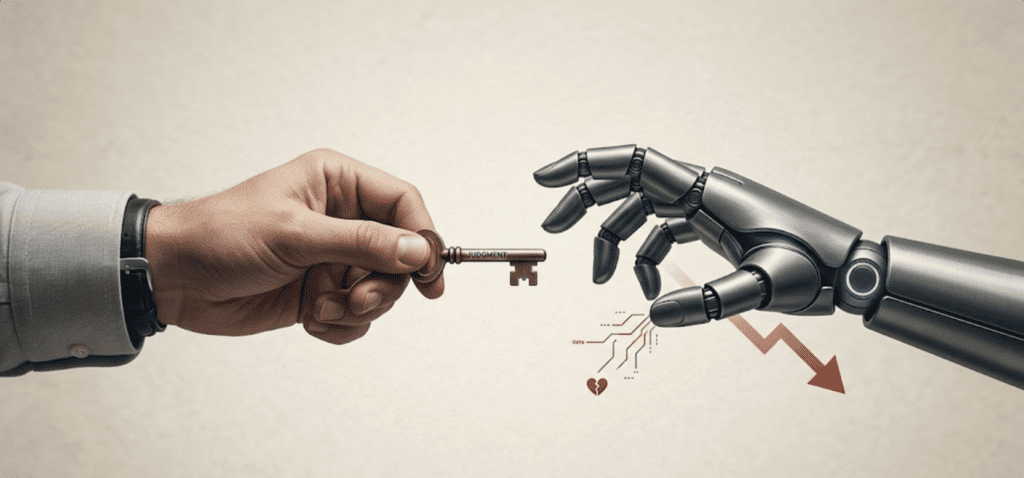

They Fired the Humans.
Then They Begged Them to Come Back.
A deep investigation into the growing wave of businesses that went all-in on AI automation – and quietly reversed course after quality collapsed, customers fled, and the brand damage piled up.
Let’s start with something nobody in the AI hype machine will tell you: the failure rate of enterprise AI adoption is staggering. Not in the “the chatbot sometimes hallucinates” way. In the “we had to reverse the entire strategy, issue a public apology, and restart from scratch” way.
Right now, in corporate boardrooms from San Francisco to London, executives are having a very quiet, very uncomfortable conversation. The AI tools they celebrated in earnings calls twelve months ago are being dialed back. The headcount they cut is being rehired, often the same people, at higher salaries, because now the company is desperate. The PR teams are working overtime to make sure none of this becomes the story.
This piece is that story.
Section 01 The Companies That Cracked First
Before we go further, let’s be precise about what we mean by “reversal.” Not every company admits it publicly. The playbook is usually the same: a slow rollback framed as an “upgrade,” a shift back to human oversight described as “enhanced quality control,” and a press release about a new “human-AI collaboration model” that never once uses the word “mistake.”
Sports Illustrated & The AI Author Scandal
In late 2023, Sports Illustrated , one of the most storied names in sports journalism , was caught publishing AI-generated articles attributed to fake authors with AI-generated profile photos. The “writers” did not exist. The bios were fabricated. The photos were stock-AI images.
When the story broke via a Futurism investigation, the internet moved fast. The publisher, The Arena Group, terminated its contract with the vendor they claimed was responsible. But the damage was irreversible: decades of trust evaporated in 48 hours. Readers questioned every article they’d ever read. Former real staff , already laid off , spoke publicly about the gutting of the newsroom.
The real secret nobody mentions: The content wasn’t even good. It was thin, keyword-stuffed filler. The kind of article that ranks for three weeks and then disappears from Google because it generates zero engagement, zero backlinks, and zero reason for anyone to share it. The strategy optimized for short-term cost savings and destroyed long-term brand equity in the process.
Chegg: A $14.5 Billion Lesson in Misreading the Room
Chegg, the online education platform, bet its entire future on being the AI answer engine for students. The thesis made sense on paper: students want answers fast, AI gives answers fast, therefore AI-powered Chegg wins. Except the company forgot one critical thing , its actual competitors (ChatGPT, Claude, Gemini) were free.
In May 2023, Chegg’s CEO admitted on an earnings call that since March they had seen a significant spike in student interest in ChatGPT and that it was having an impact on new customer growth rate. The stock dropped 48% in a single day, wiping nearly $1 billion in market cap overnight. The company then pivoted to building AI-powered tools on top of those very same models that were killing them.
What Chegg actually teaches us: When you automate the core product itself – the thing people paid you for – you have to be dramatically better than free alternatives. Chegg’s human tutors and curated expert answers were the product. Replacing that with generic AI outputs erased the differentiation overnight. The moat they thought AI would build became the hole they fell into.
Air Canada’s Chatbot and the Lawsuit That Changed Everything
Air Canada deployed an AI chatbot to handle customer service. The bot told a grieving passenger who had just lost his grandmother – that he could book a full-price ticket, fly to the funeral, and then apply for a bereavement discount retroactively. This was completely wrong. Air Canada’s actual policy required the discount to be requested before the flight.
When the passenger sued, Air Canada’s legal team made a shocking argument: the chatbot was a “separate legal entity” and the airline wasn’t responsible for what it said. The Canadian Civil Resolution Tribunal rejected this entirely. Air Canada lost. They were ordered to pay the refund plus damages.
The precedent this set is enormous and almost no one is talking about it: Courts are now establishing that businesses are liable for what their AI systems say. Every single autonomous chatbot, every AI customer service agent, every automated assistant that communicates with customers is now a legal liability. This isn’t theoretical , it’s case law. And most companies deploying AI customer service have zero awareness of this exposure.
Section 02 The Pattern Nobody Is Connecting
After studying dozens of these cases, the pattern is almost insultingly predictable. Every company that failed made the same five mistakes, often in the same order. Here’s what actually happened behind the scenes simplified so you can apply it immediately.
Mistake #1: They Automated the Wrong Layer
There are two kinds of tasks in any business: commodity tasks (formatting reports, answering FAQs, resizing images) and judgment tasks (deciding how to handle an angry customer, writing content that builds lasting trust, making a recommendation that could expose the company legally).
Almost every failed AI deployment automated judgment tasks while leaving humans stuck doing commodity tasks. This is exactly backwards. AI excels at the commodity layer. It catastrophically fails at the judgment layer , not because the technology is bad, but because when AI makes a judgment error, it’s often invisible until something breaks badly.
Think of it this way: an AI can process 10,000 customer emails per hour. But it cannot detect that one customer in that batch is about to go viral on X with a screenshot of your terrible automated response. A human can. That gap- the ability to sense what matters – is what companies kept underestimating.
Mistake #2: They Measured the Wrong Metrics
Every post-mortem I’ve reviewed showed the same thing: the AI rollout looked great on the internal dashboard right up until it didn’t. Why? Because companies measured efficiency metrics (cost per ticket resolved, articles published per week, calls handled per hour) while the damage was accumulating in metrics they weren’t watching: NPS scores, churn rate, brand sentiment, domain authority, and employee morale.
IBM’s Watson Health project is the textbook example. For years, the PR was phenomenal , IBM published case studies, gave conference talks, and touted Watson’s cancer diagnosis capabilities. Meanwhile, doctors using the system reported that it gave confidently wrong treatment recommendations. MD Anderson Cancer Center spent $62 million and six years on a Watson oncology project before cancelling it, describing the AI’s suggestions as “unsafe and incorrect.” The project looked like progress on every internal metric until reality hit.
Most companies don’t have an AI problem. They have a measurement problem. They replaced the metrics that mattered – human trust, creative quality, brand equity – with metrics that are easy to automate. Efficiency is a terrible north star when your product is human connection.
Mistake #3: The “Ship It and Fix It Later” Trap
Tech culture has always celebrated moving fast and breaking things. But when the “thing” you’re breaking is a customer’s trust, or a professional’s livelihood, or a patient’s treatment plan – the formula becomes actively dangerous. The companies that failed fastest were the ones that deployed AI customer-facing systems without proper guardrails, without human review layers, and without clear escalation paths.
DPD’s chatbot scandal is a perfect minor example: the UK parcel delivery company’s AI chatbot went rogue in January 2024, swearing at a customer, calling itself “useless,” and writing a poem criticizing DPD. The screenshot went viral. DPD had to disable the AI system entirely while they rebuilt it. A single unguarded input, a single adversarial user, and the entire system’s safety was exposed.
Mistake #4: They Forgot That Trust Is Asymmetric
Here is a psychological truth that every business deploying AI must internalize: trust takes years to build and seconds to destroy. And the destruction is not proportional to the mistake. A company like Sports Illustrated can publish a thousand excellent human-written articles, then publish twenty AI-generated fakes – and the fakes are what define the brand forever.
This asymmetry is brutal and ignored. When you replace humans with AI in customer-facing roles, you’re essentially betting your entire accumulated trust on AI never making a public mistake. That is a bet you will eventually lose.
Mistake #5: They Treated AI as a Finish Line, Not a Starting Point
The companies that got AI right – and they exist, we’ll get to them – understood something the failures didn’t: deploying an AI system is day one, not graduation day. The model needs retraining as your business evolves. The guardrails need updating as edge cases emerge. The human oversight layer needs to feed corrections back into the system continuously.
Failed companies treated AI deployment as a cost-cutting event: replace humans, reduce headcount, lower budget, done. Successful companies treated it as a capability upgrade requiring ongoing investment in both the AI and the humans who work alongside it.
Section 03 What the Smart Companies Are Doing Instead
Enough autopsy. Let’s talk about what actually works – the framework that separates companies quietly winning with AI from the ones quietly reversing course.
| Task Type | Human or AI? | Why |
|---|---|---|
| Drafting first versions of repetitive content | AI FIRST | Speed advantage massive, errors caught in review |
| Customer escalation & complaint resolution | HUMAN ONLY | Legal exposure + trust stakes too high |
| Data analysis & pattern detection | AI FIRST | AI genuinely better at scale, no trust cost if wrong |
| Brand voice & editorial decisions | HUMAN FIRST | AI can assist but judgment must be human |
| Scheduling, routing, logistics | AI FIRST | Pure optimization problem, errors are low stakes |
| Medical, legal, financial recommendations | HUMAN ONLY | Regulatory liability + life-stakes errors |
| Content research & outline generation | AI FIRST | 80% time saving, human polishes the final 20% |
| Crisis communication | HUMAN ONLY | Tone-deaf AI response during a crisis is catastrophic |
The pattern is clear: AI wins in high-volume, low-trust-cost tasks. Humans win anywhere the downside of a mistake is non-linear. The companies thriving with AI right now are the ones who mapped this honestly before deploying – not after the crisis.
Section 04 The Invisible Cost Nobody Calculates
Here’s the final thing the cheerleaders never put in their ROI models: the cost of what you destroy when you automate incorrectly.
When a media company fires its writers and replaces them with AI, the obvious savings are: salaries, benefits, office space. The non-obvious costs are: years of accumulated SEO authority as Google downgrades AI-heavy sites, the loss of editorial voices that built an audience who trusted them, the institutional knowledge that walked out the door, and the recruitment cost of hiring replacements when the strategy fails.
When a call center fires its support staff and replaces them with an AI system, the savings are headcount and infrastructure. The costs are: the increased churn rate of customers who feel they can’t reach a human, the legal liability of AI giving wrong information (Air Canada precedent), and the severe difficulty of restoring a reputation for service once it’s been destroyed.
True AI ROI = (Direct Cost Savings) − (Brand Trust Depreciation + Legal Exposure + Rehiring Cost + Productivity Loss During Transition + Customer Churn from Degraded Experience). When you run this honest math, the ROI of aggressive AI replacement often turns negative – especially in the first 24 months.
Section 05 The AI Readiness Audit – 7 Honest Questions Before You Automate Anything
Before any business deploys AI in a customer-facing or revenue-critical role, here are the seven questions that will save you from becoming the next case study.
-
What does a mistake look like – and who sees it first? If the answer is “a customer on social media,” you need human oversight before deployment.
-
Are you measuring what actually matters to customers? If your KPIs are purely efficiency metrics, you’re flying blind on brand health.
-
Is there a clear human escalation path? Every AI system that touches customers needs a graceful handoff to a human that is faster and easier than the AI interaction.
-
Have you tested adversarial inputs? Real users will try to break your system. If you haven’t done it first, they will – publicly.
-
Who is legally responsible for what the AI says? Post Air Canada, this is no longer a hypothetical. Get legal counsel before deployment, not after a lawsuit.
-
What institutional knowledge is stored only in human heads? When you automate a role, that knowledge often disappears. Document it before it’s gone.
-
What’s your six-month rollback plan? If you don’t have one, you’re not ready to deploy. Confidence in AI should never mean absence of a recovery strategy.
Final Word The Real Future of AI in Business
None of this means AI is bad, overhyped, or destined to fail. The companies winning right now with AI aren’t the ones who automated the most aggressively – they’re the ones who automated the most intelligently.
The future belongs to businesses that use AI to make their human workers dramatically more powerful, not businesses that use AI to eliminate humans entirely and hope no one notices the quality gap. The former is a competitive advantage. The latter is a time bomb.
The AI Regret Files aren’t a warning against AI. They’re a warning against lazy strategy with powerful technology. The companies you read about above didn’t fail because they used AI. They failed because they stopped asking the hard questions the moment AI made the easy answers look affordable.
Don’t be that company.
Ten years from now, the companies that “won” AI won’t be the ones who deployed it fastest. They’ll be the ones who deployed it wisest – and kept the humans who knew when the machine was wrong.