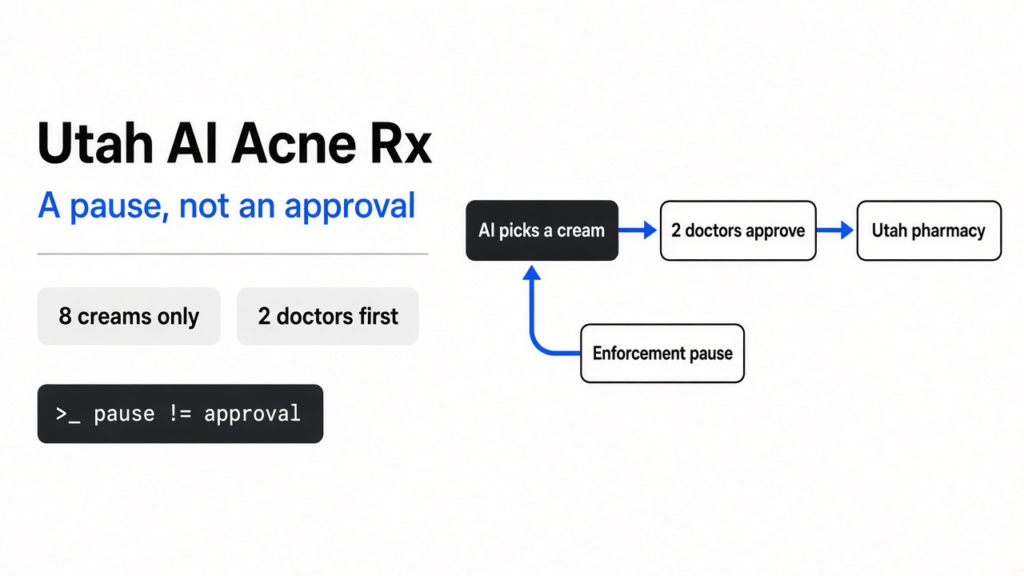
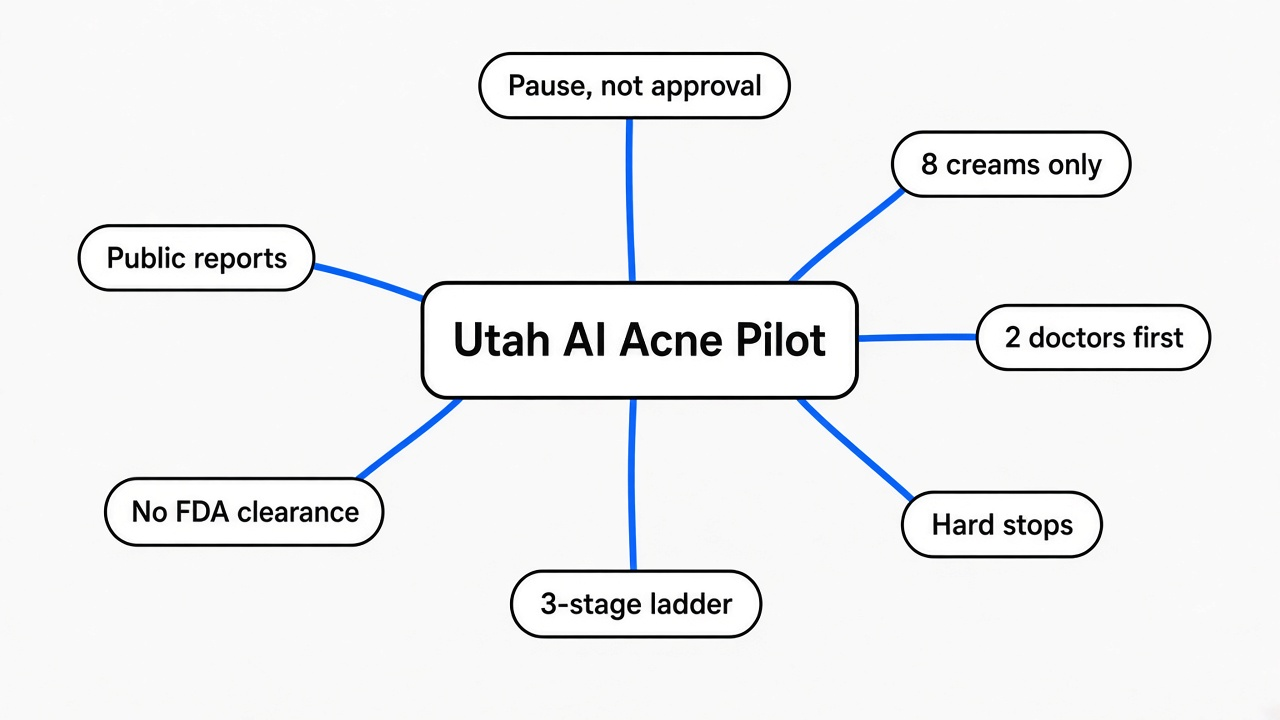
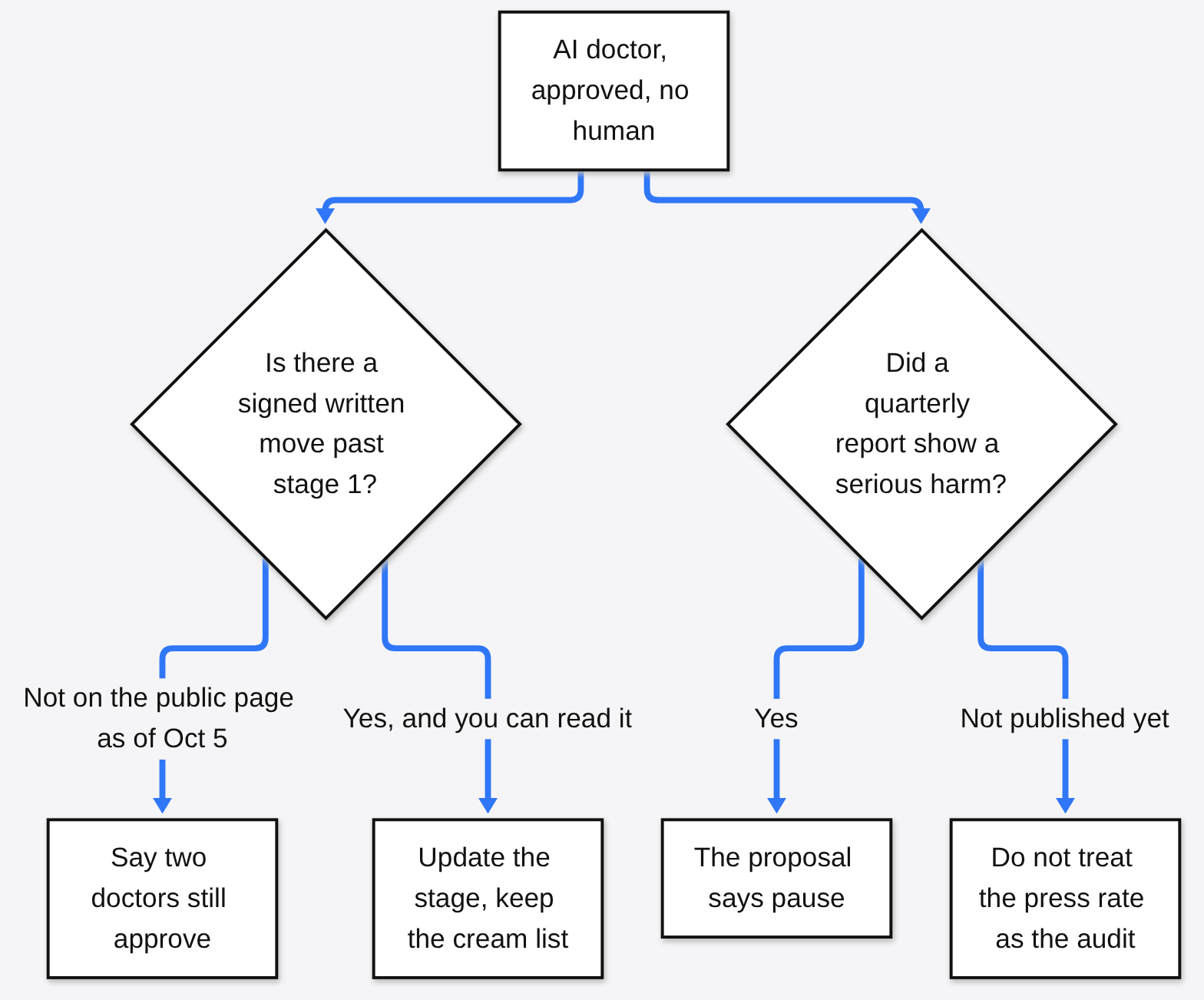
Short answer: Utah did not approve an AI doctor. On September 22, 2026 the state signed a temporary enforcement pause so one app, Nolla Derm, may send a first AI acne prescription in Utah for mild or moderate acne, and only for a fixed list of skin creams. In the opening stage, two Utah-licensed doctors still have to approve every prescription before a pharmacy sees it. The “no doctor” version is a later stage. The state has to say yes in writing before that stage can start.
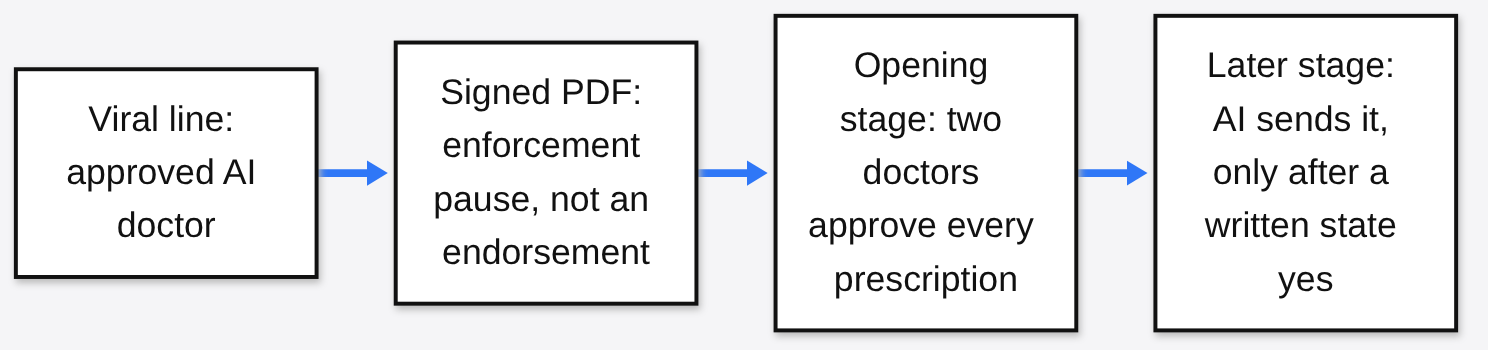
On the afternoon of October 5, 2026, Nolla’s co-founder Luis Wenus posted that the company had “regulatory approval” and had become “the first ever actual end-to-end AI doctor.” That post was already near 400,000 views. Bloomberg’s headline was “No Doctor Needed.” The sentence in the signed deal says the opposite of approval.
What did the headline get wrong?
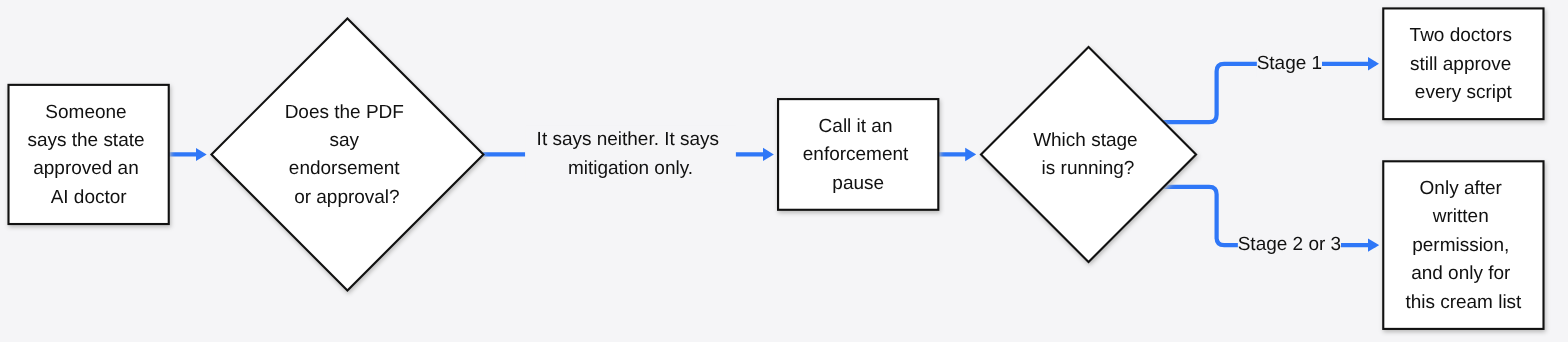
It treated a promise not to prosecute as a stamp that the product works, and it skipped the doctors who still sign first.
Start with the object on the table. The parties are Utah’s Office of Artificial Intelligence Policy (the state AI office, created in 2024), the Division of Professional Licensing (the agency that licenses doctors and pharmacists), and Magic Health, Inc. plus its subsidiary Magic Health Services, LLC, which do business as Nolla Health. They signed a regulatory mitigation agreement (a written deal that pauses enforcement of named rules for one product, for a limited time). Section 3.E says this is “a grant of regulatory mitigation only and does not constitute an endorsement or approval” by the State of Utah.
That is the whole correction. Approval (a government says the thing is fit to use) did not happen. Endorsement (a government vouches for the company) is explicitly forbidden in the company’s ads. Mitigation (the regulator agrees not to punish this one activity while it watches) is what was signed.
Utah already did a narrower version. On January 6, 2026 the same office announced a deal with Doctronic so an AI could renew an existing prescription for a chronic condition. Renew means “send the same medicine again.” It does not mean “decide you need this medicine for the first time.” A second refill pilot, August AI, was signed October 2, 2026. The state page says that one may not write a new prescription, change a dose, or swap one drug for another. Nolla is the first item on the public list that may issue a first prescription. First-on-this-list is true. “First AI doctor on earth” is the company’s sentence, not the state’s.
One more clock. The public pilots page, checked October 5, still said: “The demonstration period has not started yet.” The agreement starts the 12-month clock only on the commencement date (the day Nolla makes the technology available to customers and sends the office written notice). The company announced availability on October 5. The page had not yet flipped. Until that notice is on the record, “it is live” and “the legal window is open” are two different facts.
What is a prescription, before any software is in the story?
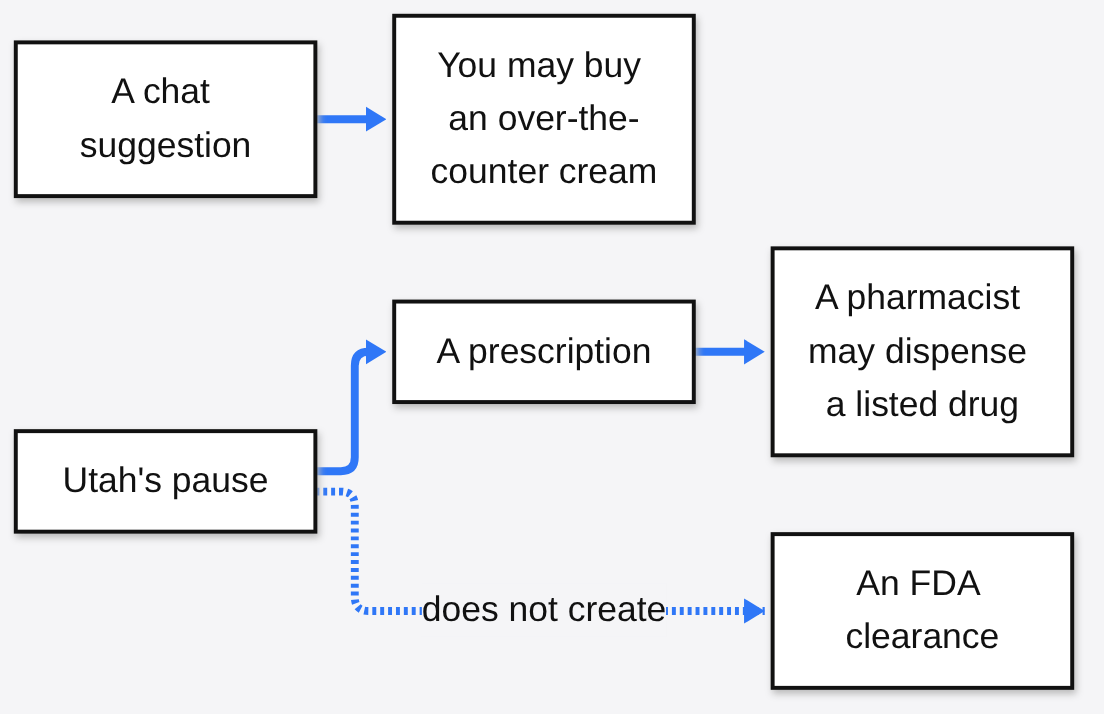
A prescription is a legal order a pharmacy is allowed to fill. A chat reply is not that order.
A drug on a store shelf is over the counter (you may buy it with no one’s permission). A prescription drug (a drug the law says a pharmacist may hand over only with an order from someone the law recognizes) is the other kind. The order is the prescription. The person who may write it, in ordinary Utah practice, is a licensed clinician (a doctor, or another professional the licensing law names).
Diagnosis (naming what you think is wrong) is not the same act as prescribing (ordering the drug). A friend can say “that looks like acne.” A website can say “people often use a cream.” Neither sentence authorizes a pharmacy to dispense.
The thing the Division can punish is unlicensed practice (doing a licensed job without the license) and breaking the telehealth rules (the rules for care delivered by screen instead of in a room). The Nolla deal does not repeal those rules. The Division agreed not to bring an enforcement action when this app issues a topical acne prescription, or a renewal of one, to an eligible Utah adult and sends it to a Utah-licensed pharmacist, under the protocol in the agreement. The same shield covers the physicians who rely on the system for that purpose. The state page says the shield “expressly reaches nothing else Nolla Health offers.”
Federal law is still on. The agreement says the company remains subject to every federal, state, and local law the deal does not expressly waive. The U.S. Food and Drug Administration (the FDA, the federal agency that decides which medical products may be sold) is not a signature on this PDF. If you want the other door, the one where software is sold as a medical device, that is a different failure: most FDA-cleared medical AIs were never tested on whether patients got better. Do not mix the two stamps. Utah paused a licensing penalty. The FDA did not clear a device. Neither stamp means the acne got better.
What does the app actually do with a face?
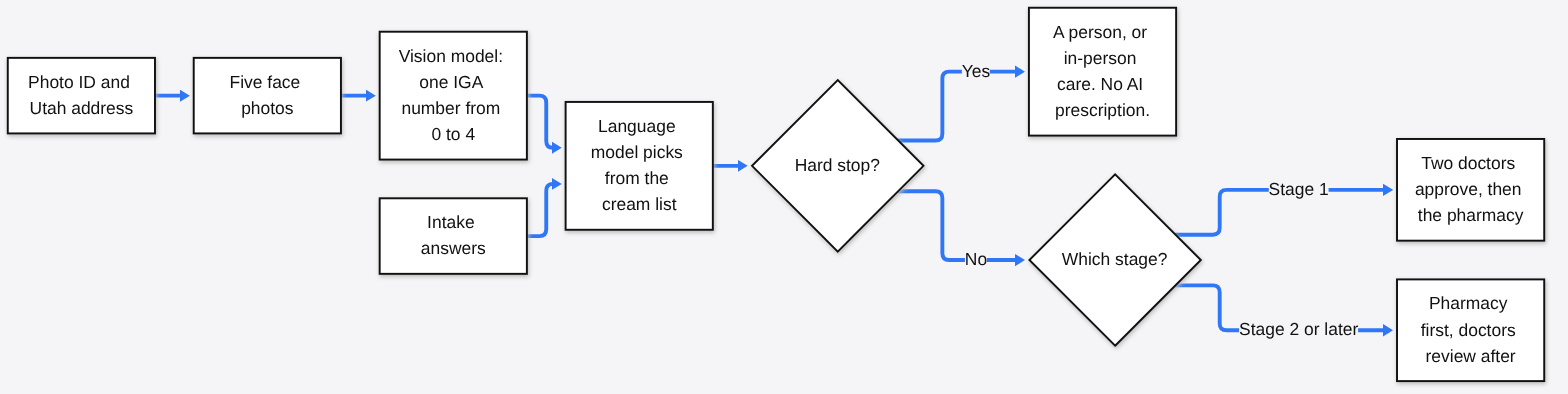
It turns five photos into a severity number, then a language model is supposed to pick one cream from a closed menu.
This is not a general chatbot that can type any drug name and hope a pharmacy blinks. The path in the proposal, which is Schedule B of the signed agreement, is a pipe with hard walls.
You have to be 18 or older and in Utah. Identity is checked with Stripe Identity (a service that matches a government photo ID to a selfie). The delivery address has to be in Utah, and the proposal also checks phone geolocation (a rough guess of where the phone is, from the network). A prescription goes only to a Utah address. You complete safety questions, including a pregnancy attestation (you state whether you are pregnant, trying to become pregnant, or breastfeeding). Then you take a five-angle face scan: front, up, down, left, right. The proposal says severity is scored from those images, not from you typing “mine is mild.”
The photo model outputs one number on the IGA scale (Investigator’s Global Assessment, a 0-to-4 score dermatologists use for how severe acne looks, where 4 is severe). The proposal says that model was trained on over 100,000 labeled cases, and that on a held-out set of 10,348 cases (pictures kept out of training) it reached an R² of 0.947. R² (how much of the variation in the expert’s number the model recreates, where 1 would be a perfect match) is an agreement score. It answers “did we match an expert’s mark?” It does not answer “did the patient’s skin improve?” Those are the company’s own figures, inside their own proposal. Nobody independent has published that test.
That number, plus the intake (prior treatments, symptoms, skin sensitivity, and contraindications, meaning reasons a drug would be a bad idea for this person), is handed to an LLM (a large language model, software that produces the next words from patterns in old text). The proposal says this layer recommends one topical formulation (a cream or gel, not a pill) from the approved list, inside “predefined protocol boundaries.” A menu written in a PDF is not, by itself, proof the software cannot name a drug that is off the menu. The agreement requires the prescription to stay on the list.
Which patients never get an AI prescription?
Severe acne, pregnancy, a failed ID check, and anyone under 18 are supposed to be stopped before a cream is ordered.
A hard stop (a rule that ends the automated path, rather than a hint a human might ignore) is the part worth trusting more than the model score. The state page and the proposal line up on these stops:
- Age under 18.
- The identity check fails.
- The address is not in Utah.
- Acne scored as severe or nodulocystic (deep, painful lumps). A score above 3.5 on the IGA scale goes to a physician before any prescription. A score of 4.0 is a hard stop, and the person is pointed to in-person care.
- Pregnant, trying to become pregnant, or breastfeeding.
- A weakened immune system, such as chemotherapy or an organ transplant, or severe kidney or liver disease.
- A past bad reaction to one of the listed drugs.
- Photos that stay too poor to score after the app asks for a retake.
Isotretinoin (the oral acne drug sold as Accutane, tightly controlled because it can cause severe birth defects) is not on the list. Neither are other oral drugs, nor systemic hormones (hormones that act through the bloodstream, not just on the skin). The state page says this in one line: the pilot does not prescribe oral medication or isotretinoin, and it does not treat severe acne.
If a story tells you an AI is now “the doctor,” ask which cabinet it is allowed to open. This one opens creams for mild to moderate acne vulgaris (the ordinary medical name for acne, diagnosis code L70.0). It does not open the cabinet where the dangerous drugs live.
What is actually in the cabinet?
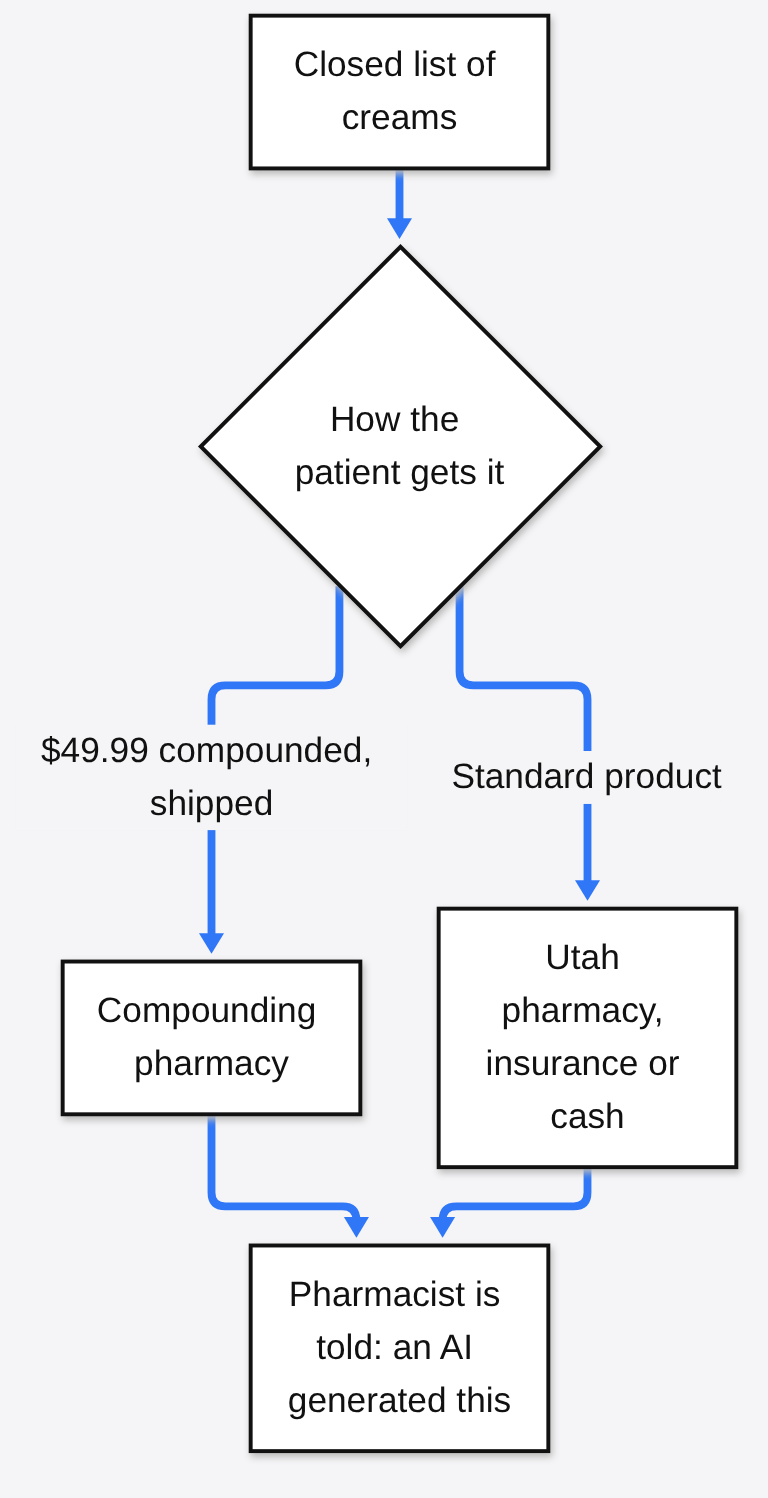
Eight cream recipes. Several of the plain versions are drugs a person can already buy, or already gets from an ordinary clinic.
Every plan is a morning product and an evening product. The patient can take a compounded version (a pharmacy mixes the ingredients to the company’s recipe) shipped to the door, or a standard retail version at a local pharmacy. The proposal prices the compounded pair at $49.99. The company’s October 5 launch post prices the app itself at $4.99 a month during the pilot, down from $9.99. Those are different charges. The $49.99 is in the signed proposal. The $4.99 is the company’s announcement.
| What it is, in plain words | Compounded recipe in the deal | Closest ordinary product |
|---|---|---|
| Tretinoin (a retinoid, a vitamin-A-like chemical that changes how skin cells shed) plus spironolactone (here a 1% cream, not the blood-pressure pill) plus niacinamide (a form of vitamin B3, an extra, not the acne drug) | Tretinoin 0.03% or 0.06%, spironolactone 1%, niacinamide 4% | Tretinoin 0.025% or 0.05%. The proposal says the spironolactone cream has no generic twin, so that mix is compound-only. |
| Tretinoin plus niacinamide | 0.03% or 0.06% tretinoin, niacinamide 4% | Tretinoin 0.025% or 0.05%, prescription |
| Adapalene (a gentler retinoid). The 0.1% gel has been sold in the U.S. without a prescription for years. | Adapalene 0.125% with niacinamide 4% | Adapalene 0.1%. The agreement marks this retail version as both prescription and over the counter. |
| Clindamycin (an antibiotic, a drug that kills bacteria) with benzoyl peroxide (a chemical that also kills acne bacteria on the skin, and can dry and irritate it) | Clindamycin 1.25% with benzoyl peroxide 4.25% | Clindamycin 1% with benzoyl peroxide 5%, prescription |
| Benzoyl peroxide alone | 4.25% | 5%. The agreement marks the retail version as available over the counter. Many people already buy a version of this. |
| Azelaic acid (an acid used for acne and for dark marks left after a spot heals) | 17.5% with niacinamide 4% | Azelaic acid 15%, prescription |
The pharmacist has to be told three things: the prescription was generated by AI, it sits under this agreement, and here is a Nolla physician to call. That label matters. A cream crossing a counter with no human name on the story is how “the AI prescribed it” becomes invisible.
When do the two doctors step back?
Not on day one. After at least 100 patients, four weeks, a 95% match with the doctors, zero serious harms, and a written yes from the state. Then the bar rises again.
The proposal’s stage 0 is the world they say they are already in: the AI recommends, and licensed physicians review, approve, and submit. The pilot then steps the human backward.
| Stage | How long, at least | How many patients, at least | Who touches the prescription |
|---|---|---|---|
| 1. Before it is sent | 4 weeks | 100 | The AI parks it. Two Utah-licensed physicians each review it, independently, before it goes to a pharmacy. The proposal allows up to 24 extra hours for that review. |
| 2. After it is sent | 8 weeks | 500, counting earlier patients | The AI sends it. A physician reviews every case afterward, at least weekly. |
| 3. A sample | No minimum weeks are written | 750, counting earlier patients | Doctors review at least 10% each month, plus every case with a side effect or an escalation (a handoff to a human). |
Leaving a stage requires written approval from the office, plus three gates: at least 95% concordance (the AI and the reviewing doctors chose the same treatment), zero missed hard stops in the human quality check, and zero serious adverse events (serious harms). Any serious adverse event triggers an immediate review and a pause. The proposal’s stage 0 baseline, from the last 12 weeks of human-supervised use, is at least 95% concordance. The launch post said 96%. Treat both as the company’s count until the office publishes a quarterly report.
The state page puts the same ladder in shorter words: two physicians first, then review after the fact, then sampling, and each move needs written approval.
Patients are not locked out of a person. The proposal says the physician team is reachable in the app at no extra cost, and that asking for a physician is itself an escalation. A renewal is not a fresh guess every morning. The proposal says daily face scans are part of monitoring, and a renewal waits for a minimum of 28 scans.

What happens to the photos, and who pays if this hurts someone?
The company keeps the legal blame. It is not allowed to sell the photos. The state can still publish the quarterly numbers.
The photos are of a face, tied to a name, an ID, and a medical file. That bundle is PHI (protected health information, the legal name for health data that can identify you). The agreement requires HIPAA compliance (the U.S. health-privacy rules). It forbids selling, leasing, licensing, or transferring user data, health information, or derived metadata (new data computed from the original, such as a score). The allowed exits are narrow: a cloud host working for Nolla, a Utah pharmacist or treating clinician who needs the prescription, the office or an auditor with the names removed, a court or a statute, or someone the patient explicitly points at.
There is also an ad rule inside this health deal, separate from the ads ChatGPT started testing the same day. Nolla may not advertise a product to a Utah user inside the AI unless the ad is obvious and any paid relationship is disclosed.
On harm: the company’s terms of service may not disclaim, limit, or exclude its legal liability for physical, medical, or legal harm from the AI’s outputs. The company also agrees to indemnify the office and the Division (to cover their losses if someone sues the state over this service). The state took the enforcement pause. It did not take the malpractice.
Quarterly reports go to the office, and the agreement says the office will make those quarterly reports public. That is the check a reader can actually wait for. Until a public report shows the match rate, the missed-stop count, and the harm count, the launch post is a press release.
What would make this post wrong?
A written jump past stage 1, a public harm report, or a reader who hears “not an approval” as “the cream cannot help.”
This post would be stale if the office has already signed the written approval to leave stage 1 and the public page has not caught up. It would be incomplete if a serious adverse event has already forced the pause the proposal describes. It would be unfair if you read it as “these creams do nothing.” Tretinoin, adapalene, benzoyl peroxide, and the others are old drugs with long use. The new object is who is allowed to order them, and how fast the human is removed.
It would also be wrong to import the company’s access statistics as census facts. The launch post says more than 80% of U.S. counties are care deserts, that Utah has about 100,000 people with active acne, and that only 10% see a dermatologist. Those are the company’s numbers. The legal text does not depend on them. A long wait can be real and still not turn an enforcement pause into an approval.
What should you do with this if you are the patient?
If you are in Utah, read the stage before you read the price. If you are not in Utah, this legal window is not yours.
- Ask which stage is actually running. If it is stage 1, two people still approve the cream. “The AI prescribed it” is true only as the first draft of the order.
- Ask which product you are paying for. A $4.99 app and a $49.99 compound are not the same bill. A pharmacy version of benzoyl peroxide or adapalene may already be something you can buy without this app.
- If you are pregnant, trying, or breastfeeding, the path is supposed to stop. Do not shop for a workaround. Retinoids are on this list, and the hard stop exists because of them.
- If the acne is deep, scarring, or painful, the score is supposed to send you to a person. An app that still offers a cream is the failure the gates were written to catch.
- Outside Utah, the company says the app can be used with a clinician in the loop. The enforcement pause itself is Utah law, Utah pharmacists, and Utah addresses.
The useful sentence is smaller than the tweet, and more usable. An AI may draft an order for one of eight acne creams, for a Utah adult with mild or moderate acne, inside a one-year experiment that starts with two doctors and only loosens if the state keeps signing. That is a real change in who holds the pen. It is not a doctor, and the state put that in writing.
Common questions about the Utah AI acne prescription pilot
Did Utah legalize an AI doctor?
No. Utah agreed not to bring a licensing or telehealth enforcement action for one narrow prescribing flow. The agreement says this is not an endorsement or an approval.
Can the AI prescribe Accutane?
No. Isotretinoin and other oral drugs are outside the pilot. So is severe acne.
Do doctors still see the prescription?
At the start, yes. Two Utah-licensed physicians review each one before it is sent. Later stages drop that only with written state approval, after the patient minimums and a 95% agreement target, with zero serious harms.
Is this FDA approved?
The FDA is not a party to the agreement. Federal law still applies. An FDA clearance is a different process, and clearance would still not mean someone measured whether patients improved.
What does it cost?
The proposal prices the compounded morning-and-evening cream at $49.99. The company announced a $4.99 monthly app price for the Utah pilot. A local pharmacy is the other route.
A cream list, a clock, and two signatures. That is the whole machine.