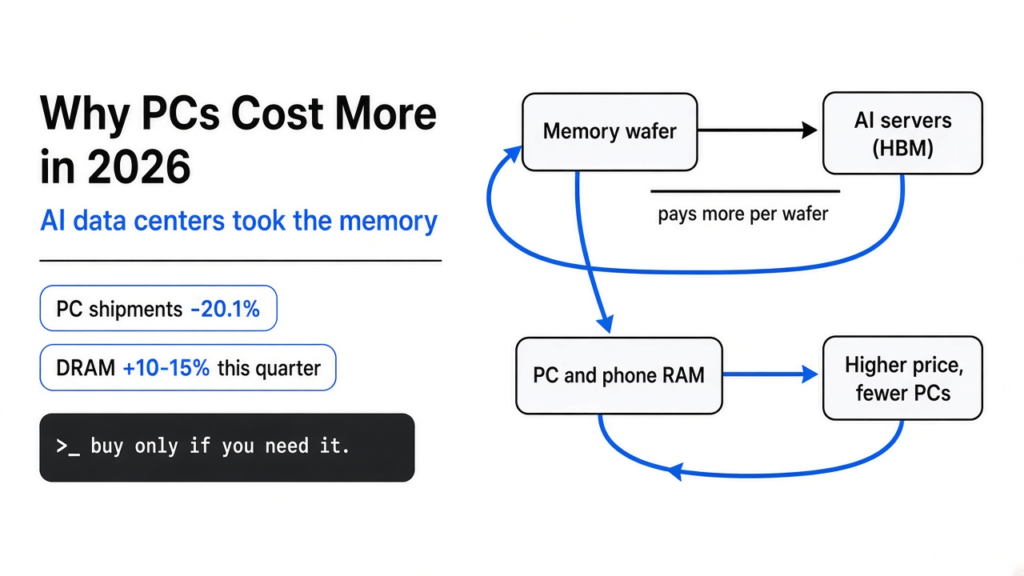
Short answer: The world shipped 20.1% fewer PCs last quarter because AI data centers took the memory chips, and the leftovers got expensive. A sale is worth taking if you need a machine. Waiting for last year’s price is a bet against the people who count the shipments.
On 8 October 2026, IDC (International Data Corporation, the firm that counts how many computers actually ship) said 62.7 million PCs left factories in the third quarter. A year earlier the count was 78.5 million. That is a 20.1% drop, the second quarterly drop in a row, and a deeper one than the 3.8% drop in the quarter before.
The same week Samsung guided to a record profit, and Nikkei reported that Apple is asking some suppliers to build fewer of its most expensive new phones. Those sound like three headlines. They are one story about a chip.
Why did PC shipments fall 20%?
Because the memory inside the machine got expensive, shops had already filled the shelves, and buyers walked.
A PC (personal computer: a laptop or a desktop a person uses) is a box that does arithmetic. The arithmetic is useless unless the box can hold the numbers it is working on. That holding place is memory (chips that store bits, the ones and zeros every file and every program is made of).
IDC’s 8 October release names the cause in plain language: higher prices “driven by AI data center build out,” and an earlier rush by sellers to stock up “ahead of memory-driven price hikes.” The third quarter, which is usually busier than the second because of back-to-school buying, was instead 9.1% smaller than the quarter before it.
What is a bit, before any of the chip names?
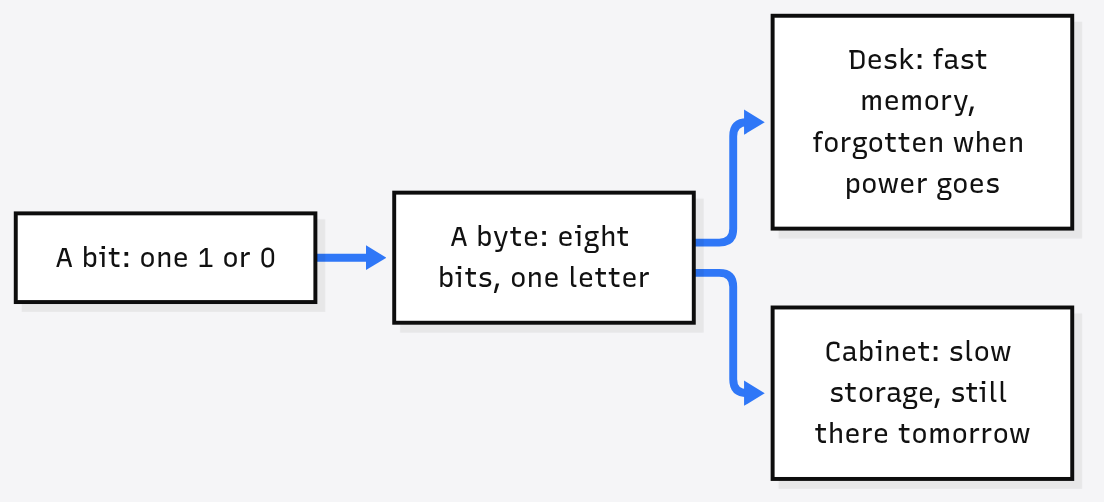
A bit is one yes-or-no. Your computer keeps a fast copy for the work in front of you, and a slow copy so the work is still there tomorrow.
A bit (one binary digit: a 1 or a 0, nothing more) is the smallest piece. Eight bits make a byte (enough for a single letter). A photo is millions of bytes. An AI model (a trained program that answers by looking up a giant table of numbers) is billions or trillions of those numbers.
The computer does not keep all of that in one place. The page you are using sits on the desk. The rest sits in the filing cabinet. Power cuts the desk clean. The cabinet stays.
What are DRAM, NAND and HBM?
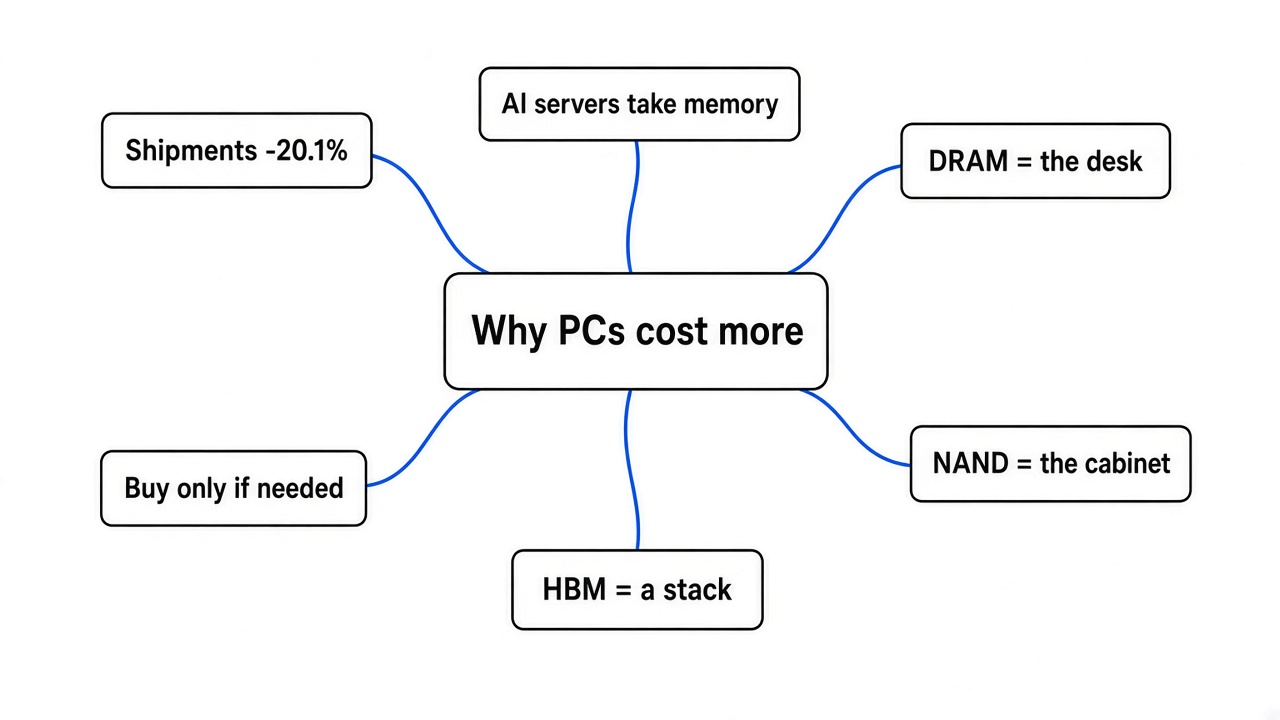
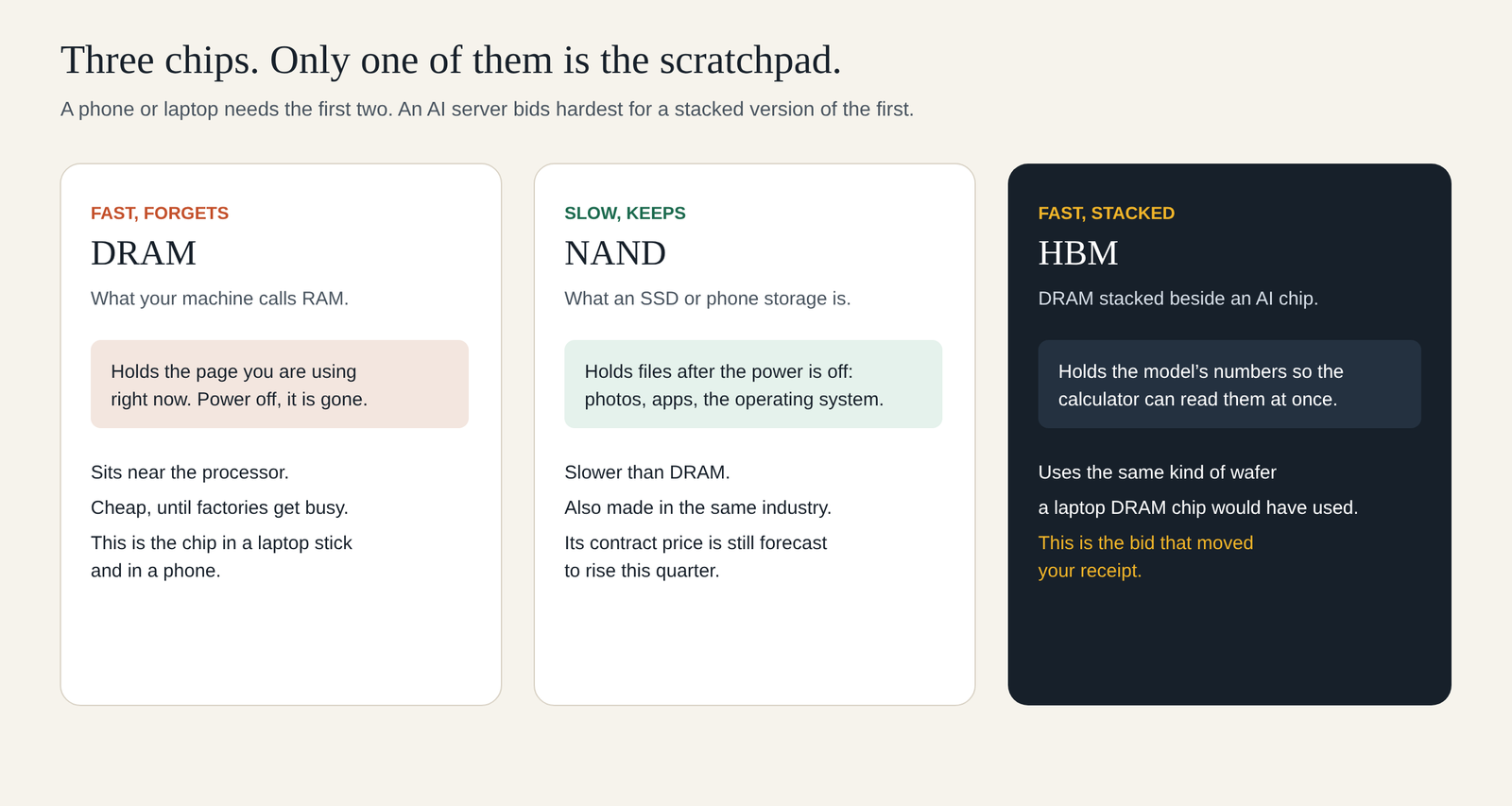
DRAM is the desk. NAND is the cabinet. HBM is a stack of desks bolted onto the AI calculator.
You need those three names, and you need them in that order, because the news mixes them up.
DRAM (dynamic random-access memory: fast memory that has to be refreshed constantly, and that forgets everything when the power goes) is the desk. A laptop calls it RAM (random-access memory: memory the processor can open at any point, without starting from the beginning). If the spec sheet says 16 GB of RAM, that number is DRAM. GB (gigabyte: about a billion bytes) is just the size.
NAND (flash memory that keeps its data with the power off) is the cabinet. An SSD (solid-state drive: storage made of flash chips, with no spinning disk) is a box of NAND. The 128 GB or 256 GB “storage” number on a phone is NAND, not RAM. Those two numbers sit next to each other in ads. They are different chips, and this year they are both getting expensive for different steps of the same shortage.
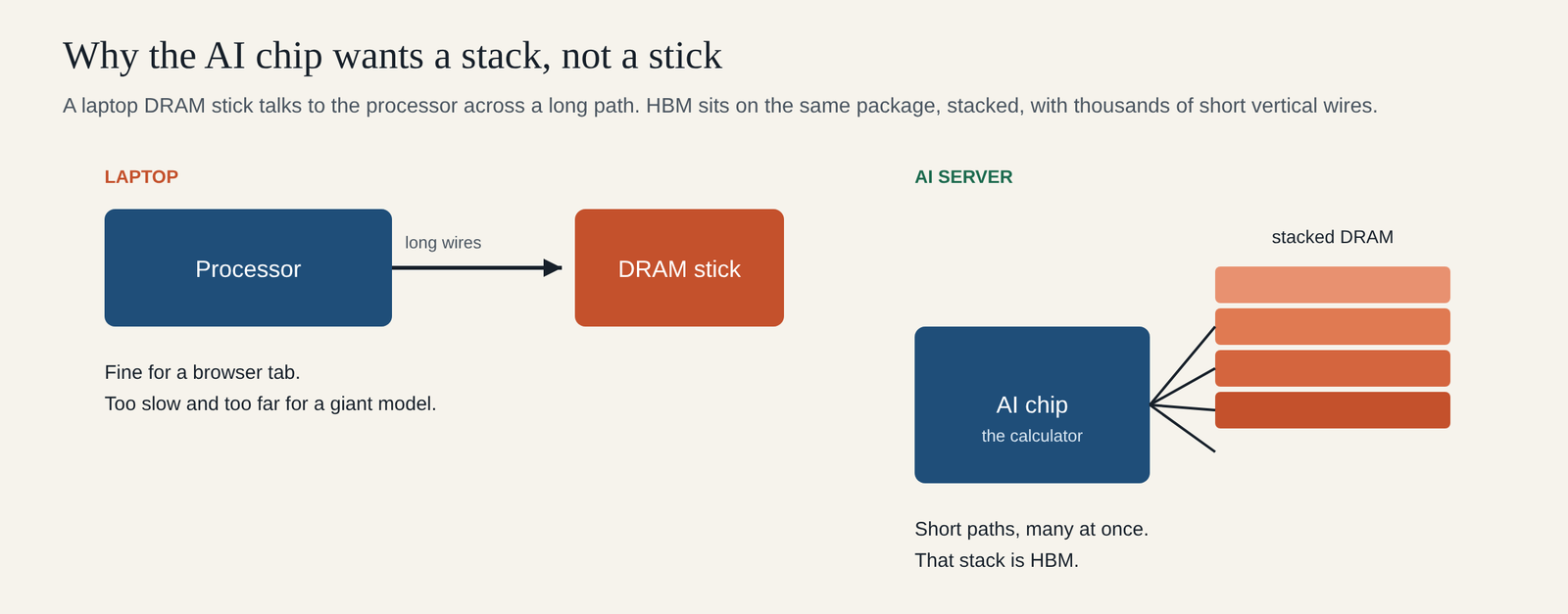
HBM (high-bandwidth memory: DRAM chips stacked in a pile and placed next to an AI processor, so a huge number of values can move at once) is what a data-center AI chip wants. A GPU (graphics processing unit: a chip that does thousands of small sums at the same time, which is how a model runs) cannot keep waiting on a memory stick at the other end of a motherboard.
Why does an AI data center take the chip a laptop wanted?
Because the factories are the same, and the AI buyer pays more per wafer.
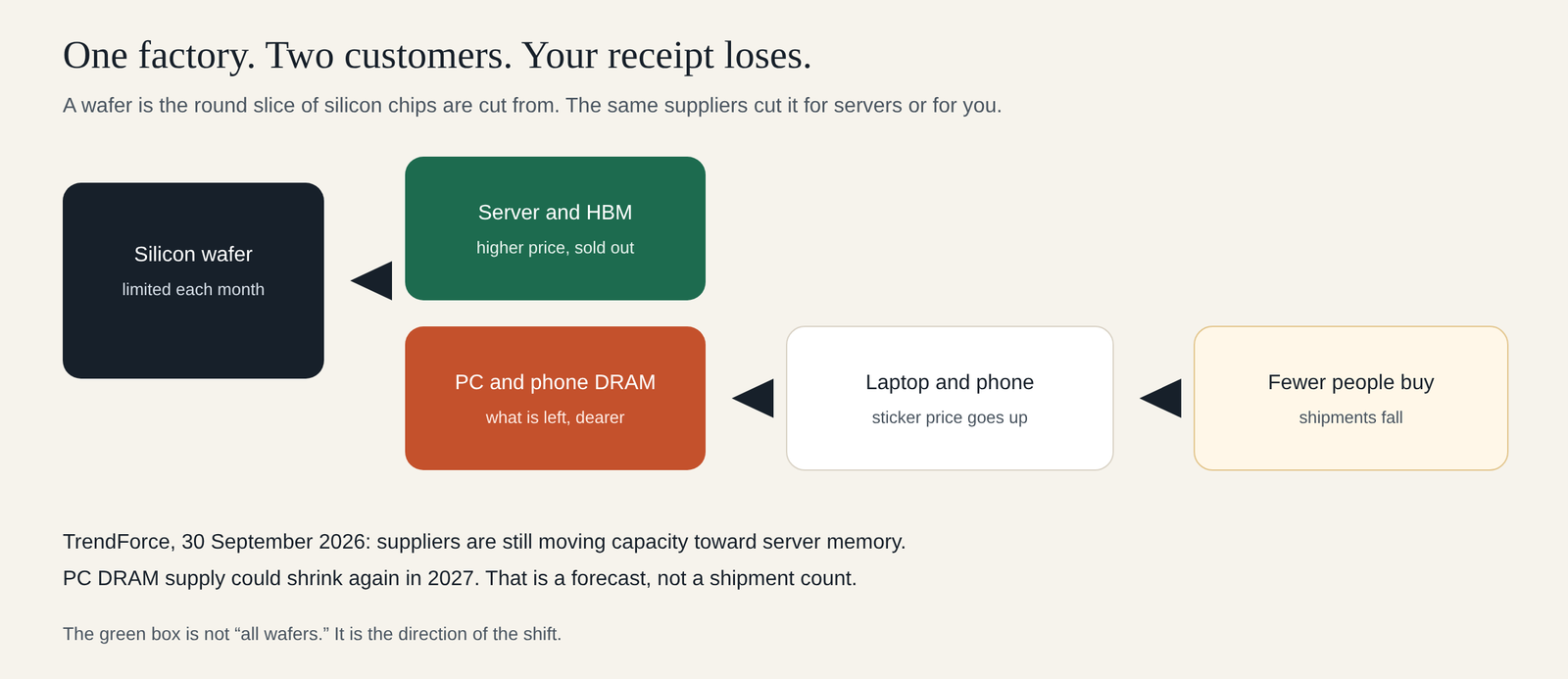
A wafer (a thin round slice of silicon that chips are cut from) only gets made so many times a month. Three companies do most of this work: Samsung, SK Hynix and Micron. A wafer can become HBM and server DRAM, which AI buyers will pay up for, or it can become the DRAM and NAND that go into a laptop and a phone.
They have been choosing the server. TrendForce, which tracks what memory makers charge their big customers, said on 30 September 2026 that suppliers are still shifting capacity toward server products. It forecast that conventional DRAM contract prices (the price a PC maker agrees with a memory maker, not the sticker in a shop) would rise another 10% to 15% in the fourth quarter of 2026. NAND contract prices were forecast up another 15% to 20%. It also said the supply of PC DRAM could shrink in 2027 as more capacity moves to servers. Those are forecasts, not receipts.
There is a second cause, and it is why this particular quarter looks so bad. In the first half of 2026, PC makers and shops bought extra machines to get ahead of the price hikes. That borrowed demand from the second half. Jitesh Ubrani, IDC’s research director for consumer devices, put it this way on 8 October: channels “loaded up on inventory early in the year to get ahead of price hikes,” and they are now “worried about carrying too much inventory into a market where high prices are suppressing demand.” He said that could mean promotions and “some short-term relief for consumers, but we don’t expect pricing anywhere near what it was a year ago. Prices will remain elevated.”
Which numbers from this week are real?
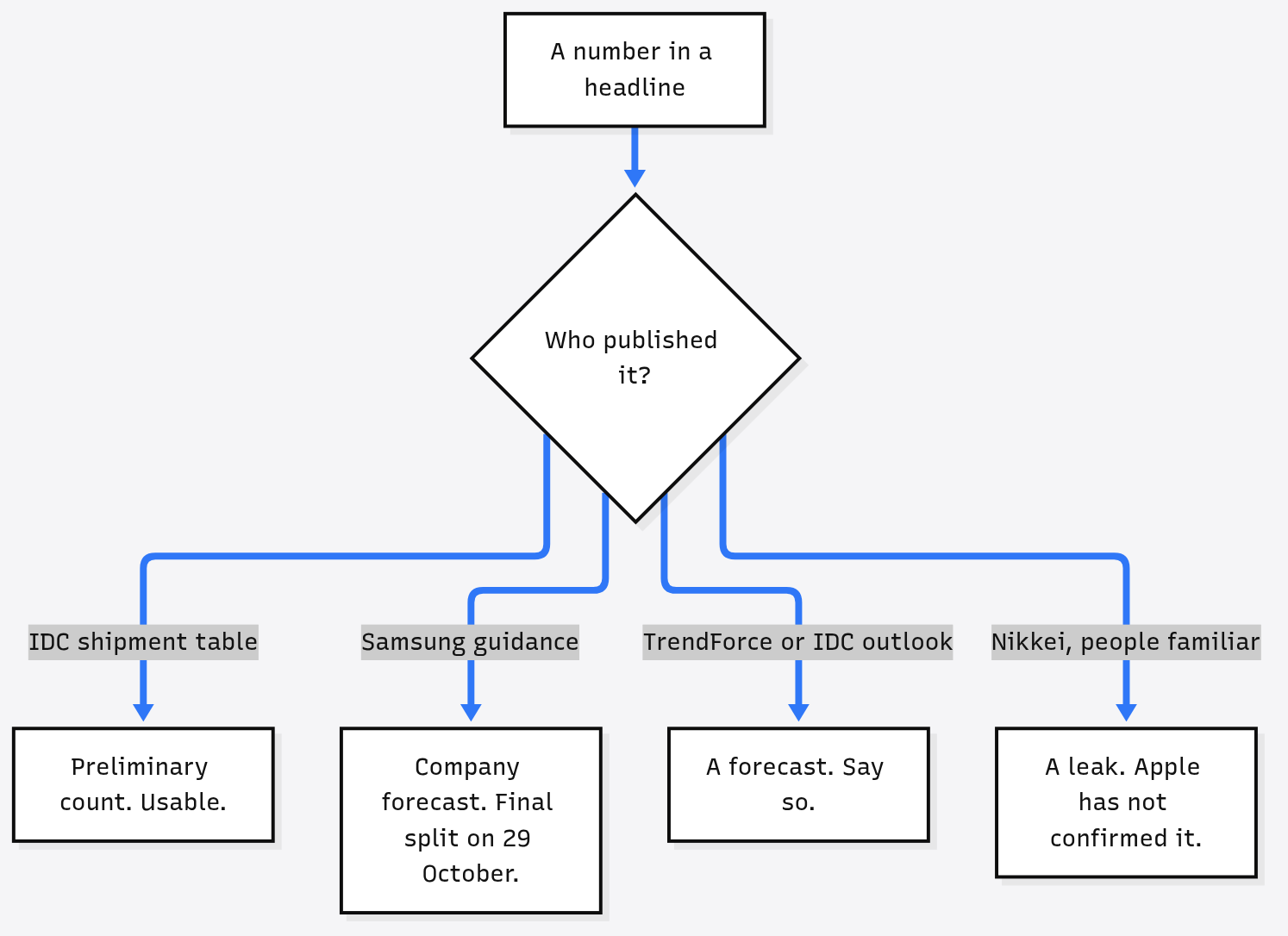
Samsung’s profit is a company forecast. The PC drop is a preliminary count. The iPhone order cut is still a supplier leak.
| What | Number | What kind of fact |
|---|---|---|
| Samsung operating profit, July to September 2026 | 107.4 trillion won, about USD 80 billion, up 782.5% from a year earlier | Company guidance, 8 October. Not the final report. |
| Samsung revenue | 195 trillion won, up about 127% (Yonhap: 126.6%) | Same guidance. Use the won. The dollar figure moves with the exchange rate. |
| Division split, including any phone-unit loss | Reuters reported a mobile loss of more than USD 1 billion. Detailed results are due 29 October. | Not a line Samsung has published yet. |
| PC shipments, third quarter 2026 | 62.7 million, down 20.1% from 78.5 million | IDC preliminary, 8 October. |
| Who fell | Lenovo down 22.6%, HP down 30.9%, Dell down 25.0%, Apple PCs down 11.3%, Asus down 8.6% | IDC. Apple’s share still rose, from 8.5% to 9.5%, because the others fell faster. |
| Phones, full year 2026 | Shipments forecast down 16.7%. Average selling price up 27.6% to USD 581. NAND and DRAM costs “up over 300%” from a year earlier. | IDC forecast from 26 August, not a count of phones already sold. The 300% is the part, not the price on the box. |
| Memory contracts this quarter | DRAM up 10% to 15%. NAND up 15% to 20%. Both versus the previous quarter. | TrendForce forecast, 30 September. |
| iPhone 18 Pro list price | Starts at USD 1,199. Pro Max starts at USD 1,299. Each is USD 100 above the matching iPhone 17 Pro. Base storage is 256 GB. | Apple’s 9 September 2026 announcement, as reported by MacRumors. |
| iPhone order cut | October component orders for the Pro and Pro Max cut 15% to 20% | Nikkei Asia, 9 October, citing unnamed people familiar with the matter. Apple has not confirmed it. |
Samsung’s profit is the clue to where the money went. Reuters described the 107.4 trillion won guide as the first time a technology company has projected quarterly operating profit above 100 trillion won, and as Samsung’s fourth record quarter in a row. Reuters also said Samsung and Micron expect the shortage to last into 2028. That is their outlook, not a law.
Yonhap reported that Samsung has begun mass production and shipments of HBM4 (the newest generation of the stacked memory) and that this generation is expected to matter more to earnings next year. The guidance press line did not say “memory made this much, phones lost that much.” Hold the Reuters phone-loss figure until 29 October, when Samsung publishes the split.
Keep two iPhone facts apart. The price step is public. The production cut is not. Nikkei’s story, as carried the same day by Yahoo Finance and others, says Apple has been more cautious since early September, and that October parts orders were cut by 15% to 20% from what some suppliers expected. Those sources also said softer orders might be because the cheaper iPhone 18, and an updated Air, are not planned until early 2027. Apple has not confirmed that calendar. A cut in parts ordered is also not a count of phones already sold. Reuters said it could not verify the Nikkei report.
Should you buy a laptop or a phone now?
Buy only if you need the machine. Take a real discount. Do not wait for last year’s price.
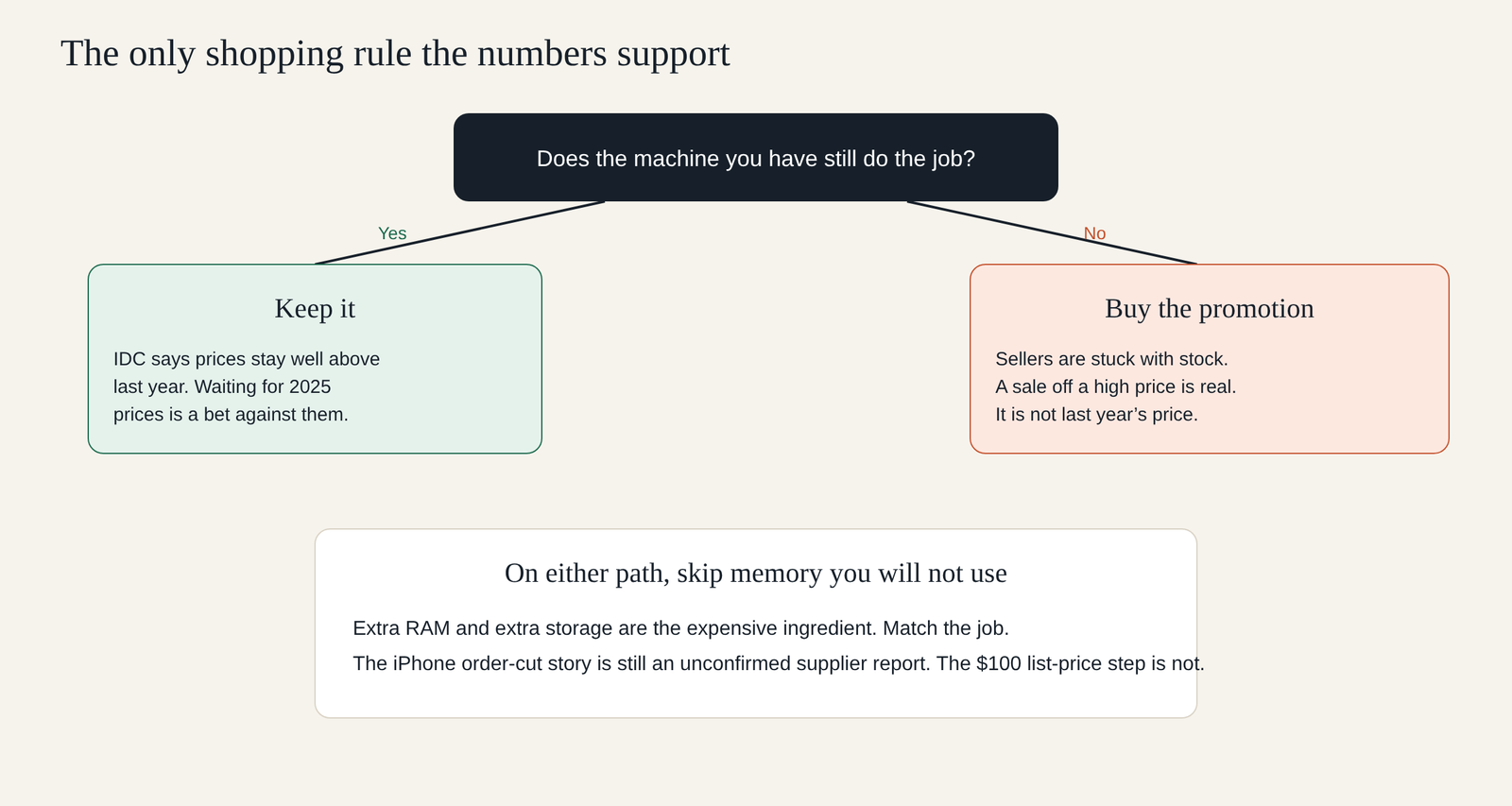
Four checks, in order.
- If the laptop or phone you have still does the work, keep it. Ubrani said prices stay well above a year ago, and that the next few quarters could get worse before they get better. TrendForce still has contract prices rising this quarter, and it warned that PC memory supply could tighten again in 2027.
- If you need one now, shop the promotions. Shops are holding stock they pulled forward. A discount off a high shelf price is real money. It is not a return to 2025.
- Do not pay for memory you will not use. On a phone, both the storage figure (NAND, the cabinet) and the RAM figure (DRAM, the desk) are inside this squeeze. On a laptop, the jump from 16 GB to 32 GB of RAM, or from 512 GB to 2 TB of storage, is you buying the expensive ingredient. A model you run on your own machine needs the RAM. A browser and documents usually do not need the top box.
- For an iPhone 18 Pro, the USD 100 step up from last year’s Pro is the part you can see on the price list. The “Apple is cutting orders” line is a leak. Do not time a purchase around a leak. If you do not need the Pro camera, the question is whether a cheaper phone you already understand is enough.
What this does not prove
It does not prove that AI spending is over, and it does not promise a cheap laptop in 2027.
IDC’s PC figures are preliminary. Samsung’s profit is guidance. TrendForce’s 10% to 15% is a forecast of contract prices, and a contract price is not the sticker in a shop. The August phone outlook, including costs “up over 300%,” was published before this week’s PC count, and it is a forecast of the year. The Nikkei order cut is anonymous, and Apple has not confirmed it.
None of that removes the mechanism the primary sources do agree on. A limited wafer went to the buyer who pays more. That buyer is an AI data center. What was left for PCs and phones costs more, so fewer PCs shipped, and a more expensive iPhone is a harder sell.
Common questions about why PCs cost more in 2026
Why are laptops expensive in 2026?
Memory is. AI servers are buying the stacked and server versions of the same chips a laptop uses. IDC said on 8 October 2026 that higher prices from the data-center buildout, plus an earlier rush to stock up, left third-quarter shipments at 62.7 million, down 20.1%.
Will PC prices fall soon?
IDC does not think they return to last year. It said promotions are possible because shops are holding stock, and that prices stay elevated. TrendForce still forecast higher DRAM and NAND contract prices for this quarter.
Is HBM the same chip as the RAM in a laptop?
Same family, different package. Laptop RAM is DRAM on a stick. HBM is DRAM stacked beside an AI chip so a model’s numbers can move faster. Making more HBM uses factory capacity that could have made ordinary DRAM.
Did Apple confirm a cut to iPhone 18 Pro production?
No. Nikkei Asia reported on 9 October 2026, citing people familiar with the matter, that some October component orders were cut 15% to 20%. The list prices, USD 1,199 and USD 1,299, come from Apple’s 9 September announcement.
Why is Samsung’s profit up if phones are a harder sell?
The memory it sells to AI servers is, on the figures reported so far, earning more than the phones are losing. Samsung has not published that split yet. The detailed report is due on 29 October 2026.