
The rocket is real. The data center is a drawing in a paper.
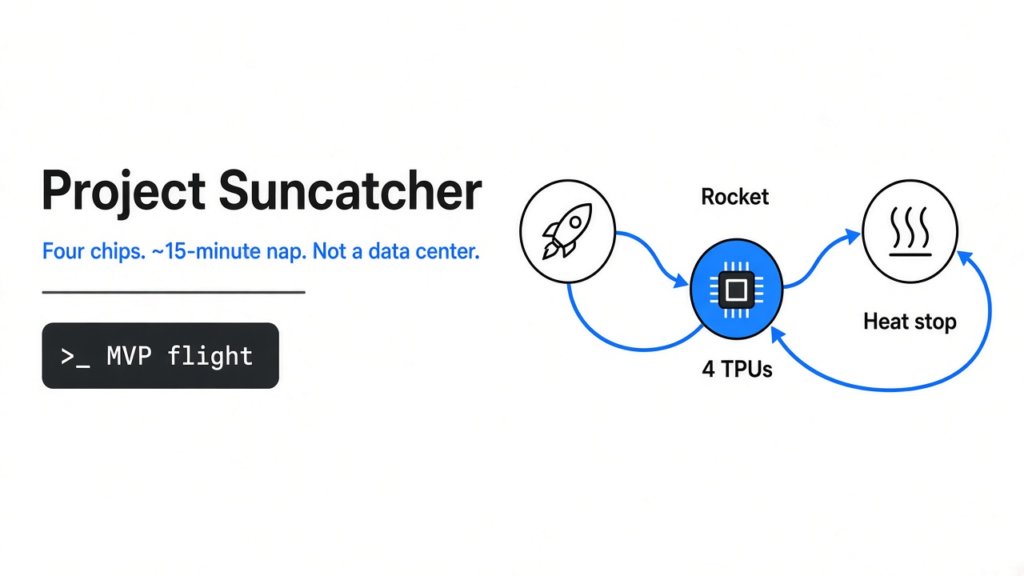
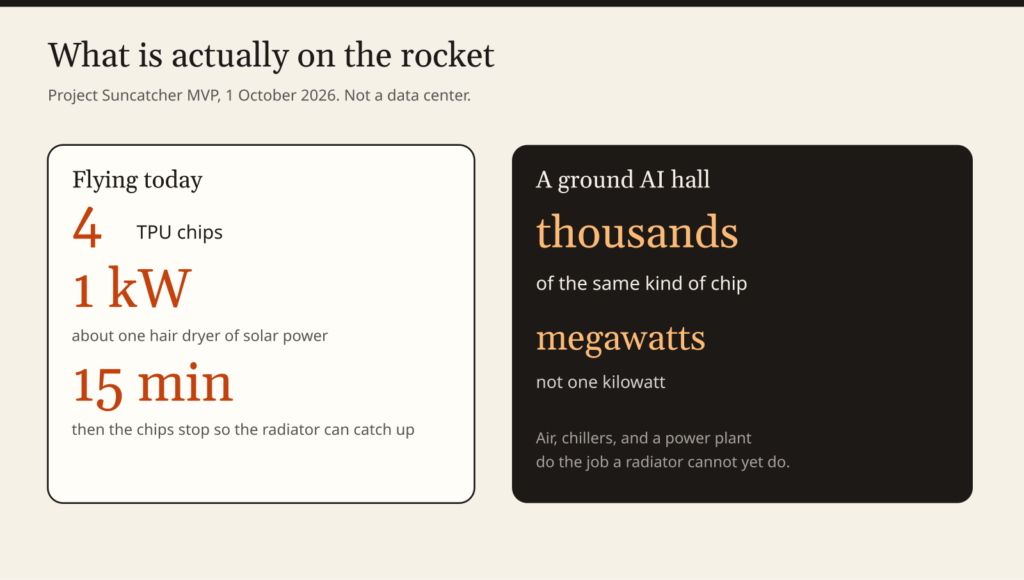
I kept seeing the same line on 1 October 2026: Google is launching an AI data center into space. I opened the launch notes and the paper the name comes from. The object on the rocket is a test. It carries four chips, about one kilowatt of solar power (a kilowatt is a thousand watts, about one hair dryer), and a cooler that makes those chips stop after roughly fifteen minutes.
What is actually launching?
SpaceX is flying Transporter-18, a rideshare (one rocket that drops off many customers’ satellites), from Vandenberg Space Force Base in California. The published window opens at 2:18 p.m. Eastern, which is 11:18 a.m. Pacific, on 1 October 2026, and stays open for 58 minutes. Space.com counts 130 payloads. CNBC rounded the same window to 11:15 a.m. Pacific. Rideshares slip. Treat the clock as the plan, not as a result.
One payload is a Planet Labs satellite that Google calls MVP. MVP means minimum viable prototype: the smallest machine that can answer one question. Ars Technica describes it as about the size of a refrigerator. Google did not build a new bus (the satellite body: power, radio, structure) from scratch for this flight. It put chips into a Planet satellite that already existed, and pulled the test forward from an early-2027 plan. Planet’s Eric Stevens has described that as taking extra risk to fly in 2026.
Inside are four TPUs. A TPU (tensor processing unit) is a chip Google designed for one job: the huge stacks of multiplications inside a neural network (a model that turns numbers into a next word, a next pixel, or a next action). It is not a general computer. On Earth, a hall holds thousands of them. The New York Times says these four have about the computing power of one server, fed by solar panels of about one kilowatt. They are there to run simple Gemini queries. Gemini is Google’s model family. A query here means one request: you send a prompt, the chip runs the model, you get an answer. That job is called inference (using a finished model). It is not training (changing the model’s numbers by showing it mountains of examples). Training is the hungry job. This satellite cannot do it.
Sundar Pichai’s line, reported by Aviation Week: “Can our TPUs survive and operate in space? Well, we’re going to find out.” Travis Beals, the Google director on the project, told reporters the first launch is about seeing what works, finding what fails, and feeding that into later flights. That is a test plan. It is not a product launch.
Why try, if four chips cannot train anything?
Start from electricity, not from space.
A data center is a building full of computers. Every calculation becomes heat, and every watt of heat was a watt you had to buy, generate, or refuse to someone else. The International Energy Agency puts data centers at about 1 percent of global electricity generation now, rising to about 3 percent in 2030. Electricity made for them goes from 460 terawatt-hours in 2024 to over 1,000 in 2030. A terawatt-hour is a billion kilowatt-hours. AI-focused halls are the fast part of that. The same week as this launch, memory makers were still saying the chips that feed those halls stay scarce for years. “Just build another hall” is not free, and it is not fast.
The Sun puts out more power than our whole grid. Google’s question, written down in November 2025, is whether you should put the chips where that light already is, instead of turning sunlight into electricity on Earth and shipping it through wires.
What “eight times the solar power” is counting
A solar panel is a sheet that turns light into electric current. On a roof at mid-latitude it loses four things before you ever talk about the chip.
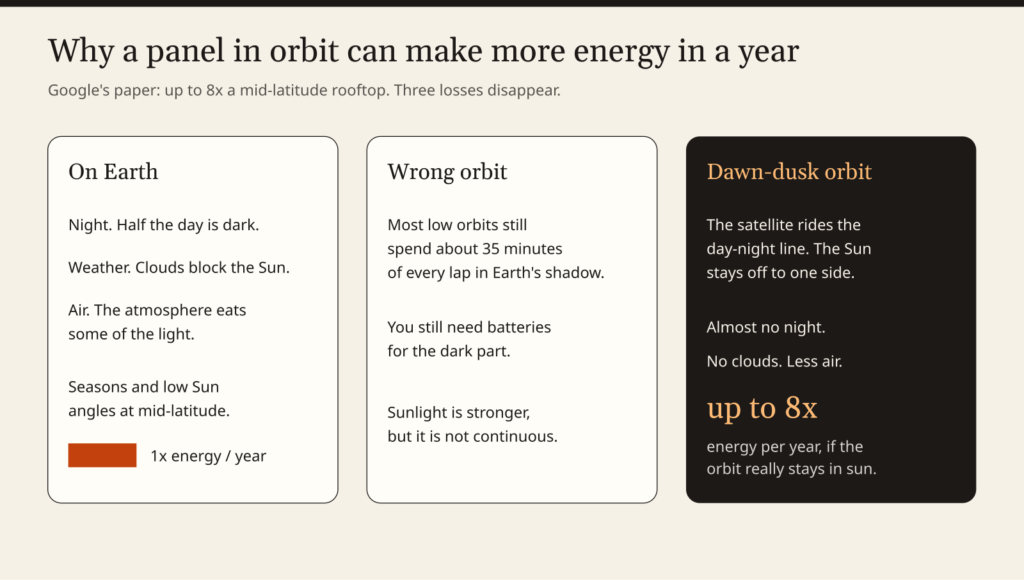
Night. The panel is dark about half the time. Weather. Clouds cut the light. Air. The atmosphere absorbs some of it before it arrives. Angle. In winter the Sun sits low, so the same panel catches less.
Google’s research note and the paper say a panel in the right orbit gets up to eight times more solar energy per year than a mid-latitude panel on Earth, and can make power almost all the time, so you carry fewer batteries. Batteries are heavy. Heavy is what you pay a rocket to lift.
“The right orbit” is the whole claim. Low Earth orbit (LEO: a few hundred kilometers up, the same neighborhood as the space station) is not automatically sunny. A typical lap takes about 90 minutes. On a normal path the Earth blocks the Sun for on the order of half an hour each lap. You get harsher light, then a blackout, then you spend battery mass to ride through the blackout.
The orbit they want is a dawn-dusk sun-synchronous orbit. Sun-synchronous means the orbital plane turns with the seasons, so the satellite keeps the same relationship to the Sun. Dawn-dusk means it rides the terminator (the moving line between day and night). The Sun stays off to one side. The satellite almost never enters shadow. No clouds. Less air in the way. That is where the “up to 8×” comes from. It is a yearly energy total for that orbit, not a reading from today’s prototype.
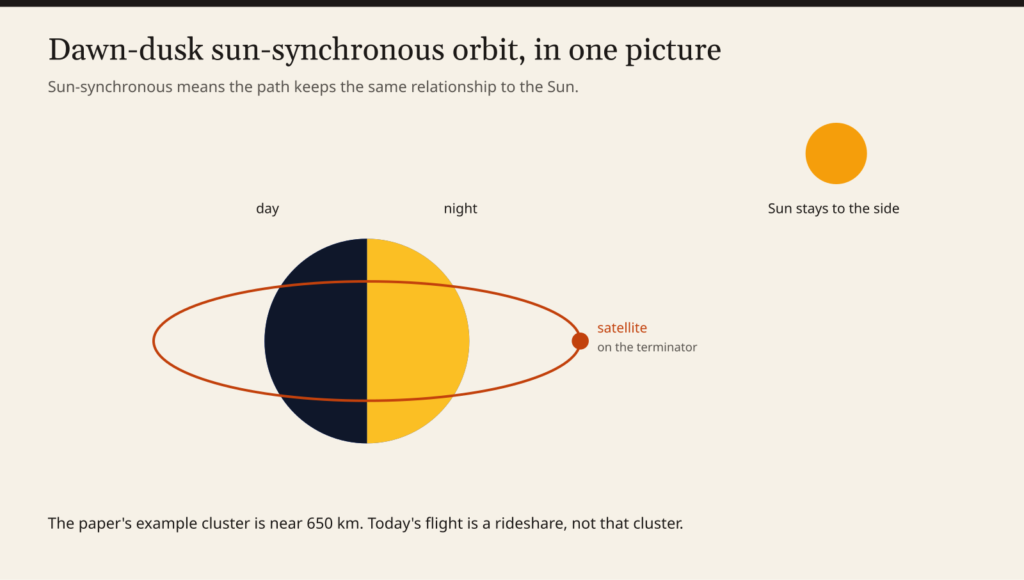
The bright edge in this NASA photograph is that terminator, seen from orbit. Dawn-dusk flight means living on that edge so the panels stay lit.
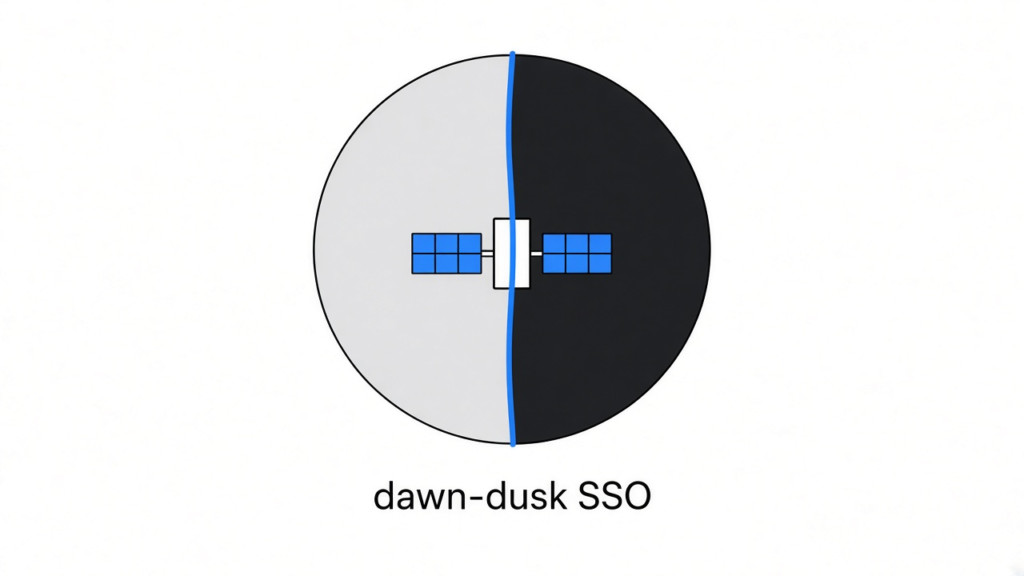
The paper’s example cluster flies near 650 kilometers. I am not going to pretend the launch page published MVP’s exact slot. Today’s flight is a rideshare test, not that cluster.
Heat is the limit the slogan skips
Every watt the chip uses becomes heat. Energy does not vanish. On Earth you move that heat into air with fans, or into water in pipes, and then a chiller (a machine that dumps the heat outside the building) finishes the job. Air is a substance. You can push it.
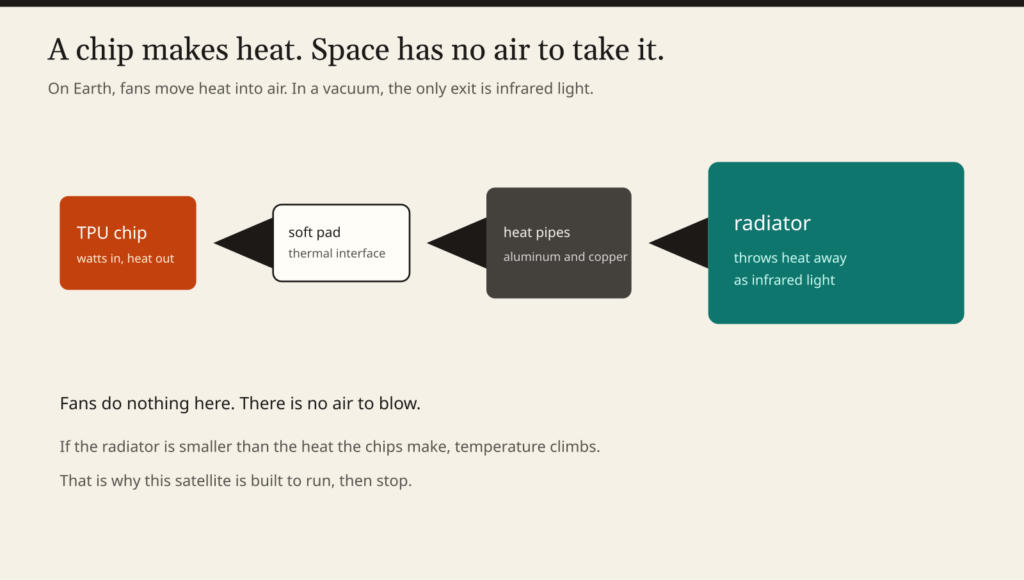
Orbit is a vacuum (almost no gas). A fan spins and does nothing, because there is nothing to blow. The only exit left is radiation in the physics sense, not the particle sense: a warm surface glows in the infrared (light your eyes do not see), and that light carries energy away into the dark. A radiator is a large surface built to glow that way.
Ars Technica describes the path Google has been testing on the ground. A soft thermal interface (a pad that fills the microscopic gap between chip and metal, because heat crosses a gap badly) sits on the chip. Heat pipes (sealed metal tubes, aluminum and copper, that move heat from a hot end to a cold end) carry it to a radiator. The radiator on this first craft cannot keep up if the chips stay on. So the plan is to run for about fifteen minutes, then shut the chips off and let the radiator catch up. Scientific American reports the same stop.
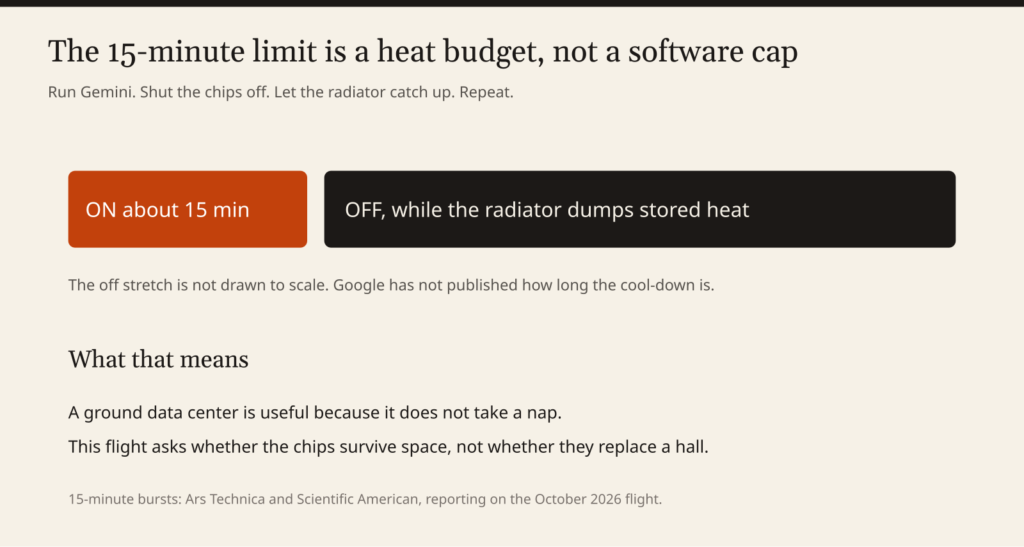
Google has not published how long the off stretch is. The diagram does not invent it. What is public is the on stretch: about a quarter of an hour, then a nap. A ground hall is valuable because it does not nap. This flight is a thermometer with a model taped to it. If the chips still answer a simple Gemini prompt after the shake of launch and the heat cycle, the test worked. If a headline calls that a data center, the headline is wrong.
The paper itself, in the discussion, lists thermal management as still unsolved for a real system. The fifteen-minute stop is that sentence, made of metal.
Why radiation hits the memory before the math
Above the air, fast particles hit the chip. Two injuries get mixed up in headlines. They are different.
Total ionizing dose (TID) is the sunburn. It adds up over years and slowly changes the materials. A single event effect (SEE) is one particle, right now, striking one tiny spot.
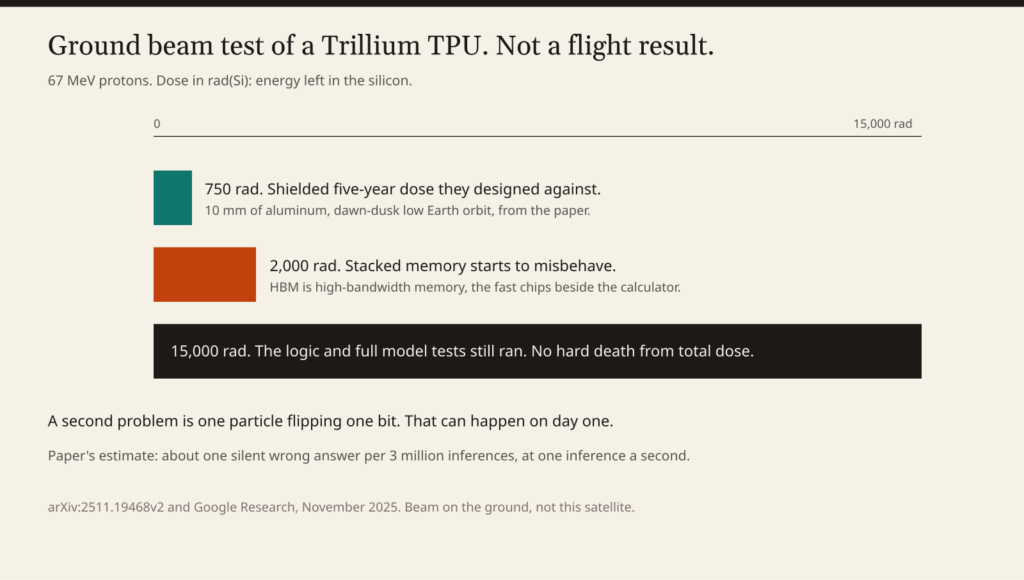
Google’s published evidence is a ground test, not this flight. They put a Trillium TPU (their v6e Cloud TPU, the generation they sell as a cloud chip) and its host computer in a 67 MeV proton beam. MeV is mega-electron-volts, a unit of how hard each proton is thrown. A proton is the nucleus of a hydrogen atom. The flight stories say the satellite carries TPUs. They do not, in what I could verify, say those four boards are Trillium. Keep the beam result and the rocket separate.
With about 10 millimeters of aluminum as a shield, the paper estimates 750 rad(Si) over five years in a sun-synchronous low orbit. Rad(Si) means energy deposited per mass of silicon. It is the dose the silicon itself absorbs.
The part that got weird first was the HBM. HBM (high-bandwidth memory) is the fast memory stacked beside the calculator, the place the model’s numbers sit while the chip multiplies them. HBM stress tests started to misbehave after 2,000 rad. That is almost three times the five-year figure, which is why Google calls the total-dose result a pass. The logic, and tests that ran a whole model, kept working up to 15,000 rad on one chip. No hard death from total dose at that level.
Memory fails first for a plain reason. A memory cell is a tiny stored charge that means 0 or 1. A little extra charge from a particle looks like the other number. The multiplier circuits are larger and harder to flip by accident. The model is mostly memory plus multiplies. Hurt the memory and you hurt the model, even if the multipliers are fine.
The one-particle problem is not solved by “we survived 15,000 rad.” For a typical transformer workload (the model shape behind chatbots; a transformer predicts the next piece of text by attending to earlier pieces), they saw silent data corruption about once per 17 rad. Silent data corruption (SDC) means a wrong answer and no crash. You do not get an error light. You get a bad token (a token is a chunk of text, often a word or part of a word).
Their orbital estimate is about 150 rad(Si) a year. One bad event per 17 rad is about nine events a year. One inference per second is about 31.5 million inferences a year. Nine divided by 31.5 million is roughly one bad answer in 3.5 million. The paper says “on the order of 1 per 3 million.” The division matches. It assumes one inference a second, and it assumes the beam matches orbit. Both are assumptions.
The ordinary computer next to the TPU is a different weak point. They estimate a crash or reboot about once per 450 rad for the CPU (the general processor) and once per 400 rad for its RAM (its own memory). At 150 rad a year, that is a reboot every few years, if the beam was honest. A reboot on a satellite is not a person walking over with a button.
The machine in the paper is 81 satellites
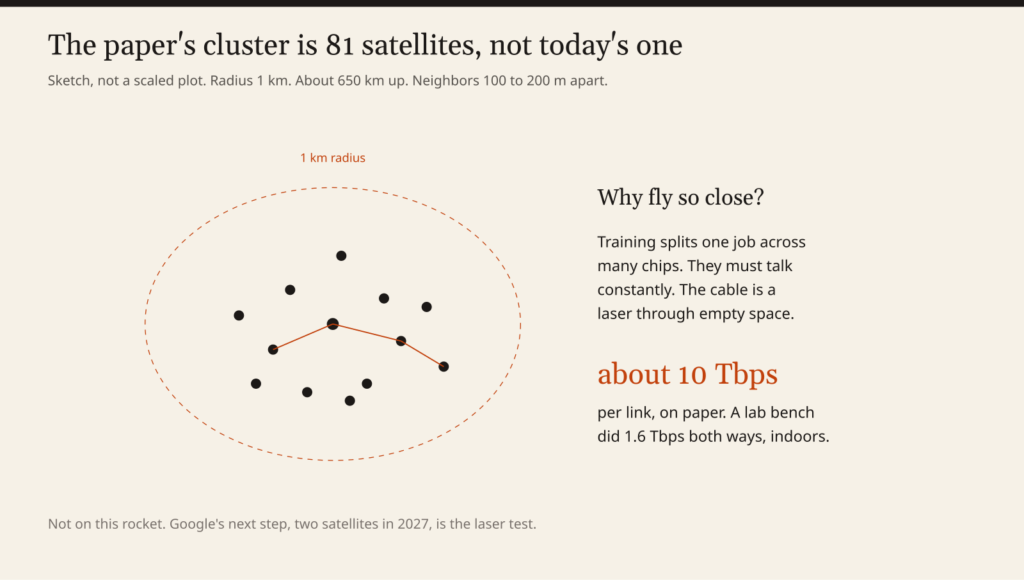
Today is one refrigerator. The design in arXiv:2511.19468 (revised 17 June 2026) is a cluster of 81 satellites, all in one orbital plane, in a circle of 1 kilometer radius, near 650 kilometers up. Neighbors sit about 100 to 200 meters apart, and that gap breathes as they fly. Close is the point.
Training splits one job across many chips. Those chips have to exchange huge amounts of data, continuously, or the job waits. On Earth that is copper and fiber inside a building. Between satellites the cable would be a laser in empty space. The name for that is a free-space optical link (light as the wire, no glass fiber).
They argue a link on the order of 10 terabits per second is buildable from parts you can buy. A terabit is a trillion bits a second. A home fiber connection is usually around a gigabit, and a terabit is a thousand gigabits. A bench demo in the lab did 800 gigabits one way, 1.6 terabits if you count both directions, across a short indoor path. That is not a kilometer of orbit, and it is not on this rocket.
Google has said the 2027 flight is a pair of satellites, to try those lasers over a short distance, and that later designs would carry dozens of TPUs each. The 81-satellite picture is an illustration of how you might fly a formation, plus a note that machine-learning models could help steer it. It is not a cargo list.
The price that would have to come true
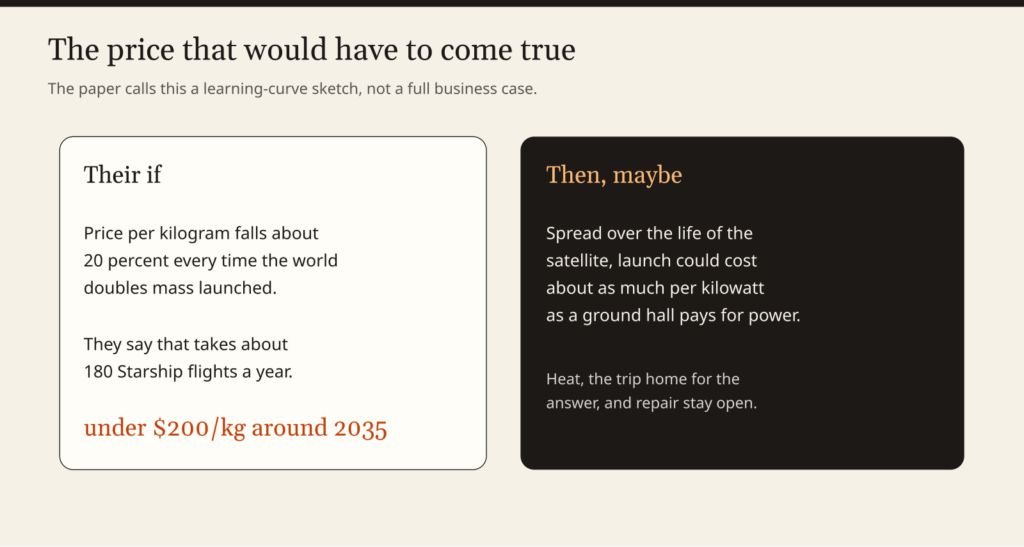
You pay a rocket for every kilogram of chip, panel, radiator, and shield. If launch stays expensive, free sunlight does not save you. You spent the money on the way up.
The paper’s sketch, which it says is not a full business case, uses a learning rate of about 20 percent. A learning rate here means the price per kilogram falls by about 20 percent every time the world doubles the total mass it has ever launched. If that rate holds, and if someone flies about 180 Starships a year (Starship is SpaceX’s giant reusable rocket, still the assumption in the paper, not a schedule I am reporting as fact), they get under $200 per kilogram to low Earth orbit around 2035.
At that price, they say, launch spread over the life of the spacecraft could land in the same ballpark, per kilowatt, as the electricity bill of a ground hall. Per kilowatt means: compare the cost of supplying one kilowatt of compute-power, not the cost of one satellite against the cost of one building.
Read the next sentence they wrote, not the one the quote graphics use. The sketch does not price the heat, the link back to Earth, or repair. Those are the open items in the discussion section.
People who do not work on the project say the same gaps in plainer words. Kerri Cahoy, at MIT, told Scientific American the jump is from arrays a few meters on a side to arrays a couple of kilometers on a side, and that launching that mass is the huge part. Alan George, at the University of Pittsburgh, said you still do not have an easy way to get data home. His line to students is that the best compression is answers: do the work up there, send the answer down, do not send the raw pile. That helps inference. It does not remove the need for the laser mesh if you wanted to train.
Alexander Wyglinski, at Worcester Polytechnic Institute, grants the sunlight and then the constraint: the computer you put on a satellite is not the computer on your desk.
Set those next to the company timelines. Elon Musk has said orbital data centers become the cheapest way to train AI within two years, maybe three. Gwynne Shotwell has said SpaceX will put “supercompute in space” in 2027. CNBC also notes Alphabet’s stake in SpaceX, above $82 billion after the June 2026 listing. A partner’s forecast is not a measurement. Two years from a 2026 speech is not the paper’s 2035 launch-price if.
What I would count, and what I would ignore
Count these, if Google publishes them from orbit:
- >The four chips still answer a simple Gemini query after launch vibration and months of particles.
- >The cooler really does force a stop near fifteen minutes, or the ground test was harsher than orbit.
- >A bit-flip rate measured in flight, set beside the beam’s “one in a few million.”
Ignore these, even if the livestream looks perfect:
- >Any sentence that says a data center launched. A data center does not take a mandatory nap after a quarter of an hour.
- >The 8× solar figure, as if this flight measured a year of energy. That figure needs the dawn-dusk orbit and a year of sun.
- >Cheap training. Four chips cannot train a frontier model. The laser cluster that might is a 2027 experiment plus an 81-satellite drawing.
- >$200 per kilogram. That is a 2035 conditional, and the paper says the learning rate has to keep going.
Beals once described the team’s method as trying to find reasons the idea was impossible, then slowly deciding it might work. “Might” is the load-bearing word. This rocket does not retire it. It is the first time the chips, the radiator, and the particles are in the same place, which is the only honest reason to watch.
1 comment