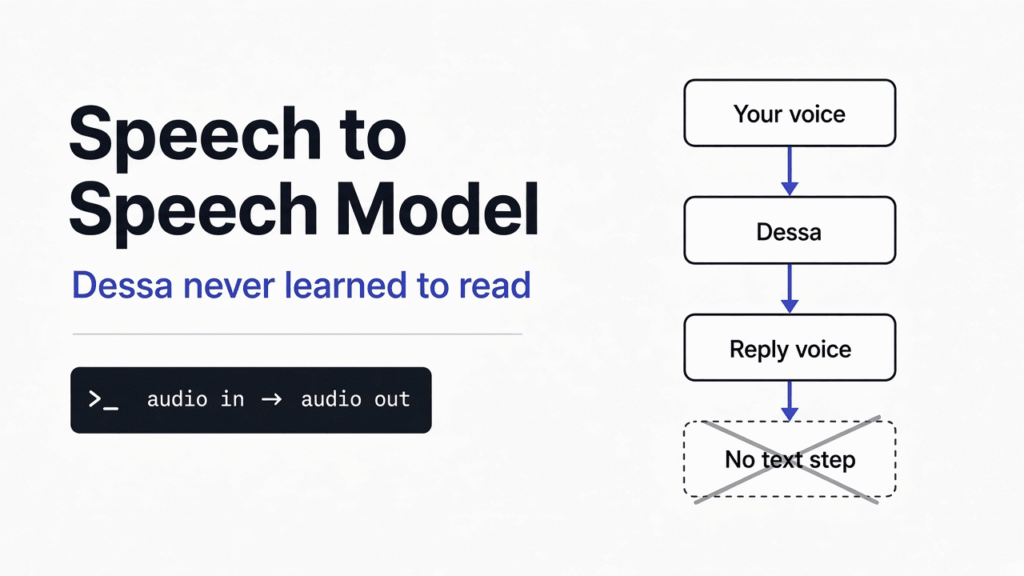
On 23 October 2026, a small lab inside Block (the company Jack Dorsey cofounded, the one that used to be called Square) put up a page for a model named Dessa. A model is a program that adjusted millions of internal numbers by looking at examples, then uses those numbers on something new. Block says Dessa was trained from scratch on human conversation only. No text. No pretrained model, meaning no earlier model that had already been taught on a giant pile of writing.
That sentence is the whole story. It is also the part most headlines skip. If a model never read, it can keep the sigh, the laugh and the moment you cut in. It also cannot know a fact that exists only on a page, unless someone happened to say that fact out loud in the talks it learned from.
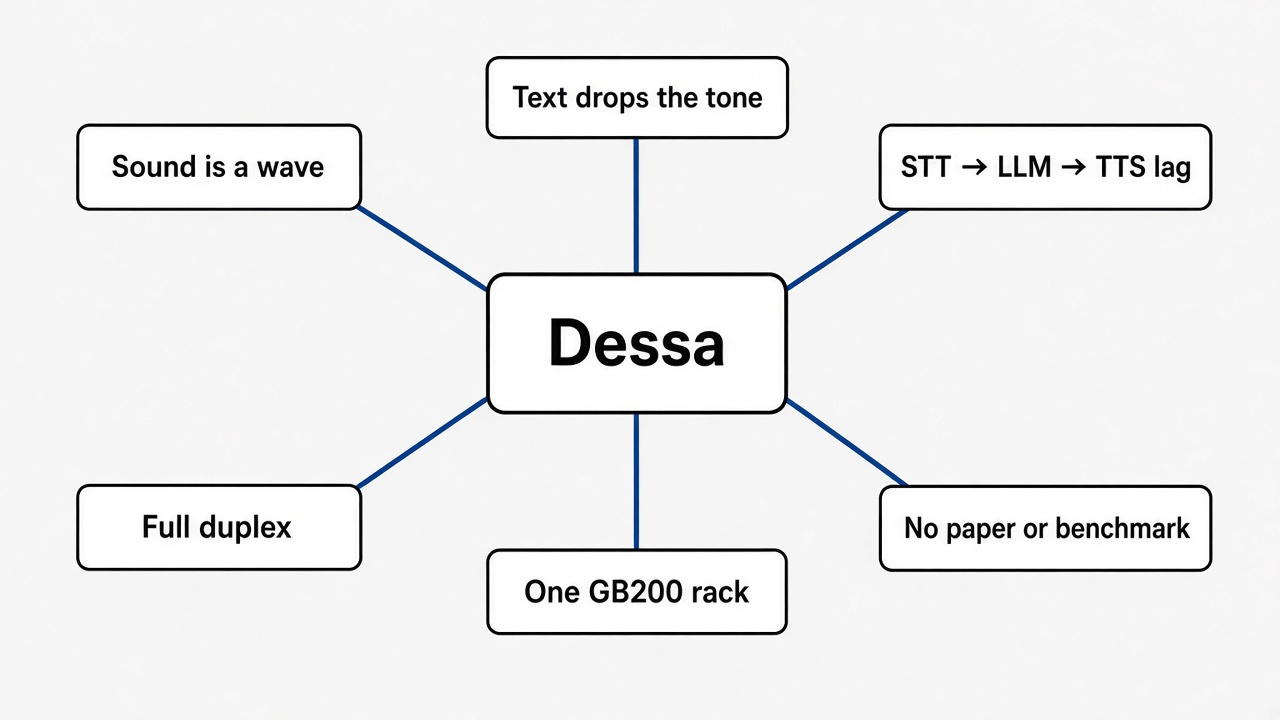
This is a research preview (a limited showing, not a product you can download). Block has not published a paper, a model size, a dataset size, a license or a benchmark. The recordings on the page are recordings Block chose. Read this for the mechanism. Do not read it as a scoreboard.
Sound is a list of heights, not a sentence
Before any product name, start with the thing in the air. A sound is a pressure wave. Your ear, or a microphone, feels that pressure go up and down. A computer cannot store “a voice.” It stores a sample, one measured height of that wave, then another, then another, tens of thousands of times a second. Line those heights up and you get a waveform, a drawing of loudness over time.
Look at a waveform and you can see when someone was loud and when they paused. You cannot yet see which pitch it was. For that, people draw a spectrogram, a picture where left-to-right is time, bottom-to-top is pitch, and brighter means louder. A spectrogram is still the same recording. It is just a more useful view of it. Speech lives in that picture: the words, the accent, the breath, the laugh, the crack in the voice.
Block’s own page makes the size of this concrete. A single spoken word takes thousands of times more bytes (stored numbers) than the same word typed out. Speech also almost never repeats exactly. The same “okay” said tired is not the same “okay” said pleased. That is why learning from sound alone is a harder job than learning from a tidy corpus of text, a corpus being a saved pile of examples.
A transcript keeps the words and throws the person away
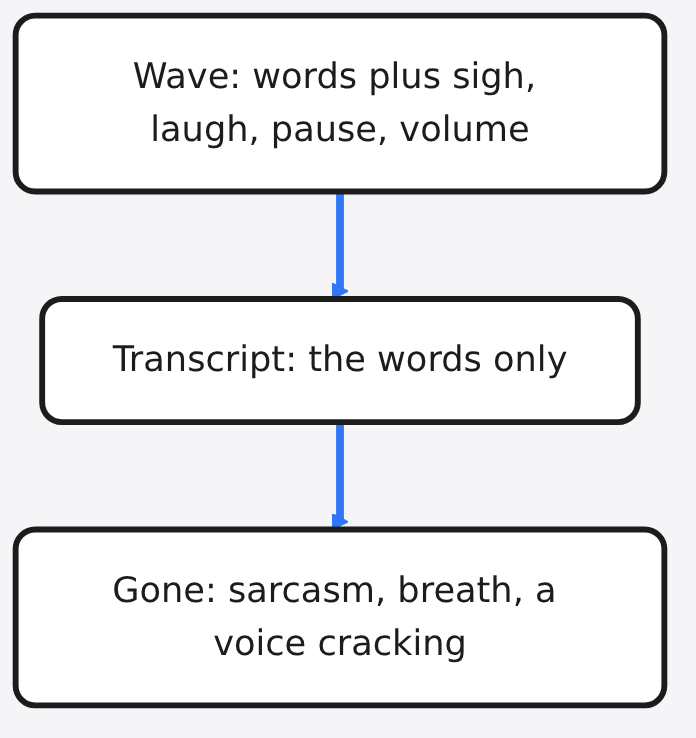
Text is a second invention. Someone, or some program, decides that a stretch of wave “was” the word okay, and writes five letters. Those letters are useful. They are also a lossy copy. Lossy means the copy cannot be turned back into the original.
What the letters drop:
- whether you were asking or telling
- whether you sighed before you said it
- whether you laughed in the middle of the word
- whether you got quieter because you were unsure
- the little “yeah” the other person slipped in while you were still talking
Block’s page says this directly: run speech through text and all of that is gone, which is why most voice AI feels stilted and slow. A separate line on the same page is sharper: the most powerful AIs in the world cannot hear how you feel, and the lab thinks that is both a worse experience and potentially dangerous. That last word is their judgment, not a measured incident. The mechanism under it is real. A text model never received the sigh, so it cannot react to the sigh.
Most “voice AI” is three programs and a pause
A chat model already knows a lot, because it read. So the cheap way to make a voice product, cheap in engineering, not in feeling, is to bolt a voice onto that reader.
Three jobs, in order:
- Speech to text, often shortened to STT. A first model listens until you seem finished, then writes a transcript.
- A large language model, an LLM, reads that transcript and writes a reply. An LLM is a text model. It has no ears. It only sees the letters from step 1.
- Text to speech, TTS. A third model reads the reply aloud in some stored voice.
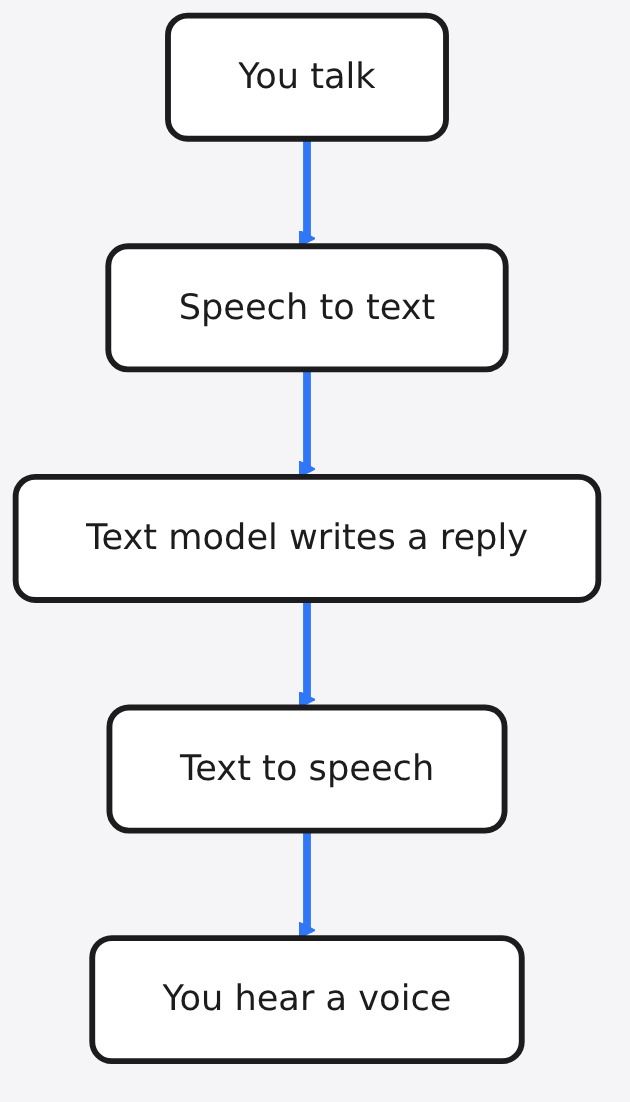
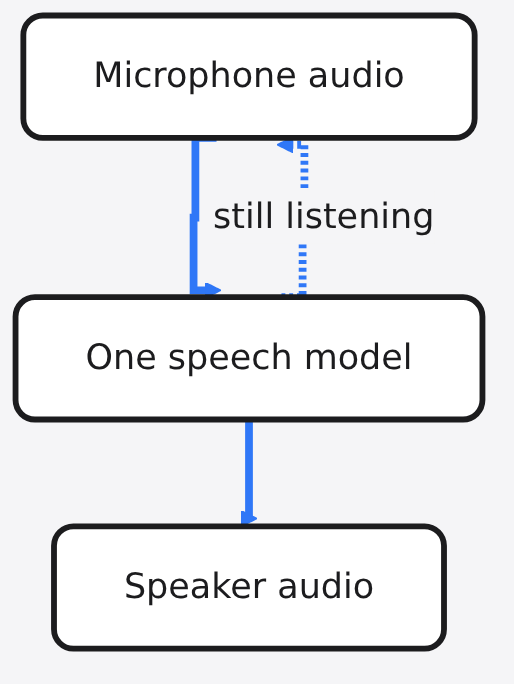
Each arrow is a wait, and each arrow is a place information dies. The text model cannot hear that you started talking again, because the first model is still “in its turn.” You feel that as the walkie-talkie habit: it waits for you to shut up, then it talks, then it goes deaf while it talks.
That habit has a name from radios, not from AI. Half-duplex means only one direction is active at a time. A walkie-talkie is half-duplex. You hold the button, you talk, you release, you listen. Full-duplex means both directions at once. A phone call is full-duplex. You can say “wait” while the other person is still going, and they can hear you.
A backchannel is the small sound a listener makes so the speaker knows they are still there: “yeah”, “mm”, “got it.” Humans do this without taking the floor. A half-duplex pipeline cannot, because it is not listening while it speaks. (Even tools that clone your voice locally still read text before they speak.)
OpenAI already shipped a full-duplex voice model earlier in 2026, reported under the name GPT-Live and, in The Verge’s account of one clip, GPT-Live-1. Duplex is not what Block invented. The claim Block is actually making is narrower, and more interesting: the duplex behavior was learned from sound, not bolted on in front of a reader.
What Block says Dessa is
Dessa is speech-to-speech. Audio goes in. Audio comes out. There is no transcript sitting in the middle as the thing the model “thinks in,” at least not as a product step Block describes. Block’s page: “Dessa is a true speech-to-speech model, and everything it knows came from human speech.”
From that same page, the concrete claims, and only these:
- Trained from scratch on human conversation. “Sounds! No text, no pretrained models.”
- Full-duplex. It listens and talks at the same time. It is supposed to know when to cut in and when to backchannel.
- It hears and produces emotion in the audio itself: sarcasm, laughter, a frustrated sigh, a voice cracking.
- Inference runs faster than real time. Inference means using a finished model, as opposed to training, which is the long job of teaching it. Faster than real time means a stretch of audio is finished in less time than that stretch lasts, so the model does not fall behind the conversation. Block published no millisecond number.
- It runs locally on a MacBook Pro with an M4 Max or better. The M4 Max is a high-end Apple laptop chip from 2024, with a strong built-in graphics processor. “Or better” is Block’s floor, not a full hardware list. No memory size was published.
- Trained on one NVIDIA GB200 NVL72.
- “As far as we know,” the first AI you can have a realistic live conversation with that was trained only from human speech. That is Block qualifying its own “first.” Treat it as their belief, not as an audit.
- Learned language from “hundreds of times fewer words” than LLMs need. Block immediately adds the fair caveat that LLMs also have to learn programming languages. No word count was published on either side.
The lab is small, and the page names it. Researchers: Louay Hazami, Hashiam Kadhim, Qi (Alex) Liu, Rayhane Mama, Aydin Polat, Marc Tyndel. The page says the lab was founded by former members of Dessa, a Toronto deep-learning startup, that they have built deep-learning models since 2012, and generative speech models for more than eight years. Press coverage identifies Ragavan Thurairatnam as the lead who posted the demo clips.
One rack taught it. A laptop is only supposed to run it
Training and inference are different jobs, and mixing them up is how this story gets exaggerated in both directions.
Training is showing the model a huge number of examples and letting it nudge its parameters. A parameter is one stored number inside the model. Block has not said how many Dessa has. Nudging those numbers until the model is good is the expensive part. You do it once.
Inference is what happens after. The numbers are frozen. New audio comes in, audio comes out. That is the part Block says fits on a MacBook Pro M4 Max or better.
The training machine is not a laptop. An NVIDIA GB200 NVL72, by Nvidia’s own spec page, connects 36 Grace CPUs and 72 Blackwell GPUs in one liquid-cooled rack. A GPU is a chip built to do a huge number of small math steps at the same time, which is the math training needs. A rack is a tall cabinet of those machines. Grace is Nvidia’s CPU, the ordinary control chip next to the GPUs. Blackwell is the GPU generation. NVLink is Nvidia’s private wire between those chips, so the 72 GPUs can pass data to each other much faster than if they were 72 separate computers on Ethernet. Nvidia’s page calls that wiring a single NVLink domain: the rack is meant to behave like one giant GPU, not 72 strangers.
“Only one rack” is small next to the buildings full of GPUs behind frontier text models. It is still 72 of Nvidia’s data-center GPUs and a liquid-cooling loop. Block’s achievement, if the claim holds, is that this speech model did not need a campus. It is not “trained on a MacBook.” The MacBook is the machine they say can run the finished model.
Dorsey promoted the launch the same day. Secondary reports quote a reply of his to the effect that it is big, and also small enough to run on a MacBook. The part you can check without his reply is Block’s own page, which says the same hardware floor.
What the clips show, and what a clip cannot show
Block’s page and the clips its lead posted are the evidence. There is no public eval, an eval being a fixed test where everyone is scored the same way.
What reporters who played the clips described:
- A guessing game where the model finishes a movie title the human is stuck on, which is the duplex claim in miniature. It was listening while a sentence was unfinished.
- Laughter, a gasp, a change in volume when asked.
- A conversation about Christopher Nolan films that wanders into Bryan Singer’s Superman films. That is fluent. It is also a reminder that “knows about films” here means “films came up in speech it learned from,” not “it read the filmography.”
- A Paris-trip clip that Block’s own page describes as the model answering with what sounds like teary gratitude. “Sounds like” is the right standard. You are hearing a performance in a selected take.
- One clip set next to GPT-Live-1, in which The Verge heard Dessa as the more natural of the two. One clip is not a comparison study.
- The Verge also heard the model call the speaker “Ronaldo” at the start of a clip Thurairatnam shared. Awkward failure, in public, is more informative than a perfect reel. It means the model is guessing who is in the room from sound and from the start of a conversation, and it guessed wrong.
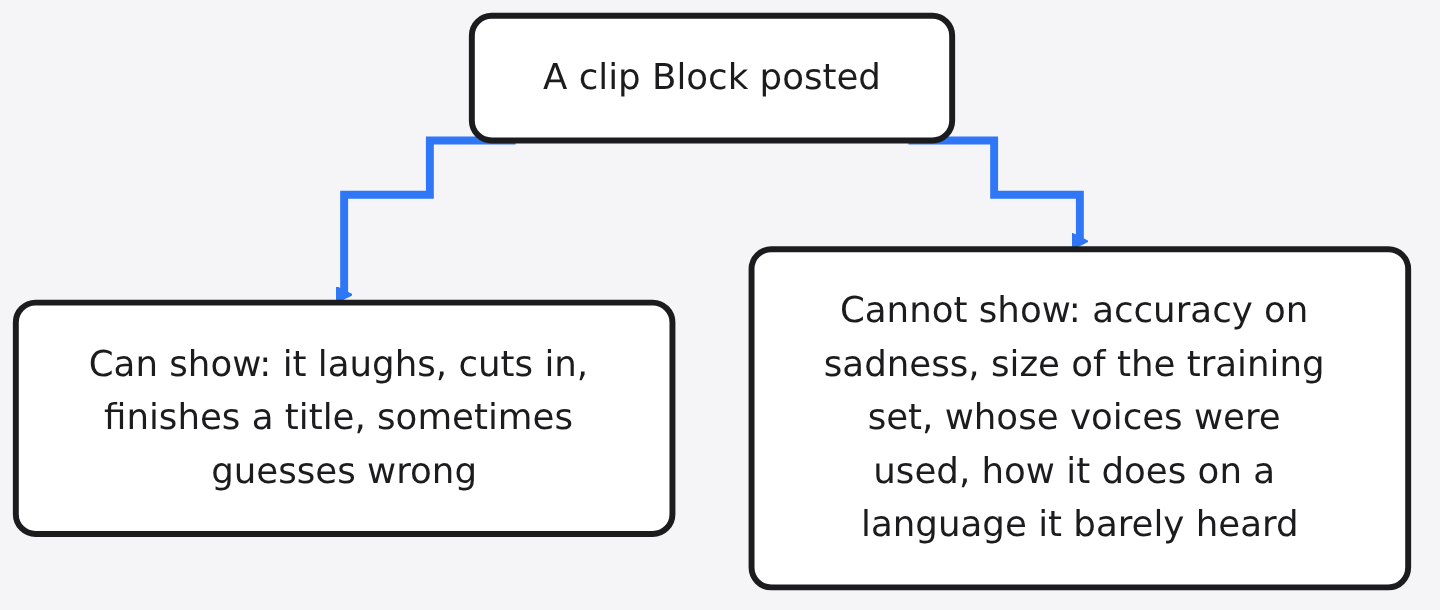
The honest inventory: published, and not
| Question | What exists on 25 October 2026 |
|---|---|
| What is it? | Speech-to-speech, full-duplex, Block’s description |
| Training data type | Human conversation audio. No text, no pretrained model, per Block |
| Training computer | One GB200 NVL72, per Block |
| Run computer | MacBook Pro M4 Max or better, faster than real time, per Block |
| Who can try it | A small group of AI safety researchers. Lab, company or university email. Launch links “coming soon” |
| Parameter count | Not published |
| Hours of audio | Not published |
| Whose voices, what consent, which languages | Not published |
| Benchmarks | Not published |
| Paper | Not published |
| Weights, license, price, API | Not published. Weights are the parameter file you would need to run it yourself |
| Watermark, “I am an AI” rule, cloning limits | Not described on the page |
The consent line is the one I would not let a PR rewrite bury. A model trained on “human conversation” was trained on recordings of people. Block has not said where those recordings came from, whether the speakers agreed to this use, or how many languages are in the pile. Until that is public, “it sounds like a person” and “it was allowed to learn from those people” are different questions. Block did the right next step on risk by handing early access to outside safety researchers and saying a model that learned to talk from sound alone is new territory. That does not answer the data question.
What “never read” costs you, in practice
This is the part worth keeping after the news cycle.
A text model can tell you an API argument because that argument was written down millions of times. An API is a set of named doors a program opens so another program can ask it to do something. If those door names mostly live in documentation, a speech-only model does not have them unless people said them, clearly, in the conversations it heard.
So Dessa’s knowledge ceiling is oral. It can be charming about a film people talk about. It can be lost on a man page nobody reads aloud. A man page is the dry manual that ships with a command-line tool. Block’s joke on its own page points at the same gap: LLMs have to learn C++ and Angular; Dessa did not have to. The flip side of that joke is that Dessa also did not get to.
That is the opposite of a voice clone. Cloning, including the local cloning covered separately on this blog, copies a sound onto words some other model already wrote. The words still come from text. Dessa’s bet is that the words and the sound are one learned thing. You gain the sigh. You give up the library.
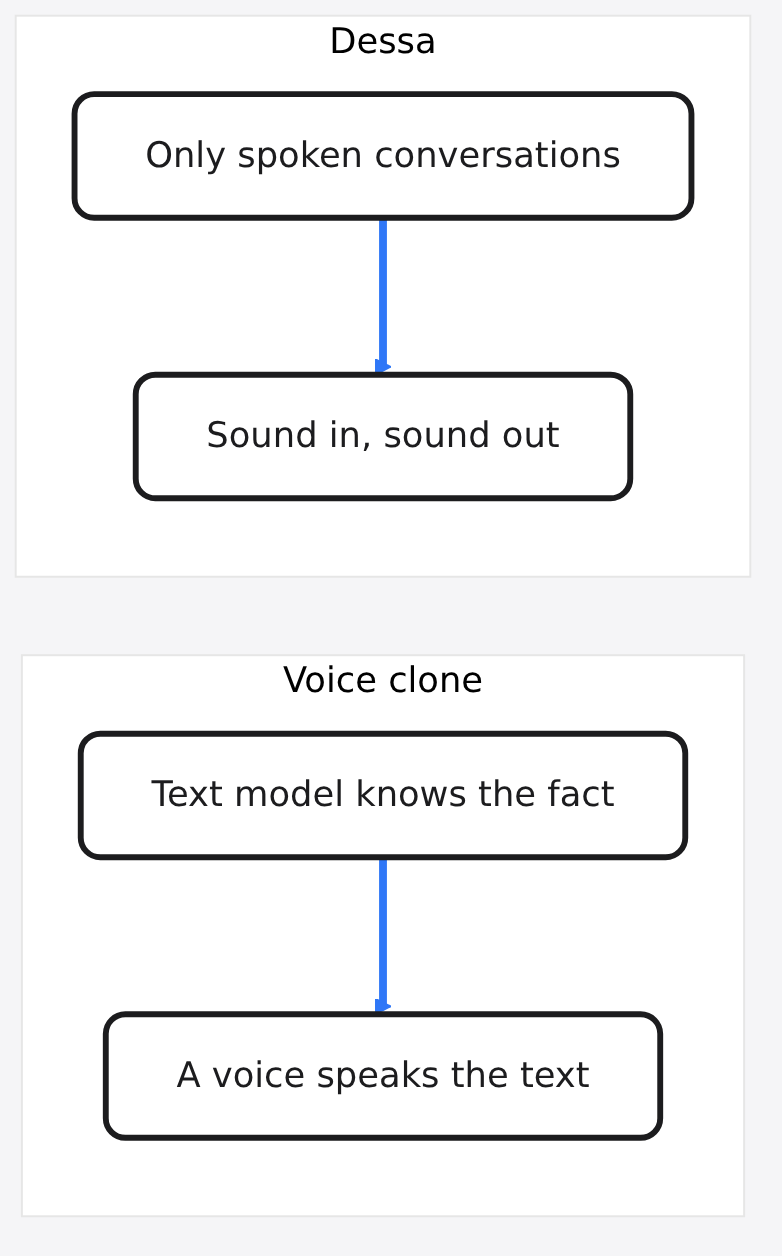
Use that when you judge the next demo reel. If the demo is a story, a joke, a gasp, an interruption, you are seeing the thing the architecture can actually do. If the demo is “it explained my codebase,” ask where the codebase entered a model that never read.
What you can do with it today
Almost nothing, on purpose.
- You cannot download weights.
- You cannot call an API.
- You can watch the clips on block.xyz/dessa.
- If you do safety research at a lab, company or university, Block asked you to write from that email address. They want outside eyes before a wider launch.
- There is no price, no date, and no promise it will be open.
Do not “switch your voice stack to Dessa” this week. There is no stack to switch to. What you can switch is your explanation, the next time a voice product feels like a walkie-talkie. It is waiting because a text model is in the middle, and a text model cannot hear you while it is talking.
A ten-line version you can say out loud
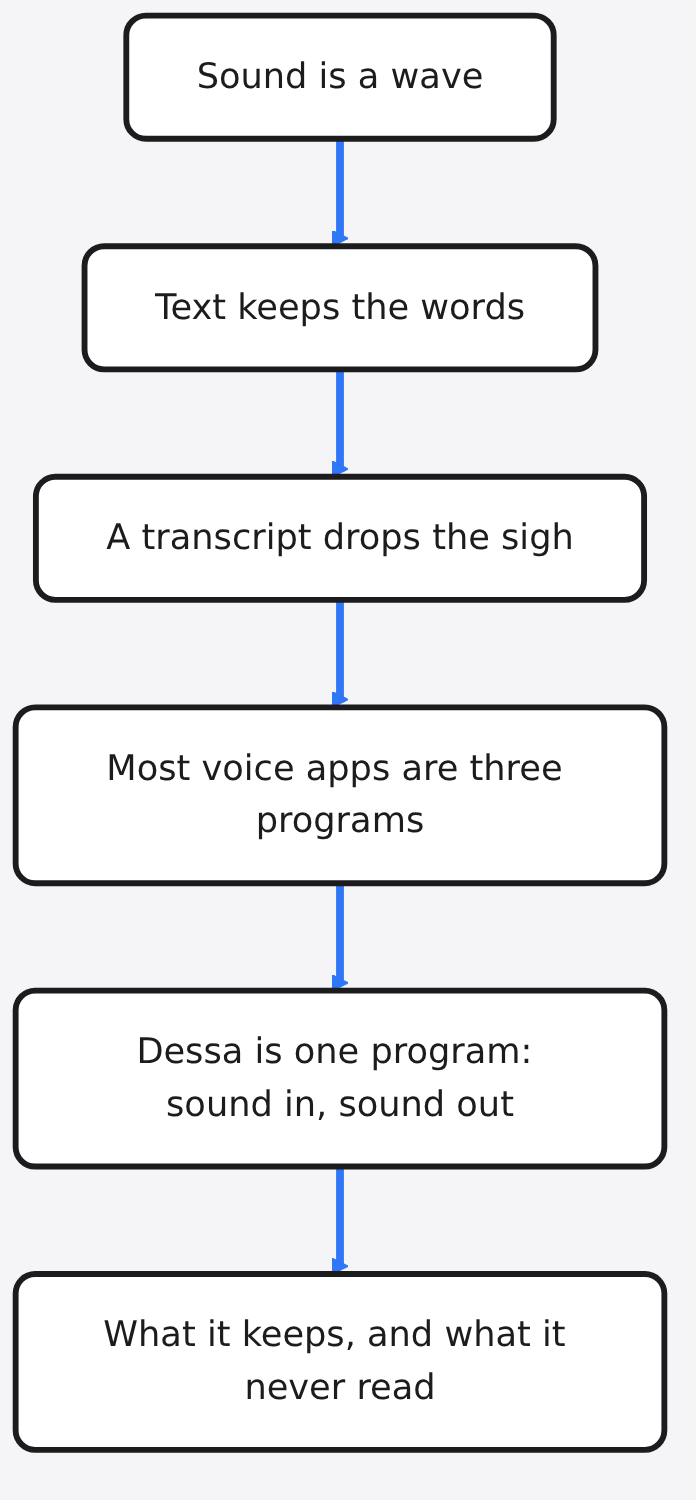
- Sound is a wave. A computer stores it as a long list of heights.
- Text keeps the words and drops the sigh, the laugh and the timing.
- Most voice apps do speech-to-text, then a text model, then text-to-speech.
- That pipeline is half-duplex. It cannot listen while it talks.
- Full-duplex means both directions at once, like a phone, not a walkie-talkie.
- Dessa is Block’s speech-to-speech model, announced 23 October 2026.
- Block says it was trained on conversation audio only, on one GB200 NVL72 rack.
- Block says the finished model runs on a MacBook Pro M4 Max or better, faster than real time.
- The public evidence is clips Block chose, including at least one wrong guess about who was speaking.
- No paper, no size, no hours, no consent statement, no weights. The feature and the limit are the same fact: it never learned to read.
Common questions about Dessa
What is Dessa?
Dessa is a speech-to-speech model from a small lab inside Block. Block says it was trained from scratch on human conversation, with no text and no pretrained models. It is a research preview.
Can I download or run Dessa?
Not yet. It is a research preview, not a product you can download. Block says it runs locally on a MacBook Pro with an M4 Max or better.
How is Dessa different from most voice assistants?
Most voice AI chains speech to text, a text model and text to speech, and waits for you to finish. Dessa takes audio in and gives audio out, and Block says it listens and talks at the same time.
Has Block published benchmarks for Dessa?
No. Block has not published a paper, a model size, a dataset size, a license or a benchmark. The clips on its page are recordings Block chose.