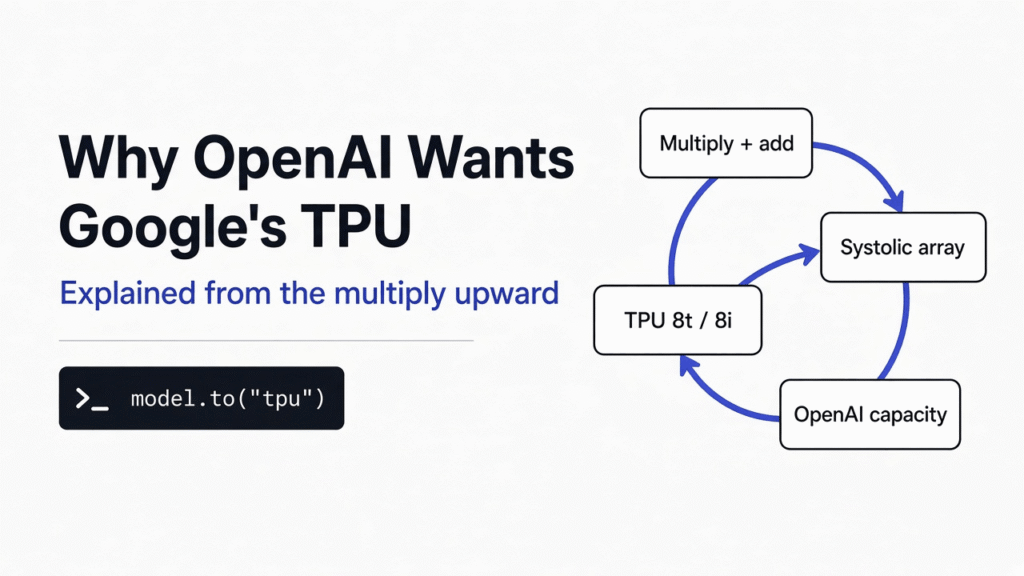
On Tuesday night, The Information reported that OpenAI plans to buy artificial-intelligence chips from Google: the TPUs Google designs for its own data centers. Reuters carried the report. On Wednesday morning, Bloomberg reported the same plan, from its own unnamed source. Neither company has confirmed it. No price, no chip count, and no delivery date is public. OpenAI declined to comment.
That is the whole news. It is still worth your time, because the sentence is useless until you know what is being bought. The rest of this piece builds that, from one multiplication upward, and then comes back to the headline.
Start before the chip
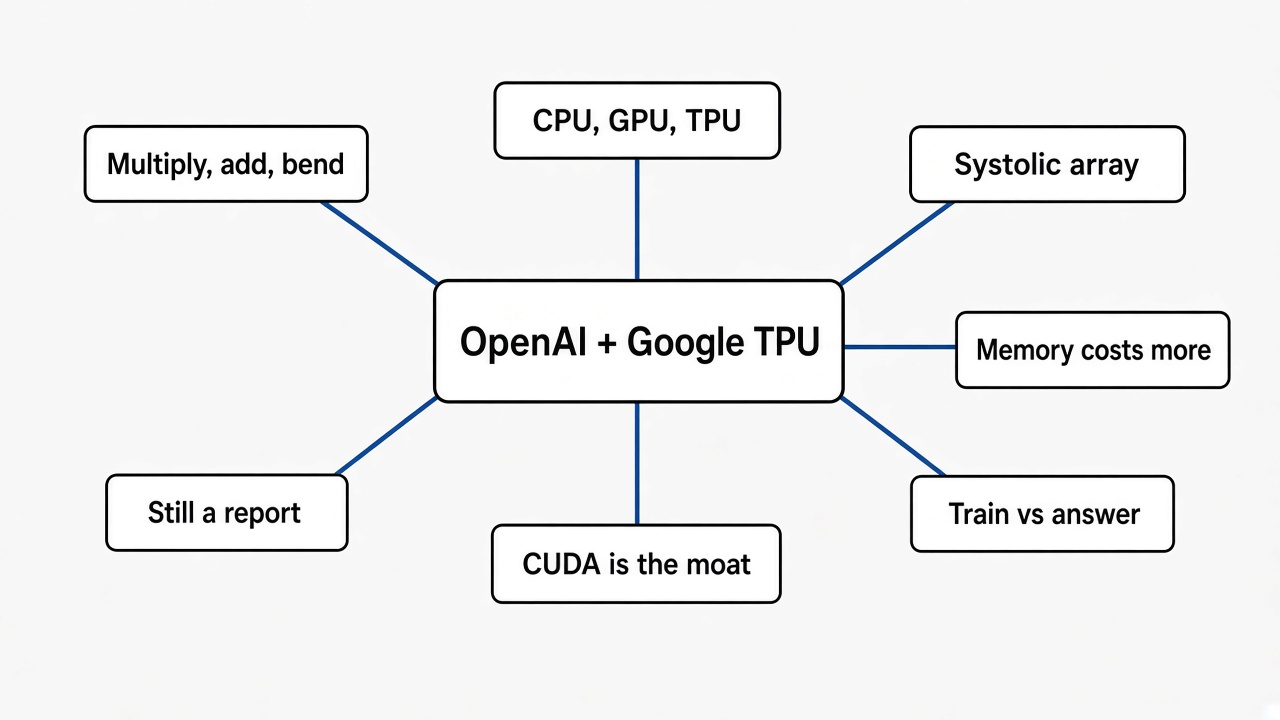
A computer does not understand a sentence. It stores numbers and follows steps. Most of the steps inside a modern AI model are not clever logic. They are arithmetic, the same arithmetic, an outrageous number of times.
A neural network (a stack of number-grids that turns an input into an output, tuned by examples instead of by handwritten rules) is mostly this recipe:
Take a number coming in. Multiply it by a weight (a stored number that says how much that input should count). Add those products together. Then bend the total a little.
That bend is an activation (a simple rule applied after the sum, for example “if this is negative, make it zero”). The bend is cheap. The multiplies are the bill. ChatGPT answering you, Gemini answering you, and a search ranker deciding which link goes first are, down at the metal, oceans of multiply-then-add.
The only object these chips care about
Before the acronym, the object. A tensor (a block of numbers with a shape: a row is a vector, a grid is a matrix, a stack of grids is a bigger tensor) is just organized numbers. Nothing mystical.
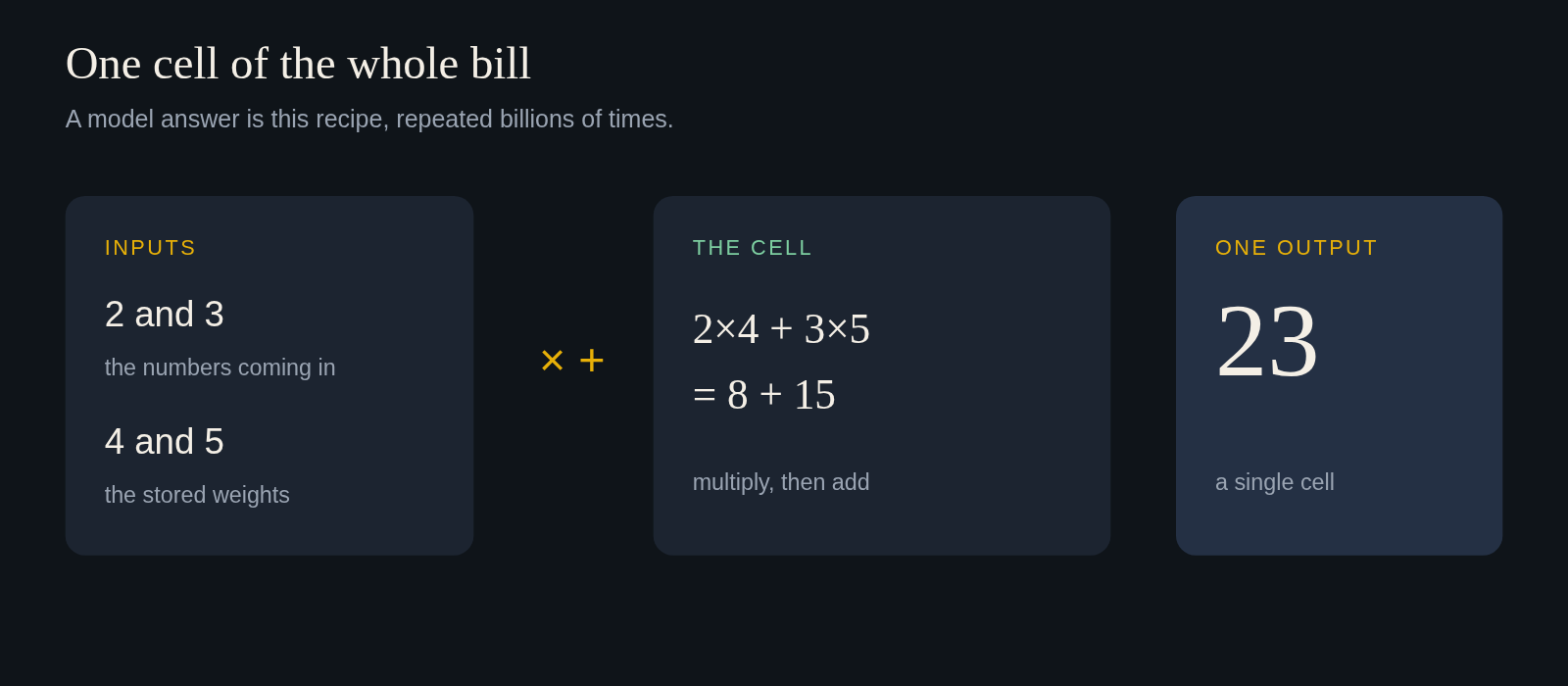
The operation that eats the electricity is matrix multiplication (combining two grids into a third, where each new cell is one row times one column). Here is one cell, small enough to do by hand. The row is 2 and 3. The column is 4 and 5.
2 times 4, plus 3 times 5, is 8 plus 15, which is 23.
That 23 is one cell of one grid. A frontier model does a version of this with grids thousands of cells wide, and it does it billions of times while it is learning, and again every time it answers. A chip for this job is a machine for producing those cells as fast and as cheaply as possible.
Three machines, and what each one refuses to do
You need three ordinary words before the headline’s abbreviation makes sense.
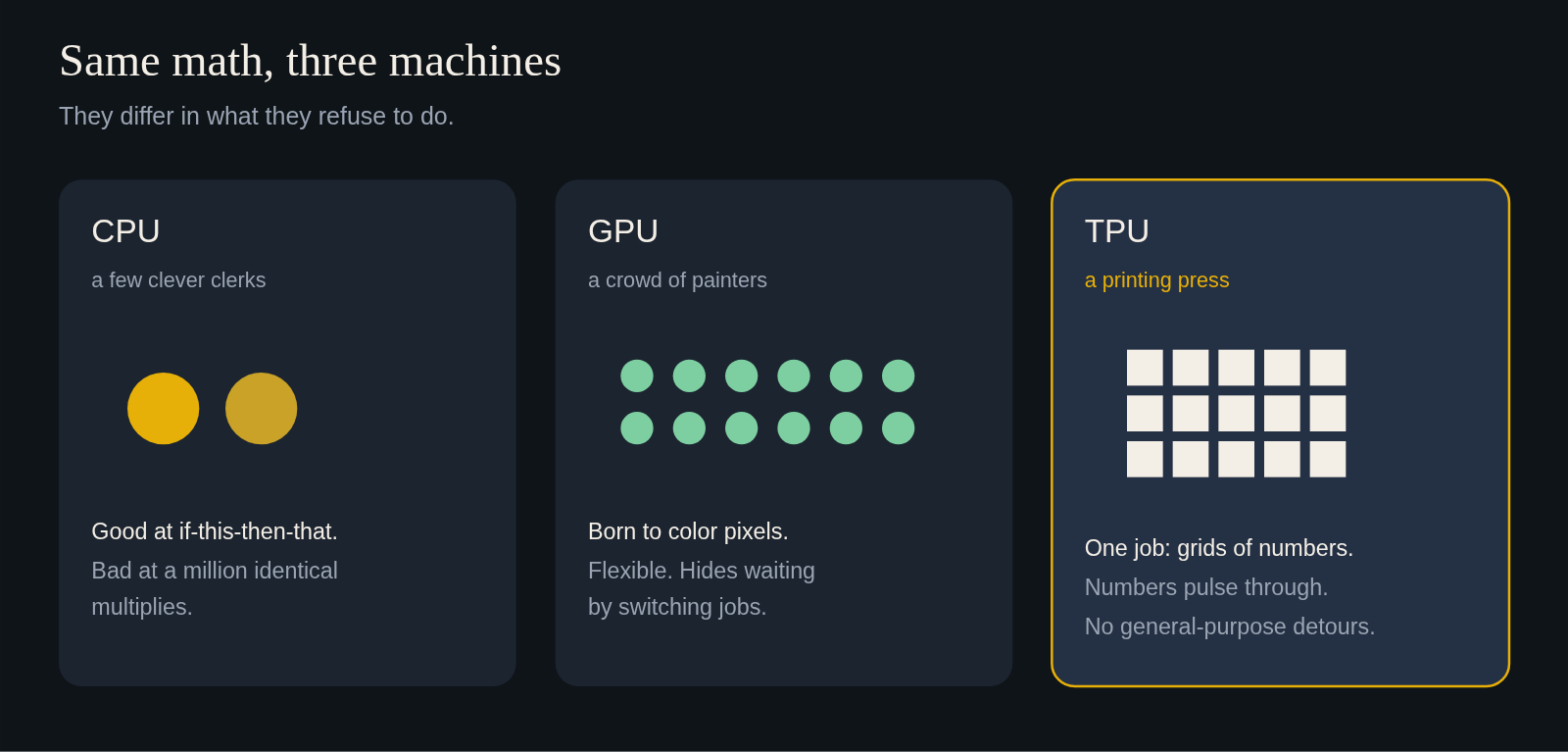
A CPU (central processing unit: the general clerk in a laptop or a phone) has a few very expensive cores. It is wonderful at “if this, then that,” at jumping around a program, and at talking to a keyboard. It is a bad factory for a million identical multiplies, because each core spends energy deciding what to do next.
A GPU (graphics processing unit: a chip invented to color pixels) grew up differently. A screen is millions of dots that can be painted at the same time, so a GPU is a crowd of small, simple workers. Neural-network math looks a lot like painting: one small instruction, a huge amount of data. Nvidia leaned into that and added tensor cores (tiny blocks inside the GPU that only multiply small grids, using shorter, rougher numbers so more math fits).
A TPU (tensor processing unit: Google’s name for a chip that refuses to be general) goes further. It throws away a lot of what makes a CPU clever. Branch prediction (guessing which way an if-statement will go), a big automatic cache (fast on-chip memory that guesses the next number you will need), and speculative execution (starting work before you are sure you need it) all exist because ordinary programs are unpredictable. A neural network’s math is predictable. A compiler can schedule it in advance. What remains is a factory for those grids.
The heartbeat inside the factory
In 2013 Google’s engineers did a frightening sum. Neural networks were growing so fast that, if they stayed on ordinary chips, Google might have to double the number of data centers it ran. An ASIC (application-specific integrated circuit: a chip printed for one job, not a general computer) usually takes years. Google says it designed, verified, built, and deployed the first TPU in 15 months. The tech lead was Norm Jouppi, one of the architects of the old MIPS processor.
The heart of that chip is the MXU (matrix multiply unit: the block that does the grids). It is a systolic array (a grid of tiny calculators that tick together and pass numbers to their neighbors, the way a heart squeezes blood in a wave). The first one was 256 by 256 cells. That is 65,536 multiply-adds in lockstep.
Each tick, a cell does three dull things. It multiplies the two numbers it is holding. It adds that product to its running total. It passes the numbers on, one to the right and one down. Nobody calls a meeting. The numbers are read from memory once, then they ride the wave.
Google’s own picture of this, from its write-up of that first chip: it is like printing a whole page at once, instead of one character at a time. The tradeoff, also Google’s, is that the array is a poor general computer. It bought density by giving up flexibility.
Loop back to Tuesday. OpenAI is not “buying Google’s brain.” If the report is right, it is trying to buy more of these waves.
Moving the numbers costs more than multiplying them
A FLOP (floating-point operation: one multiply or one add on a number with a decimal) is cheap now. Fetching the number from memory is the expensive part, in time and in electricity. That is why these chips are wrapped in unusual memory.
HBM (high-bandwidth memory: memory chips stacked beside the processor, so the pipe between storage and math is very wide) exists for that reason. SRAM (static memory sitting on the chip itself, even closer than HBM, and much smaller) is the handful of numbers you want in your hand, not in the next room.
The same memory-versus-math squeeze shows up at home scale when you run a 70B model on a 4 GB GPU: the card is not short of multipliers, it is short of room for the numbers.
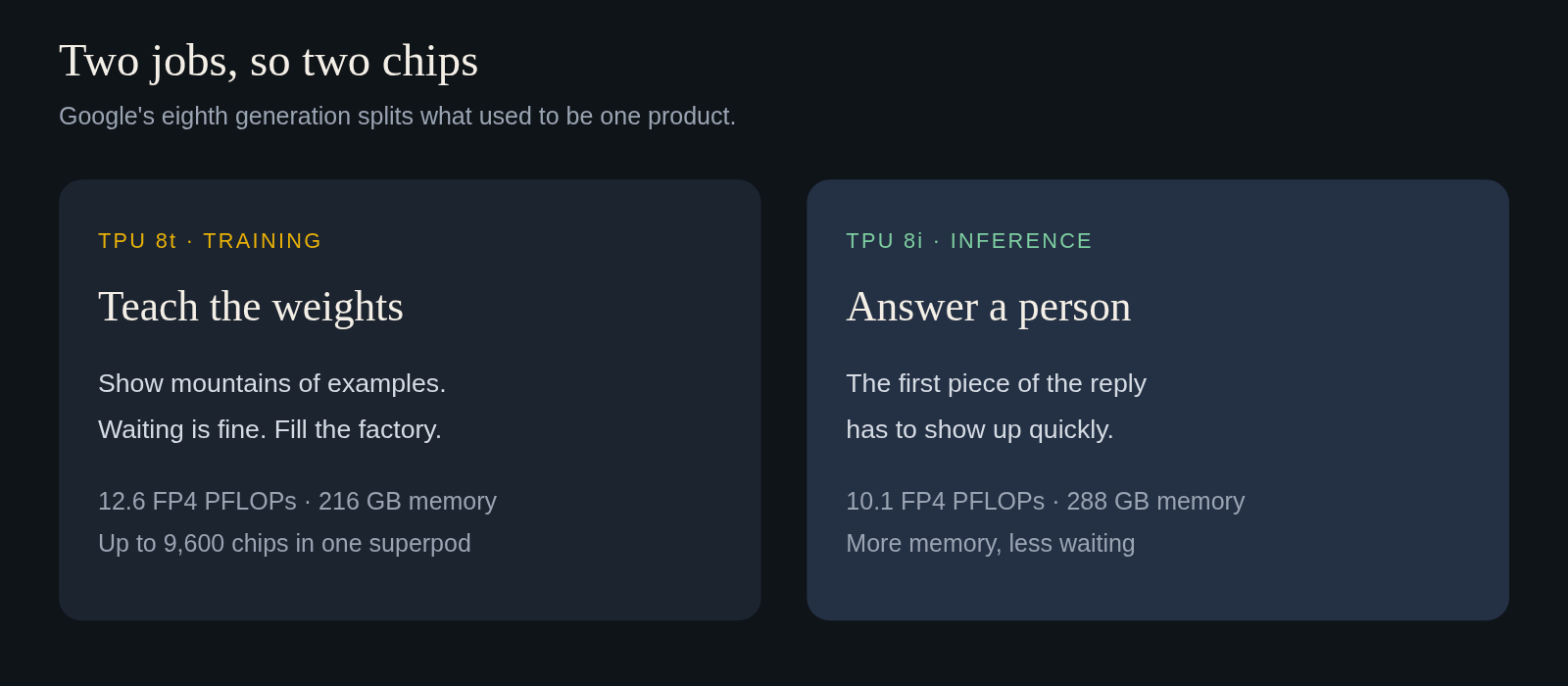
Google’s Cloud blog, published 22 April 2026, gives the eighth generation as two different chips. These are peak figures on a short number format. Read them as “how wide the factory is,” not as “how fast your answer arrives.”
FP4 (4-bit floating point: a very short way of writing a number, rough on purpose, so more math fits in the same silicon and the same memory) is the format those peaks use. A PFLOP (petaflop: a million billion of those operations a second) is the unit. 12.6 PFLOPs is the ceiling, on that rough format, not the speed of a chat.
| TPU 8t, for teaching a model | TPU 8i, for answering | Source | |
|---|---|---|---|
| Peak compute | 12.6 FP4 PFLOPs | 10.1 FP4 PFLOPs | Google Cloud, 22 April 2026 |
| High-bandwidth memory | 216 GB at 6,528 GB/s | 288 GB at 8,601 GB/s | same |
| On-chip SRAM | 128 MB | 384 MB | same |
| How they cluster | up to 9,600 chips in one superpod | up to 1,024 active chips, 36 groups, optical switches | same |
An optical circuit switch (a switch that steers light, so groups of chips can be rewired without a truck full of cables) is how the answering pods are linked. I am not quoting interconnect speeds here. Secondary write-ups disagree on bits versus bytes, and the disagreement is an 8-times error. The memory numbers above are the ones Google printed in GB and GB/s.
Teaching and answering are different jobs
Training (showing the model mountains of examples and nudging every weight so the next guess is less wrong) wants raw throughput. You can wait hours. You want every cell busy.
Inference (using a finished model to answer one person) wants the first token fast. A token (a chunk of text, often a piece of a word, not a whole word; models write by emitting these one after another) is the unit of that stream. A person staring at a blinking cursor feels a five-second pause. A training run does not.
Google split the eighth generation on purpose. The 8t is the teaching factory. It has a SparseCore (a side engine for messy lookups, so the neat multiply grid is not stuck doing irregular work). That matters for embeddings (giant tables that turn a word, a user, or a product into a list of numbers) and for a mixture-of-experts model (a huge model that only wakes a few specialist slices for each question). The 8i is the answering chip: more memory close by, less waiting, aimed at multi-step reasoning and long context (keeping a very long document in mind at once).
Google also claims “up to 2.7 times” the training performance per dollar of its previous Ironwood TPU, and “up to 80 percent” better performance per dollar on low-latency inference. Those are vendor claims. “Up to” is doing a lot of work.
Nvidia’s real moat was never only the silicon
A GPU can do this math too, and Nvidia’s chips still lead on flexibility. On many interactive workloads they also lead on how fast the first token comes back. Memeburn’s reading of a SemiAnalysis model from September 2026, comparing the previous Ironwood TPU with Nvidia’s B200 and B300, is the cleanest public picture of the trade I could find. It is a model of one serving setup, not an invoice, and it is not about the eighth generation.
| At the stated setup | Ironwood (Google) | B200 (Nvidia) | B300 (Nvidia) |
|---|---|---|---|
| Estimated cost per million tokens, at 100 tokens a second per user | USD 0.181 | USD 0.222 | USD 0.276 |
| Seconds to the first token, 256 people waiting | 5.41 | 3.75 | 2.40 |
Cheaper per answer. Slower to start talking. That is the product argument in two rows. Do not promote it to “TPUs are 30 percent better.” Change the setup and the winner can move. And Ironwood is the previous generation, not the chip in this week’s rumor.
The deeper moat is software. CUDA (Compute Unified Device Architecture: Nvidia’s software stack; almost every lab’s code assumes it) is why a model written as “send this to the Nvidia chip” does not run on a TPU.
Google’s compiler is XLA (Accelerated Linear Algebra: the program that turns neural-net math into TPU instructions). On 20–21 October 2026, Google and Meta’s PyTorch team open-sourced TorchTPU. PyTorch (the Python library most researchers use to describe a model) can now say .to("tpu") instead of .to("cuda").
Google’s own caveat, in that same post: the one-line change makes the model run. It does not make it fast. Shapes, sharding (how you slice one model across many chips), and the operations themselves may still be tuned for a GPU. A TPU tensor core is effectively single-threaded and wants wide grids. A GPU has many small cores and is happy launching lots of small jobs. Switch the number format up to higher precision and Google says the cost can be several times worse.
So “OpenAI will just switch” is false. Trade coverage of The Information’s story says OpenAI has posted roles for engineers to optimize frontier models on TPUs, and that The Information reads the work as early. I did not open the listing, so I am not quoting it.
Now read the week again, in order
Hold the chip knowledge and the headline changes shape.
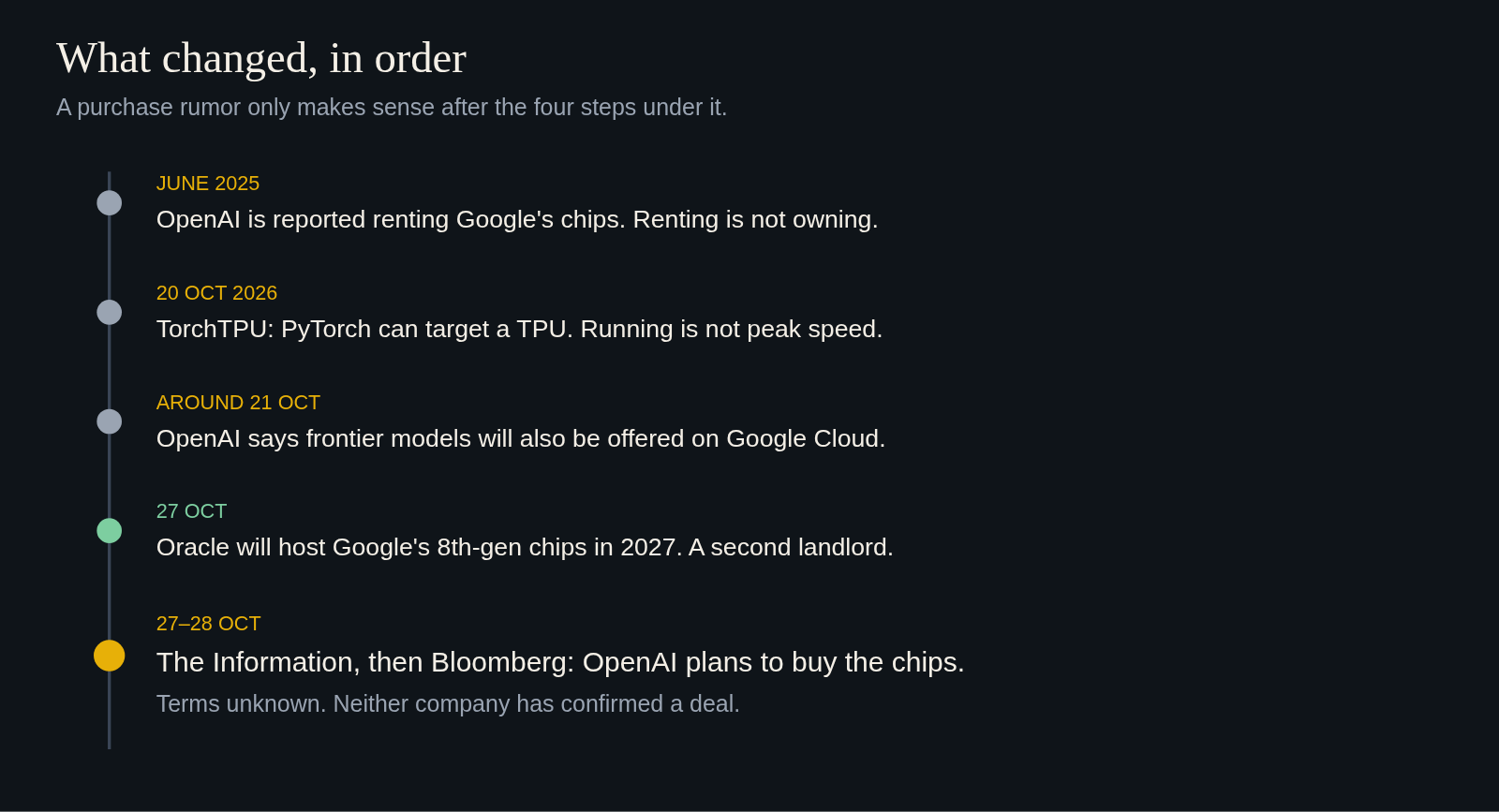
OpenAI has been renting Google TPUs through Google Cloud since a Reuters report in June 2025. Renting means Google owns the machines and OpenAI pays for time.
Around last week, Reuters says, OpenAI said its frontier models would also be available through Google Cloud. That is distribution. It is not a chip purchase.
On 20–21 October, TorchTPU landed. The software door got less stuck. It did not disappear.
On 27 October, Oracle and Google said eighth-generation TPUs will be offered on Oracle Cloud starting in calendar year 2027. That is the first time a major cloud other than Google hosts them. Until now, wanting a TPU mostly meant being a Google Cloud customer. A second landlord changes the negotiation, even before anyone signs with OpenAI.
Late on 27 October, The Information reported the purchase plan. On 28 October, Bloomberg matched it. Terms unknown. OpenAI declined to comment. Google did not confirm the report.
In the background, OpenAI is also designing its own chip, reported under the name Jalapeno, with Broadcom, aimed at later this year. A company building its own chip and still shopping for a rival’s chip is telling you the in-house one is not yet the whole plan. I am not saying Jalapeno is late. I am saying a second source is what you arrange when one source is not enough.
Buying, if the report is right, is a different relationship from renting. It is capacity you can plan a year against, closer to how a big lab procures Nvidia systems. It is also a bet that Google’s software stack will be good enough to use at OpenAI’s scale.
The money, without the fan fiction
Reuters, in the same story: Amazon, Microsoft, and Google’s parent Alphabet plan to spend as much as USD 600 billion combined this year on AI infrastructure. Investors are asking when that spending becomes profit. Alphabet reports earnings later on Wednesday. People will listen for cloud growth, and for any word on TPU sales.
Alphabet’s chief financial officer, Anat Ashkenazi, has already said the company expects to recognize only a small percentage of revenue from TPU sales agreements by the end of this year, with the vast majority in 2027. Even a real OpenAI purchase would mostly show up on next year’s line, not this quarter’s.
Google has been selling TPUs directly to some customers this year. Reporting on Alphabet’s 22 July 2026 call says the company delivered TPU systems into customer data centers for the first time that quarter. Anthropic, which competes with both OpenAI and Google on models, is already a major TPU customer. The chip line is no longer an internal tool that accidentally leaked. It is a product. OpenAI would be the loudest logo on it, not the first.
I am leaving out giant dollar figures for Anthropic’s TPU commitments that circulated on social media today. They were not in the Reuters, Bloomberg, or Google material I could check, and several of those posts were labeled as written by AI. A big number with no document is not a fact.
What to believe on Wednesday afternoon
Believe this.
The reported plan is real as reporting. Two serious outlets, the same day, unnamed sources. That is a strong rumor. It is not a contract.
The strategic logic is obvious once you know the machines. OpenAI needs more multiply-add factories. Nvidia is the default, and the expensive one, and the one the software already fits. Google built a narrower factory that can be cheaper per answer, and it is finally willing to let other people plug it in, including a rival cloud in 2027.
Software, not silicon, decides whether a purchase is useful. TorchTPU opened a door on 21 October. Peak speed is still a porting project. The reported job ads are that project.
Do not believe this.
That a price, a chip count, or a delivery date exists. Nobody published one.
That Nvidia is displaced. A second supplier is leverage. Leverage is not a coup.
That TPUs are “faster.” On the best public comparison I could find for the previous generation, they were cheaper per token in one serving model and slower to the first token.
If you remember one picture: a CPU is a clever clerk, a GPU is a crowd of painters who learned accounting, and a TPU is a printing press that only prints one kind of page. OpenAI already rents the press. This week it was reported to be trying to buy one, from the company whose chatbot it is trying to beat.
Common questions about OpenAI and Google TPUs
Is OpenAI buying Google’s TPUs?
It is reported, not confirmed. The Information and Bloomberg reported the plan on 27 and 28 October 2026. Neither company has confirmed it, and no price, chip count or delivery date is public.
What is a TPU?
A tensor processing unit is Google’s chip built for one job: the multiply-and-add grids inside neural networks. It gives up general-purpose flexibility to fit far more of that math.
What is the difference between TPU 8t and TPU 8i?
The 8t is built for training, with up to 9,600 chips in one superpod. The 8i is built for answering, with more on-chip SRAM and more high-bandwidth memory so the first token comes back sooner.
Can OpenAI just move its models from Nvidia to TPUs?
Not quickly. Most lab code assumes Nvidia’s CUDA. TorchTPU lets PyTorch target TPUs with a small change, but Google says making a model fast there is still porting work.