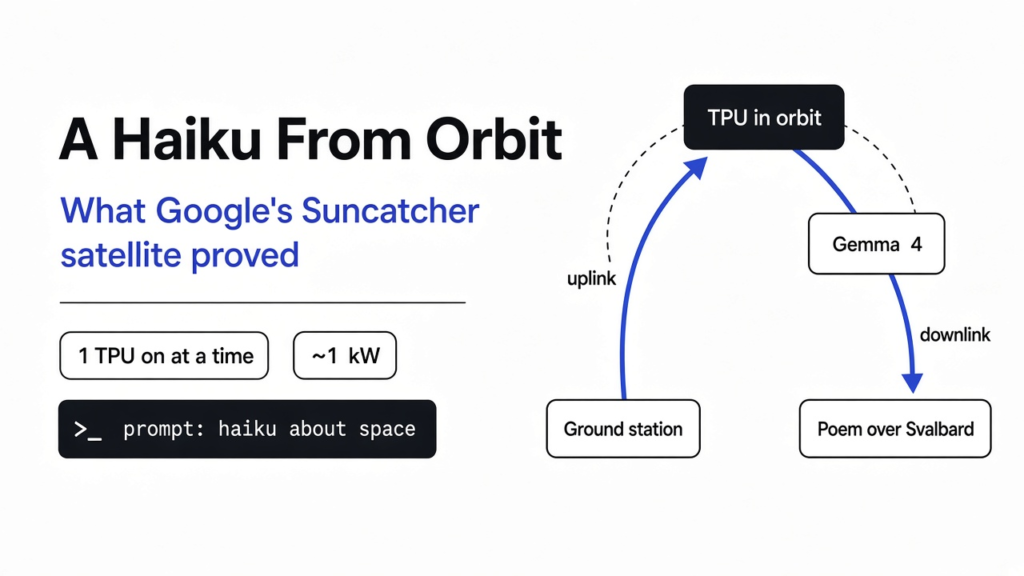
Short answer: On 30 October 2026, Google’s Project Suncatcher satellite sent back its first complete AI answer from orbit: a haiku written by the Gemma 4 open model running on a data-center-class TPU. The Project Suncatcher haiku proves the whole chain worked once. It does not prove the chip survives heat or radiation. Google says those tests come next.
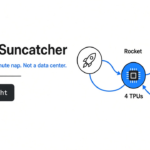
On launch day this site explained what four chips and a short power budget can and cannot be, in four chips and a fifteen-minute nap. This is the result that piece said to wait for. It is smaller than the headlines, and more specific.
On 30 October, Travis Beals, senior director of Paradigms of Intelligence at Google, posted that the prototype had returned its first AI response from orbit. The same day Sundar Pichai, Google’s chief executive, called it a hello world milestone and listed the steps: send a command up, boot the TPU, run the prompt, get a complete response back on Earth. The answer was a three-line poem.
Checked against Google’s 1 and 30 October posts, Sundar Pichai’s X post and TechCrunch’s 30 October report on 31 October 2026.
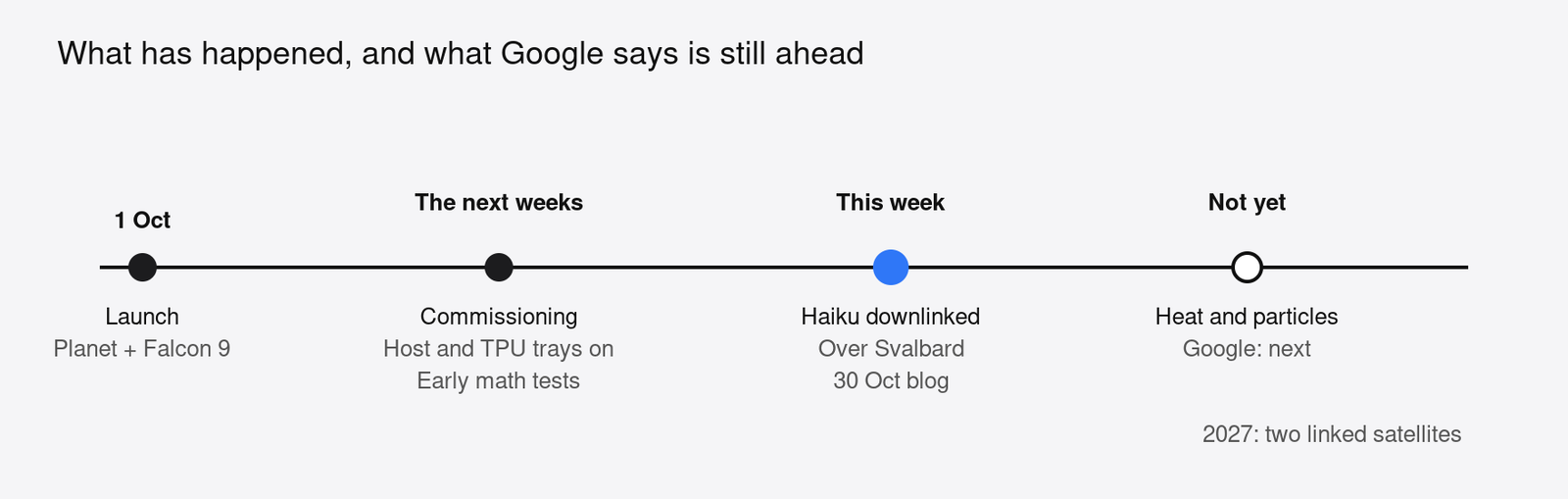
What Google’s 30 October post actually says
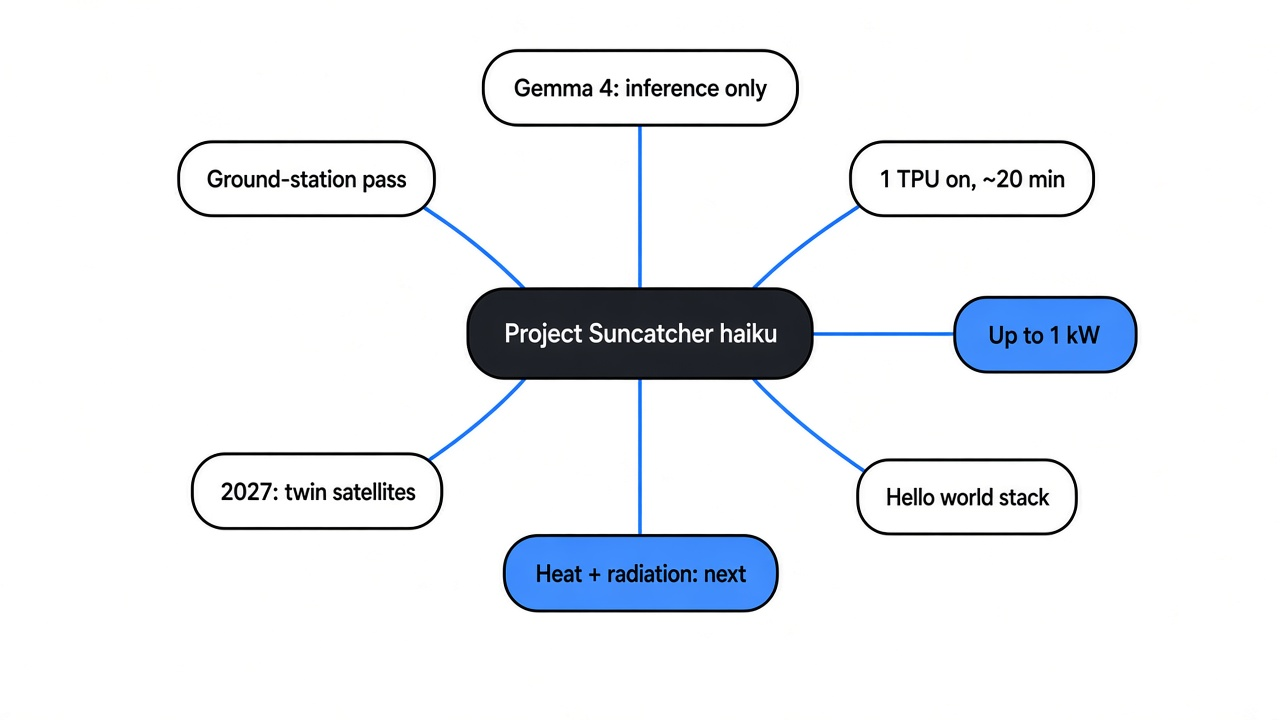
Read the post in order, not the screenshot of the poem.
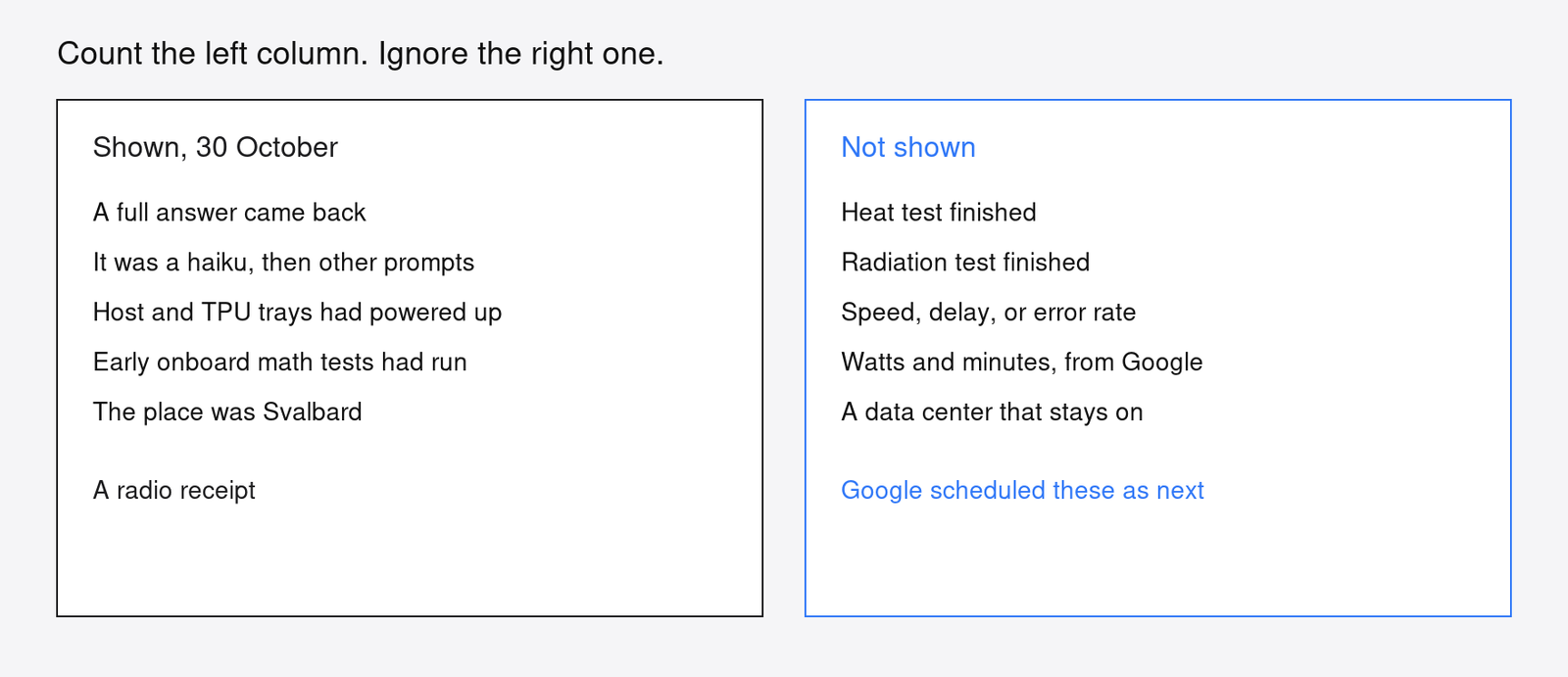
Google’s 1 October post says the satellite was built in partnership with Planet and launched on SpaceX’s Transporter-18 rideshare (one rocket carrying many customers’ satellites; TechCrunch counts more than 100 other spacecraft on that Falcon 9). The weeks after launch were commissioning (the checkout: turn each part on and see if it still works after the shake of launch). Beals says the team powered up the host and the TPU trays and successfully ran early machine learning tests. Those tests are not the public poem. The poem is the first time a full answer came back to Earth.
Then the sentence the headlines cut. Next, Beals writes, the team will test how the TPUs perform under thermal stress and radiation exposure in orbit. Next means not done. The poem is the receipt that the machine can speak. It is not the report card for heat, and it is not the report card for particles.
Four public sources cover this week, and each one adds something different:
| Source | What it adds | What it leaves out |
|---|---|---|
| Google blog, 30 October (Beals) | Gemma 4 on board, the haiku over Svalbard, limerick and telemetry prompts, heat and radiation tests next, twin satellites in 2027 | Chip count, watts, minutes, speed, error rate |
| Sundar Pichai on X, 30 October | The four steps: command up, TPU boot, prompt run, complete answer down | Any measurement |
| TechCrunch, 30 October | Four TPUs, one on at a time, up to 1 kW, about 20 minutes per run, about three weeks of commissioning, “operating nominally” | The telemetry readings themselves |
| Google blog, 1 October | Built with Planet, Transporter-18 rideshare, contact confirmed | Orbit and altitude |
A satellite can only talk while a dish can see it
A satellite is not hovering. It is falling around the Earth, moving sideways so fast that the curve of its fall matches the curve of the ground. That path is an orbit (a closed fall that never hits the ground).
A radio dish on the ground can hear it only while it is above the horizon. Those minutes are a pass (one visit, from rising to setting). The message you send up during a pass is an uplink (ground to sky). The message that comes back is a downlink (sky to ground). Outside the pass, nobody is listening, no matter how clever the chip is.
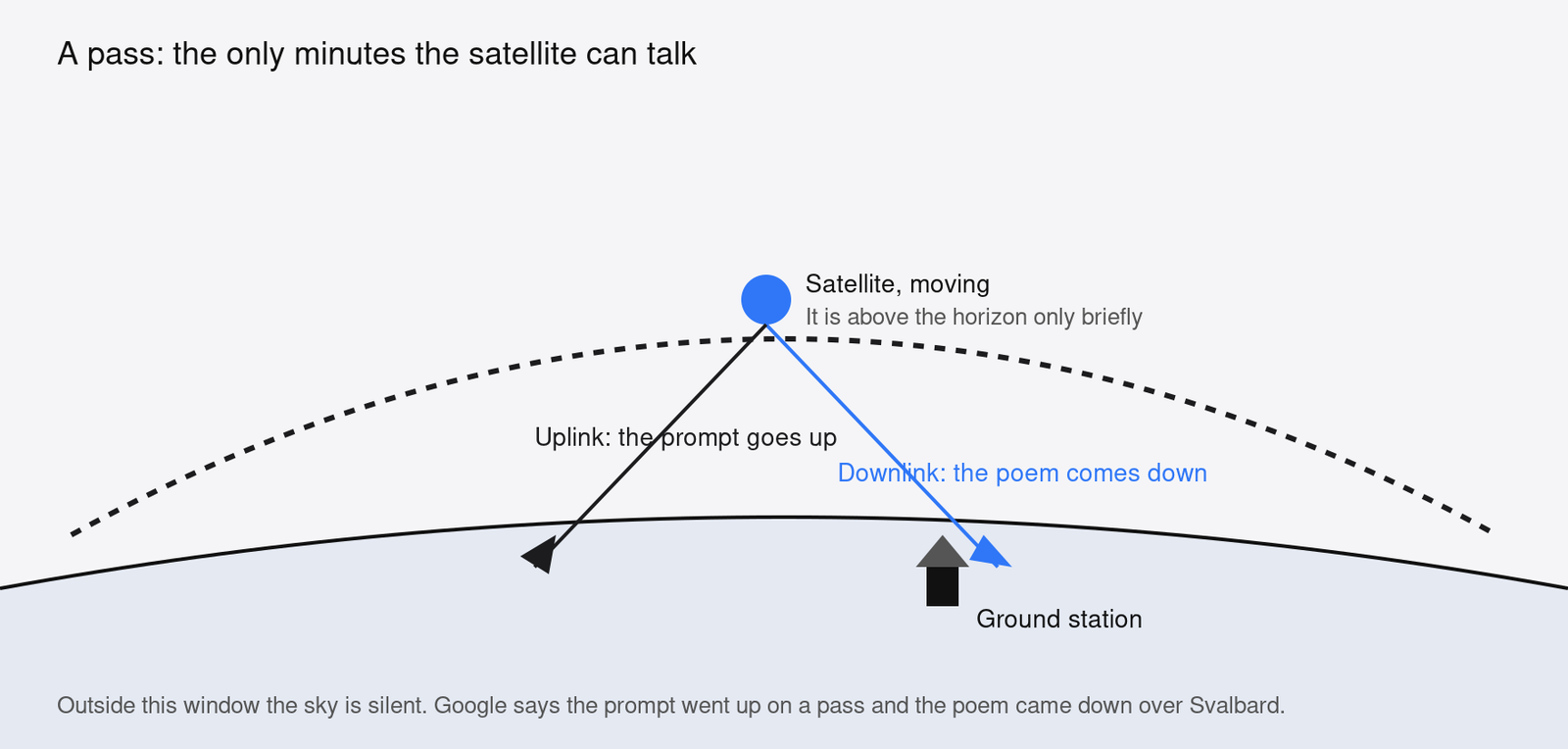
Google says the first prompt went up during a ground-station pass, and the poem came down as the satellite passed Svalbard, Norway. Google has not published which dish, how long the pass lasted, or how many seconds sat between the question and the poem.
Svalbard is an Arctic archipelago at about 78 degrees north, and Svalbard Satellite Station sits on a plateau above Longyearbyen. A satellite whose path runs near the poles crosses that high Arctic on almost every lap, roughly 15 times a day in low orbit, so a dish there sees it often. A dish near the equator sees the same kind of satellite far less. Google’s post names the island, not the orbit or the altitude, and it does not say which dish on the island caught the poem.
The poem is a receipt that a finished file ran
Start from the file, not from the word intelligence.
A chatbot, stripped down, is a huge file of numbers plus a short program that uses those numbers to guess the next piece of text. That file is a model (the learned numbers, frozen). The pieces of text it guesses one at a time are tokens (chunks, often a word or part of a word).
Gemma 4 is the model Google says was already on the satellite. It is an open model (the numbers are published, so the file can run somewhere other than Google’s website). Open does not mean the satellite taught itself. The teaching already happened on Earth, before launch.
Before launch, coverage of the flight, including this site’s launch-day piece citing the New York Times, said these chips were there to run simple Gemini queries. Gemini is Google’s closed model family, the one on the website. The answer that actually came down was from Gemma 4. Same company. Different file. Google’s 30 October post is the one to trust.
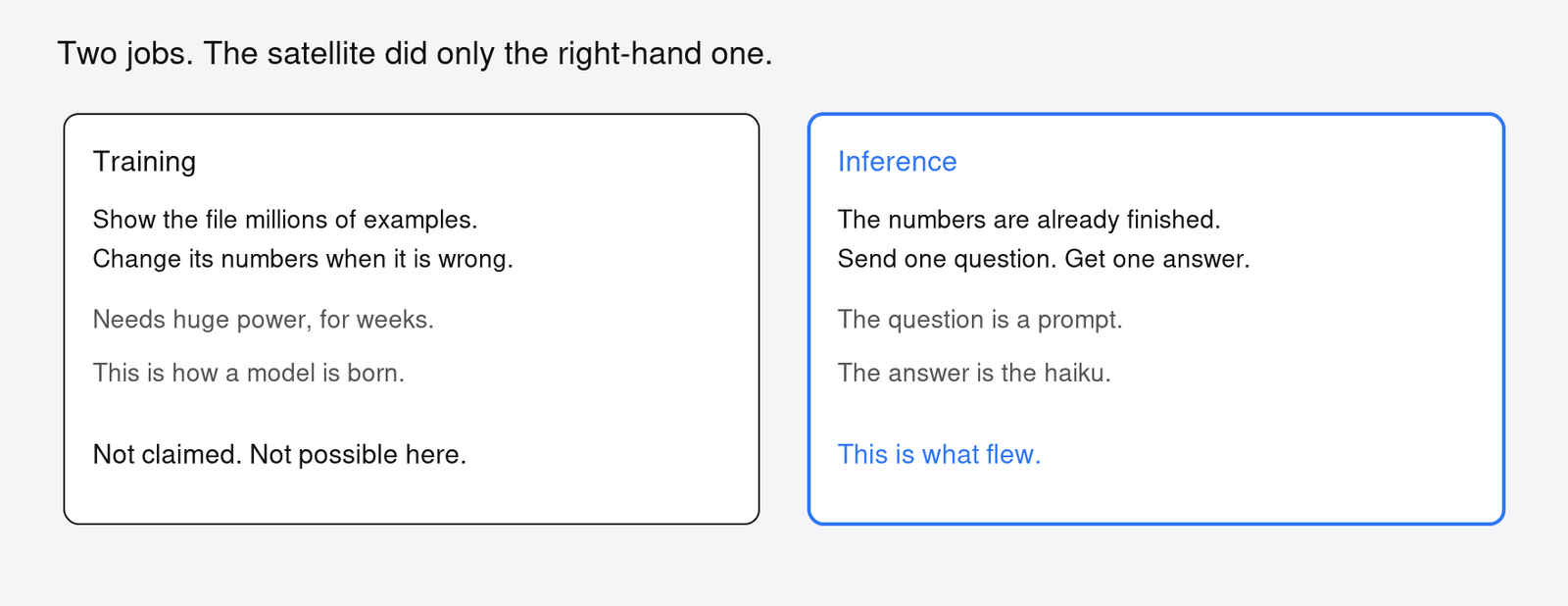
Using a finished file to answer one question is inference (read the numbers, do not change them). Changing the numbers by showing the file mountains of examples is training (the file is still being rewritten). Training wants power for days or weeks; even a tiny model trained from scratch keeps a machine busy far longer than one answer does. This satellite did the first job. Google has not said it did the second, and one chip at a time on up to 1 kW is not built for it.
The question they sent is a prompt (the text that goes in). They asked for a haiku about being in space. A haiku here is just a very short poem in three lines. Short is the point. A person can see that a whole answer arrived, with nothing chopped off the end.
The lines, as Google printed them:
Blue marble below
Data streams in silent grace
Starlight feeds my core.
Google’s post ends the poem with a sparkle emoji. The words above are exact.
After the poem, Beals says they tried space-themed limericks (another short poem shape, five lines, usually a joke) and telemetry prompts reporting the technical status of the payload systems. Telemetry is the satellite reporting its own body: temperatures, voltages, whether a box is healthy. Those are better tests than a poem. A poem could, in theory, have been written on the ground and replayed from storage. A fresh instrument reading is harder to fake, because the asker can compare it with what the radio already knows about the craft. Google did not publish those readings. The stronger test was run. The public still only has the poem.
The first line of the poem is not a photograph this satellite took. The Blue Marble is the nickname of the picture the Apollo 17 crew took on 7 December 1972, on the way to the Moon. A language model repeats pictures people already know. That is what the file was built to do.
What a data-center-class TPU is, in one job
An ordinary computer chip is asked to do many kinds of work. The work inside a language model is mostly multiplying big grids of numbers, over and over. Those grids are tensors (the old word for a grid of numbers). Google built a chip that does that multiplication and little else. That chip is a TPU (tensor processing unit), and why OpenAI wants to buy Google’s TPUs walks through that multiply-first design from the bottom up.
Data center class means this is the family of chips Google puts in its buildings on Earth, not a tiny chip designed for a phone. A data center is the building: rows of machines that stay on, with power and cooling sized for that. Four chips that have to rest are not that building. Google’s phrase is about the kind of chip. It is not a claim that a data center is now in orbit.
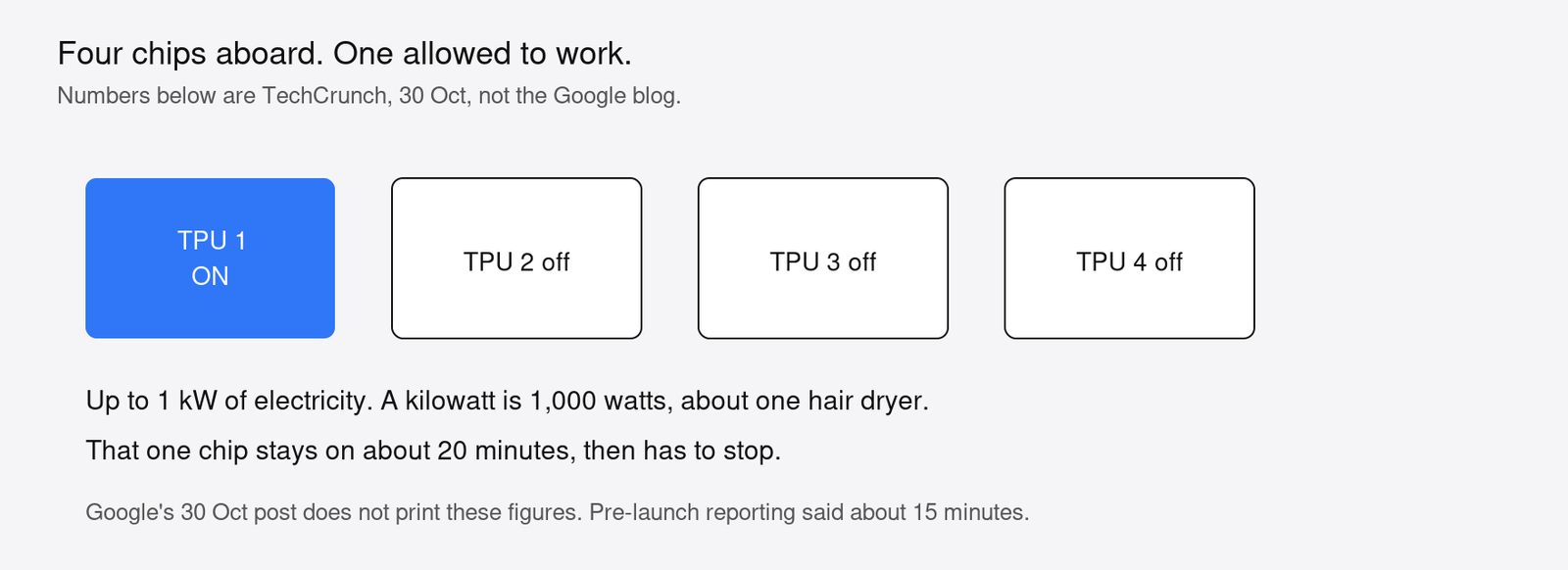
Google’s 30 October post does not say how many chips, how many watts, or how many minutes. Those numbers are in Tim Fernholz’s TechCrunch story the same day, which prints a correction: four TPUs are on board, and only one can run at a time. The story says the craft generates up to 1 kW, and that the TPU’s power demands mean it can turn one on for only about 20 minutes at a time. A kilowatt (kW) is a thousand watts, about one hair dryer. A spokesperson told TechCrunch the satellite was operating nominally (normally, with no fault named).
Before launch, the reporting this site relied on (Ars Technica and Scientific American) said the cooler forces a stop after about fifteen minutes. Fifteen and twenty are not the same number, and neither one appears in Google’s own posts. Treat both as reported estimates until Google publishes an on-time measured in orbit.
Why hello world means the whole stack ran once
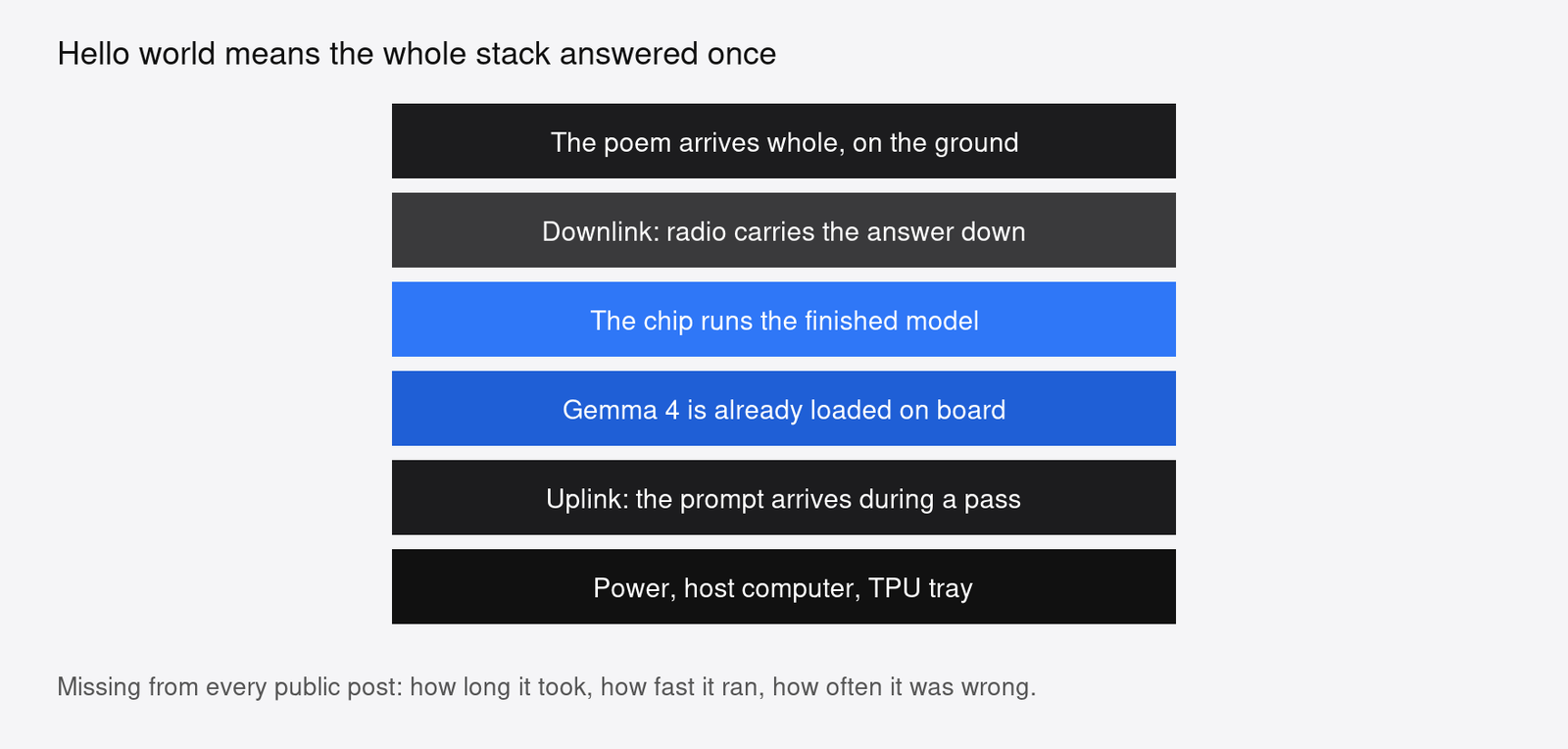
Programmers say hello world for the first time a new machine prints anything at all. The words do not matter. What matters is that every layer underneath agreed to run, once, all the way through.
The layers, in the order they have to succeed:
- Electricity reaches the box.
- The host powers up. The host is the ordinary computer that bosses the special chips.
- The tray powers up. A tray is the board the special chips sit on.
- The model file is loaded into the chip’s fast memory.
- The uplink delivers a prompt while a dish can still see the craft.
- The chip produces a full answer. Pichai’s word was complete. A poem cut off halfway would mean the radio died in the middle of the reply.
- The downlink carries that answer to a dish, intact enough for a person to read it.
Beals also says those early machine learning tests had already succeeded during commissioning. So the haiku was not the first arithmetic the chip did in orbit. It was the first full answer the ground was shown.
None of the posts give the measurements a buyer would ask for. No delay from send to reply. No tokens per second (how many text chunks the chip finishes in one second). No size of the Gemma 4 file they actually loaded. No count of wrong answers. A pretty poem can hide a slow chip, a tiny model, or one lucky pass.
Heat and particles are still scheduled, not finished
Every watt a chip uses becomes heat. Energy does not vanish. On Earth, moving air or water carries that heat out of the room. Orbit is a vacuum (almost no gas around the machine). A fan spins and pushes nothing, because there is nothing to push. The way out that remains is a warm panel glowing in the infrared (light eyes cannot see), and that glow carries energy away into the dark. If the panel is too small, the chip has to rest while the panel catches up. That rest is the nap in the launch-day piece. This week’s post does not say Google has finished measuring that nap in orbit. It says the heat test is next.
Above the air, fast particles hit the chip. One particle can flip a stored 0 into a 1. That accident is a bit flip (one binary digit changing when nobody asked it to). The wrong number can become a wrong word, with no crash and no warning light. That quiet failure is silent corruption (a bad answer that looks like a normal answer). TechCrunch says Google’s ground tests in particle accelerators suggested radiation matters more while a model is being trained than while it is only answering. A beam in a building is not the sky. Google’s 30 October post puts the orbital check in the future.
The 2027 line is narrower than a data-center dream. Beals says the next milestone is twin interconnected satellites in 2027. TechCrunch adds that the two craft will generate more power and demonstrate inter-satellite optical links (laser links between neighbors). Google’s post adds no distance and no speed. Treat 2027 as a plan to test a conversation between two craft, not as a date when orbit replaces a building.
Three numbers that would show the chip can live in orbit
Count a published telemetry reply, not only the poem. Count an on-time and an off-time measured in orbit, so fifteen minutes and twenty minutes stop being competing headlines. Count a bit-flip number from the flight, set beside the estimate from the ground beam. Those three would tell you whether the chip can live up there.
Ignore a sentence that says a data center launched. A data center does not have to nap, and it does not wait for an Arctic dish before it can speak. Ignore any claim that this flight trained a model. Ignore the eight-times-more-sunlight figure and the cheap-launch math from the research paper. Neither one was measured by a poem over Svalbard. Both are still projections, and the launch-day explainer walks through them.
The honest result is still worth keeping. For the first time, a data-center-class Google chip, in orbit, took a question from the ground and returned a complete answer. That was the hello world. The hard test is the sentence after it.
Common questions about Project Suncatcher
Did Google put a data center in space?
No. The prototype is one satellite with four TPUs, and TechCrunch reports only one can run at a time, for about 20 minutes, on up to 1 kW. Google’s phrase “data center class” describes the kind of chip, not the size of the machine.
What did the Suncatcher satellite actually do?
It ran Google’s Gemma 4 open model on a TPU in orbit and sent back a complete haiku about being in space, received as the satellite passed Svalbard, Norway. Google then tried space-themed limericks and telemetry prompts about the payload’s status.
Has Google finished the heat and radiation tests?
No. Google’s 30 October post says tests of how the TPUs perform under thermal stress and radiation exposure in orbit come next.
What is the next Project Suncatcher milestone?
Twin interconnected satellites in 2027. TechCrunch reports they will carry more power and demonstrate optical links between the two craft.