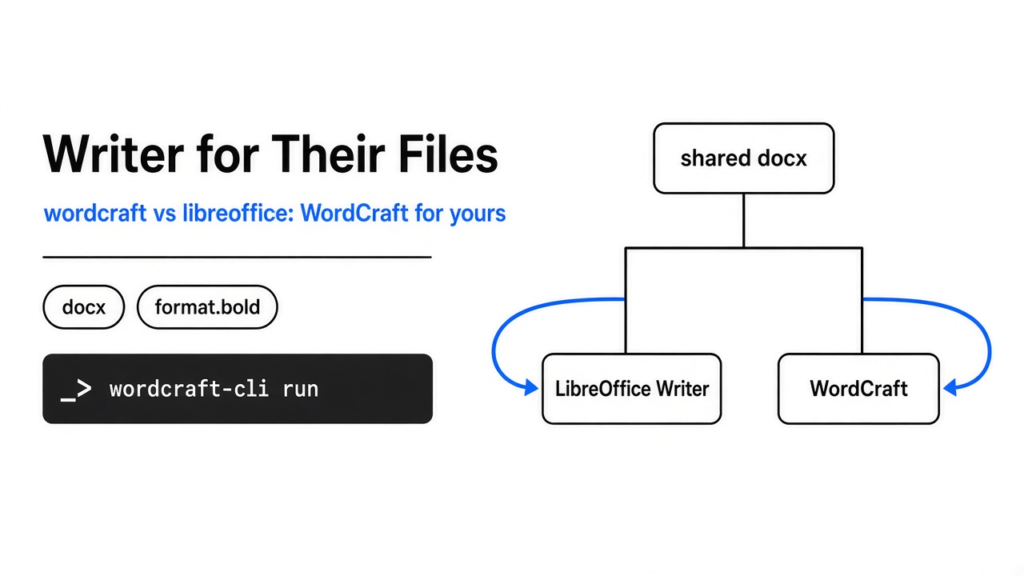
The report on your screen is not a pile of letters. A word processor remembers which words are bold, which line is a heading, and where the page ends. LibreOffice Writer is the open word processor people already trust with a file someone else made. WordCraft is a newer open word processor, written from scratch, that tries to feel like Microsoft Word and also lets a script press the same buttons. For wordcraft vs libreoffice, use Writer when the file has to survive someone else’s Word. Use WordCraft when you are writing the file, or when a program needs to edit it, and then open the result in Word before you send it.
That picture of the ordinary mess is simple. Someone is writing. The file will be emailed. The person who opens it may not have the program you used. The rest of this page is how to choose the program, starting from what the file actually is.
what is a word processor
A word processor is a program that stores a document, not just a note. A plain text file is one long string of characters. It does not know that Friday is bold, or that the first line is a title, or that the page is letter size. The extra memory is the whole product. Both LibreOffice Writer and WordCraft exist to keep that memory and draw it as pages.
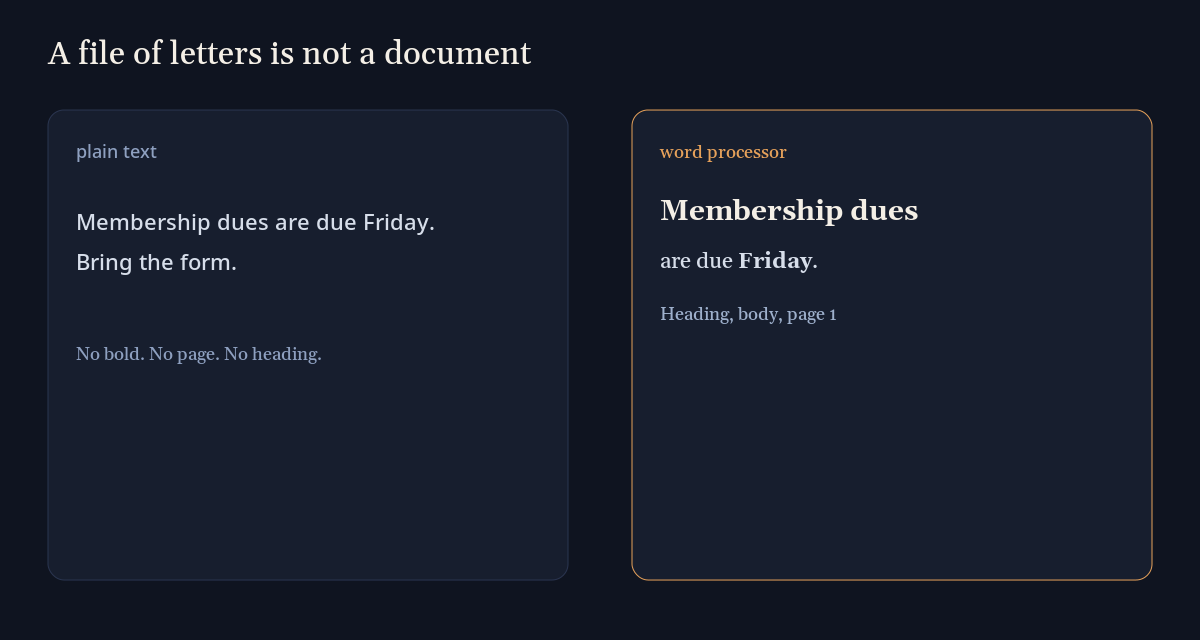
Read the left side first. Those are letters. A text editor is done. The right side is the same letters plus two facts the file must remember: this line is a heading, and one word is bold. A heading is not a bigger font you typed by hand. It is a named style, so changing Heading later changes every heading. Bold is not a new character either. It is a mark on a run of characters. A run is a stretch of letters that share the same marks. Once you see that, the buttons on both programs stop being magic. They write marks into the file.
If you only need letters, stay in a text editor. The moment a person expects a heading, a table, or a page number, you need the extra memory. That is the job these two programs share. Everything after this is about how they keep that memory, and what breaks when they disagree with Word or with each other.
what is a docx file
A docx (the Word file people email) is not one mysterious blob. It is a zip. Unzip it and you get folders. The words live in a file of XML (text with labels around each piece). Styles live in another file. Pictures sit beside them. A small list at the front says what each part is. I made a two-paragraph docx this way, with no word processor at all, just those labeled files inside a zip. Both Writer and WordCraft are programs that read that zip and decide how the page should look.
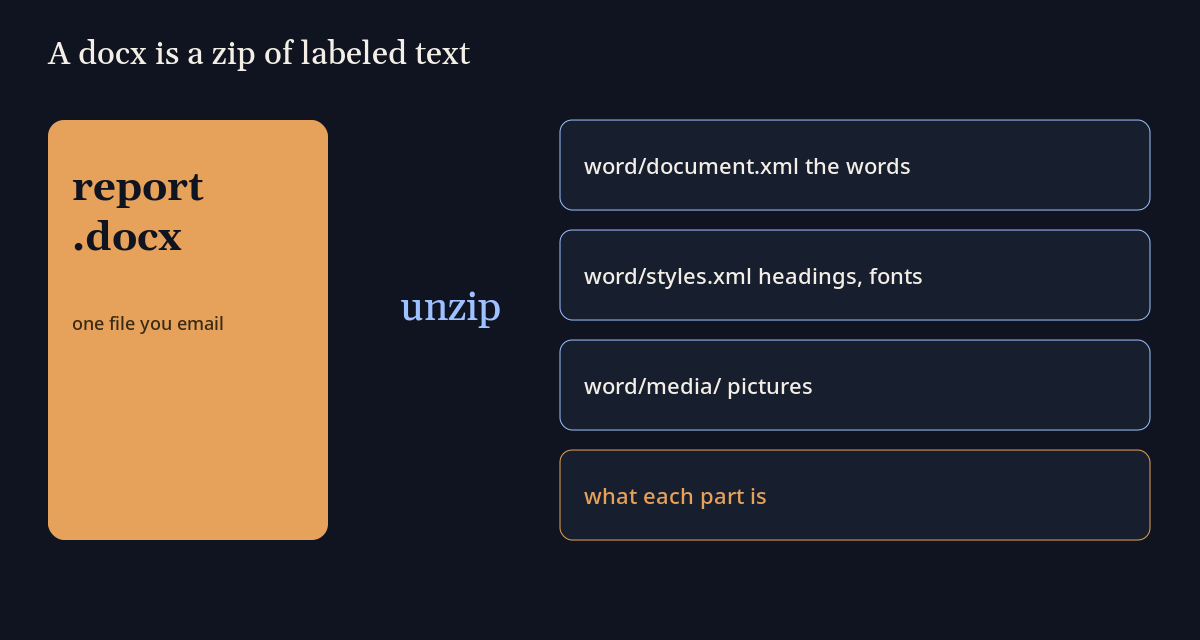
The labels are why a file can open and still look wrong. Opening means the program found the words. Looking right means it agreed with Word about margins, fonts, and where the line breaks. Those are different jobs. A program can pass the first and fail the second. When someone says a word processor “supports docx,” ask which job they mean. Finding the sentences is easy. Matching the page is the hard one, and it is the one that gets you in trouble on a shared file.
My handmade file had only the words. No styles part, no theme, no page size. That was on purpose. I wanted to see what a program writes back when the zip is almost empty. The answer is in the test further down. WordCraft did not leave it empty.
what is libreoffice writer
LibreOffice Writer is the word processor inside LibreOffice, the office suite you install once and use without an account. Its own file is an ODT (LibreOffice’s save format, also a zip of labeled text). It also opens and saves docx. The window is a title bar, a menu, a standard toolbar, a formatting toolbar, a page, and a sidebar for styles. That layout has been the free answer to Word for a long time, which is why a contract, a thesis, or a file from finance should still land here first.
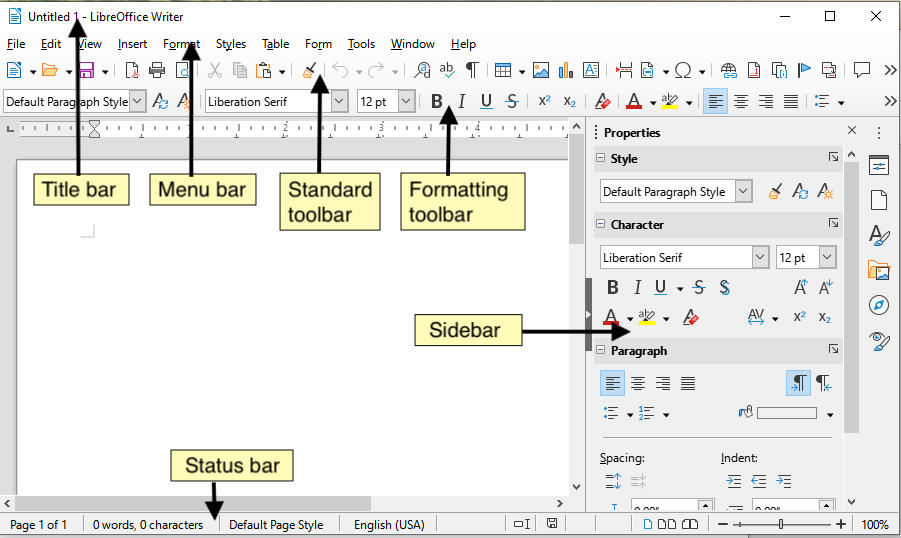
The labels on that window are the parts you actually touch. The page is the workspace. The sidebar is where a style lives, so you are not painting each paragraph by hand. Writer’s home format is ODT, not docx. When you save as docx you are translating. Translation is why a complex file can shift: a text box, a font Writer does not have, a line that breaks one word earlier. Writer has had years of that translation. It still surprises you. The surprises are old, and people have written them down.
Writer can be driven by another program. The door is called UNO (LibreOffice’s way for other programs to press its buttons). It works. It is also a second system you have to learn, with its own names, and those names are not the names on the buttons. That gap is the reason a newer program bothered to exist. If your script already speaks UNO, you do not need WordCraft for automation. If you want the script to say the same word as the Bold button, that is the other tool.
what wordcraft is
WordCraft is an open-source word processor aimed at Microsoft Word’s job: a ribbon (the row of tabs and buttons across the top), styles, tables, track changes, and docx in both directions. Clean-room (written from the public description of the file, not from Microsoft’s code) is the promise on the label. The same program runs on Linux and in the browser, which the Word desktop app does not. It is still alpha (early: the core path works, the edges break). The project’s own notes put it around 60 percent of the way to replacing Word for real work, and lower if your week is full of other people’s files.
Rust (a language that compiles to a fast program and tries to stop a class of memory mistakes) is what the app is written in. You do not need to learn Rust to use the window. You need it only if you build from source, the way I did for the test. The desktop builds exist so most people never compile anything.
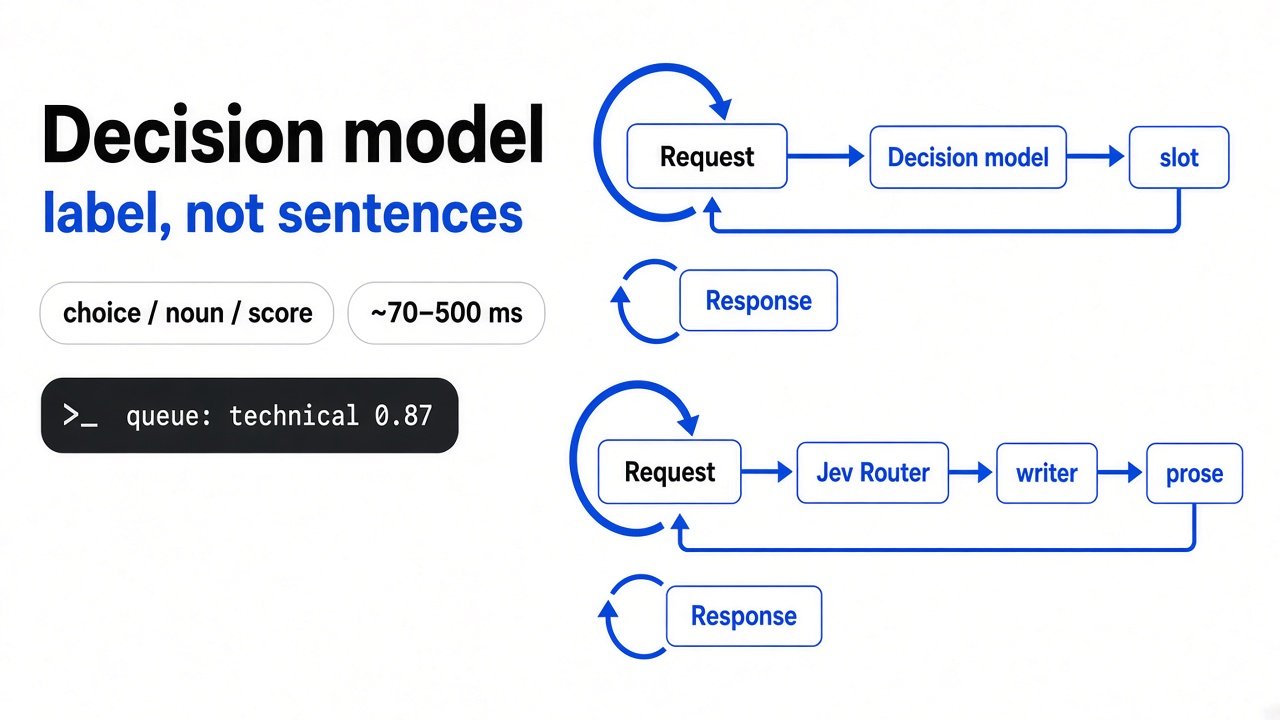
The part that is not a Word clone is the command list. Every action has an id. The same id drives the ribbon, the keyboard shortcut, the command line, and a small server an agent can call. Writer can be scripted. WordCraft wants the script and the button to be one name. That is the whole difference. It is not “faster Word,” and it is not “Writer with a new coat.”
wordcraft vs libreoffice
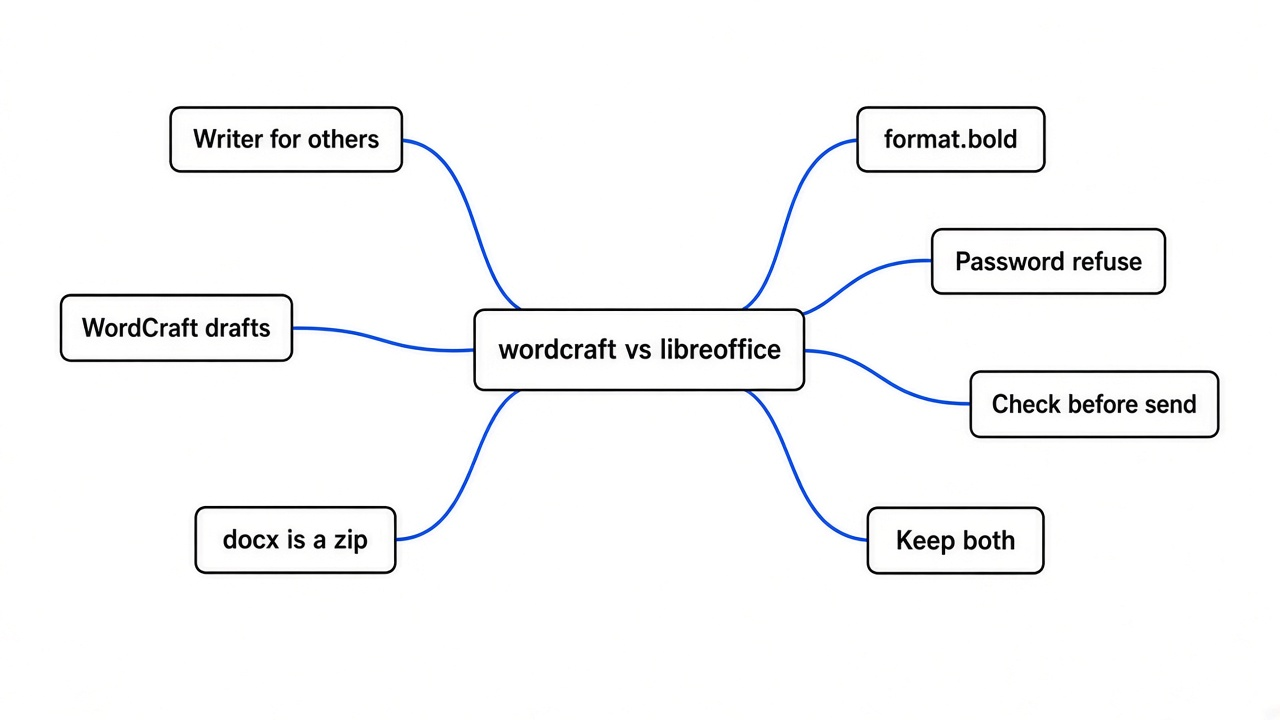
LibreOffice Writer is the safer open word processor for a docx someone else made. WordCraft is the one to try when you want Word’s habits on your own draft, or when a script must do the same thing as a click. They are not substitutes. They fail in different places.
| Job | LibreOffice Writer | WordCraft |
|---|---|---|
| Open a docx from email | Yes. Still check the pages. | Opens and saves. Real files from the wild are not a finished test. |
| Write a letter or notes | Yes | Yes, if you can live with alpha |
| Chart that Word embedded | Usually kept | Kept in the file, not fully editable |
| Password-locked file | Opens with the password | Refused |
| Same action from a script as from a button | UNO, a separate set of names | One command id |
| Linux, offline | Yes | Yes |
| Page breaks must match Word | Closer, still check | Not safe to trust |
| Spellcheck | Many languages | English, Polish, and Portuguese |
The row that matters is the script row. Writer has been the file tool. WordCraft wants to be the file tool and the button tool at the same time. If you do not have a script, that row is a zero, and Writer wins on the other rows that touch other people’s files.
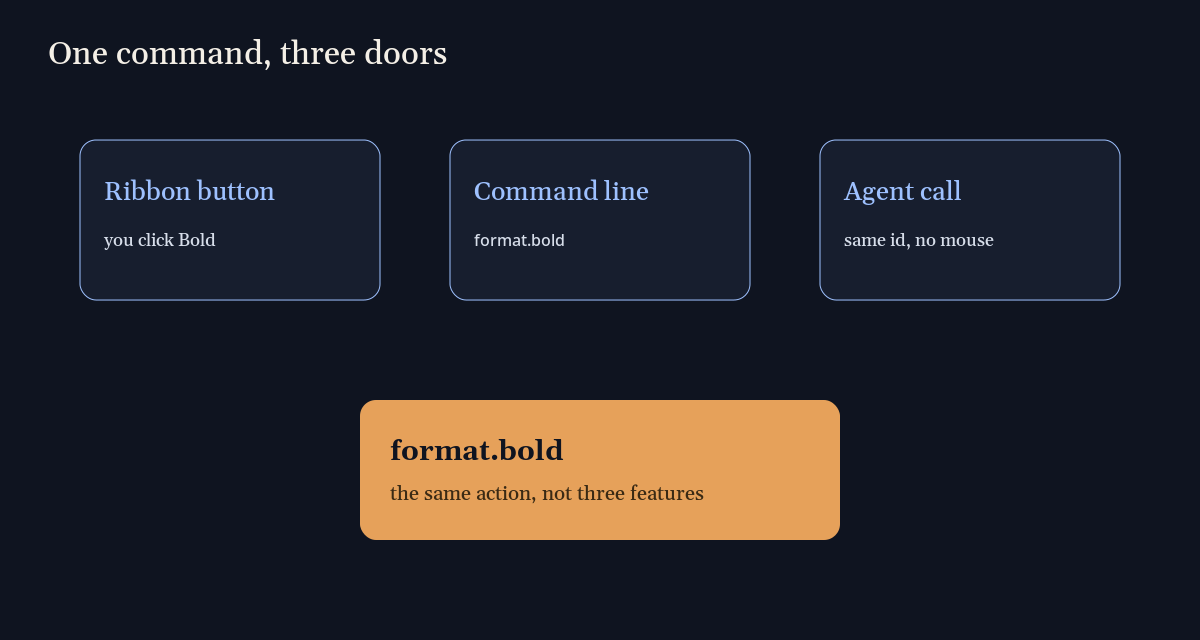
Follow the three doors down to the same id. Clicking Bold, typing the command, and letting an agent call it are not three features. They are one mark on a run of letters, reached from three places. format.bold is that id. I used it. The next section is the file it touched.
how to use wordcraft
You need Rust if you build it yourself. Install it with rustup, which is the official installer, then clone the project and build the command-line program. I did not stop at the window. I built wordcraft-cli and drove a file with it. That is the path you can finish without clicking, and it is the path I can tell you about because I ran it.
git clone https://github.com/storytold/wordcraft
cd wordcraft
cargo build -p wordcraft-cli --releasecargo is Rust’s build tool. The -p wordcraft-cli flag builds only the command-line program, not the whole desktop window. Release mode makes the fast binary. The first build downloads a lot and takes a while. After that, the useful commands are short.
wordcraft-cli text dues.docx
wordcraft-cli info dues.docx
wordcraft-cli run --file dues.docx \
  --cmd 'select.text={"text":"Membership"}' \
  --cmd format.bold \
--save dues-bold.docxtext prints the words. info prints pages, paragraphs, and a word count as JSON (labeled data a program can read). run plays command ids, then saves. select.text finds a string and selects it, which is the step before a mark. format.bold writes the mark. I listed the command catalog and format.bold was there, beside the shortcut people already know as bold.
A terminal is just a place you type those lines. You do not need a menu. If the build is more than you want, the project also ships desktop builds for macOS, Windows, and Linux, and a browser build. I am not going to pretend I clicked through those installers. The commands above are the ones I ran.
can wordcraft open a docx
Yes. I made the file, and WordCraft read it. The zip held two paragraphs and nothing else: “Membership dues are due Friday.” and “Bring the form. Leave the chart at home.” wordcraft-cli text printed both lines. info said 1 page, 2 paragraphs, and 13 words. I counted the words myself. Membership, dues, are, due, Friday, Bring, the, form, Leave, the, chart, at, home. Thirteen. Layout of that tiny file took about 31 milliseconds. That number is not a claim about a book. It is what this file took. Do not borrow it as proof that a long report will feel instant.
Then I asked it to select the word Membership and run format.bold. The plain text did not change, which is what you want. Bold is not a new word. It is a mark on a word. inspect said the first paragraph had a bold run from character 0 to character 10. Membership is ten letters. I unzipped the saved docx. That word sat in its own run, with the bold labels on it. The rest of the sentence, ” dues are due Friday.”, was a second run with no bold label. The page it drew shows the same thing.
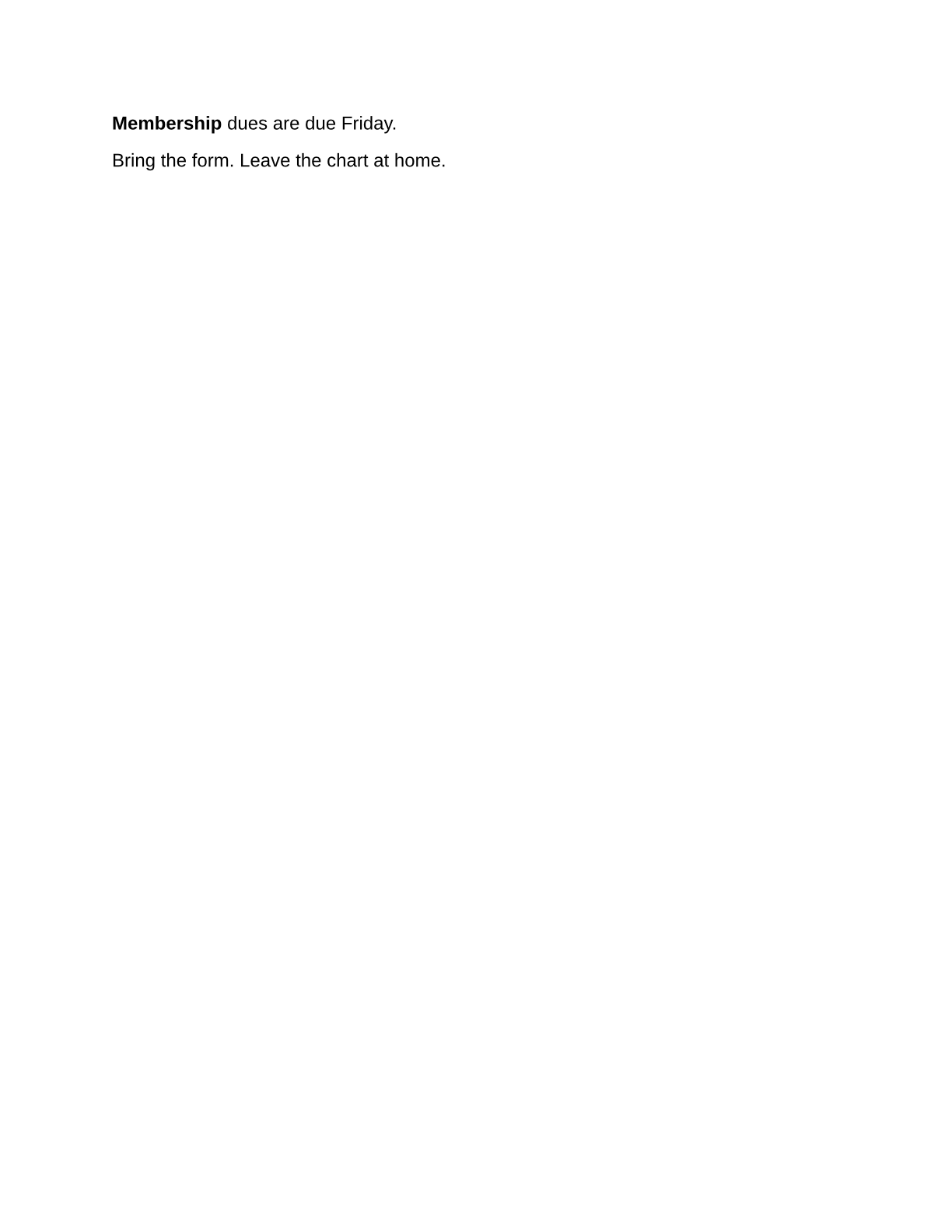
That page is the proof, not a mockup. Membership is heavy. The rest of the line is not. The second paragraph is untouched. The page is mostly empty because the file is two lines on a letter page, which is the honest result, not a cropped ad.
The saved file also filled in the parts I had left out. My handmade zip had only the words. WordCraft wrote styles, settings, a theme, and document properties. It set a letter-size page with one-inch margins. In the file those sizes are stored in twips (a Word unit: 1440 of them make an inch). The page width was 12240, which is 8.5 inches, and the height was 15840, which is 11 inches. Each margin was 1440, which is one inch. So the open worked, and the save was a fuller docx than the one I handed it.
One caveat. This file had no chart, no text box, no password, and no font that only exists on one laptop. The project’s own gap list says a corpus of real files from Word, Google Docs, LibreOffice, and Pages has not been run page by page. A chart Word embedded is kept when you save, and you still cannot edit that chart’s workbook the way you edit a chart you inserted yourself. Password-protected files are refused. Proofing, the spellcheck and grammar pass, covers English, Polish, and Portuguese. If your week is a shared drive of finished reports, this test does not cover you. A check that never opens the file is not a check, which is the same lesson as a canary that fails only if something actually reads it: systemd’s AI canary.
when not to use wordcraft
Do not use WordCraft for a file whose page count is the product. Legal papers, forms, and theses care where the line breaks, and WordCraft’s own notes say pagination does not match Word. Do not use it for a password-locked file. Do not use it as the only program that opens a chart-heavy pile of reports. Do not send the result to a client until you have opened that same file in Word or in Writer and looked at the pages.
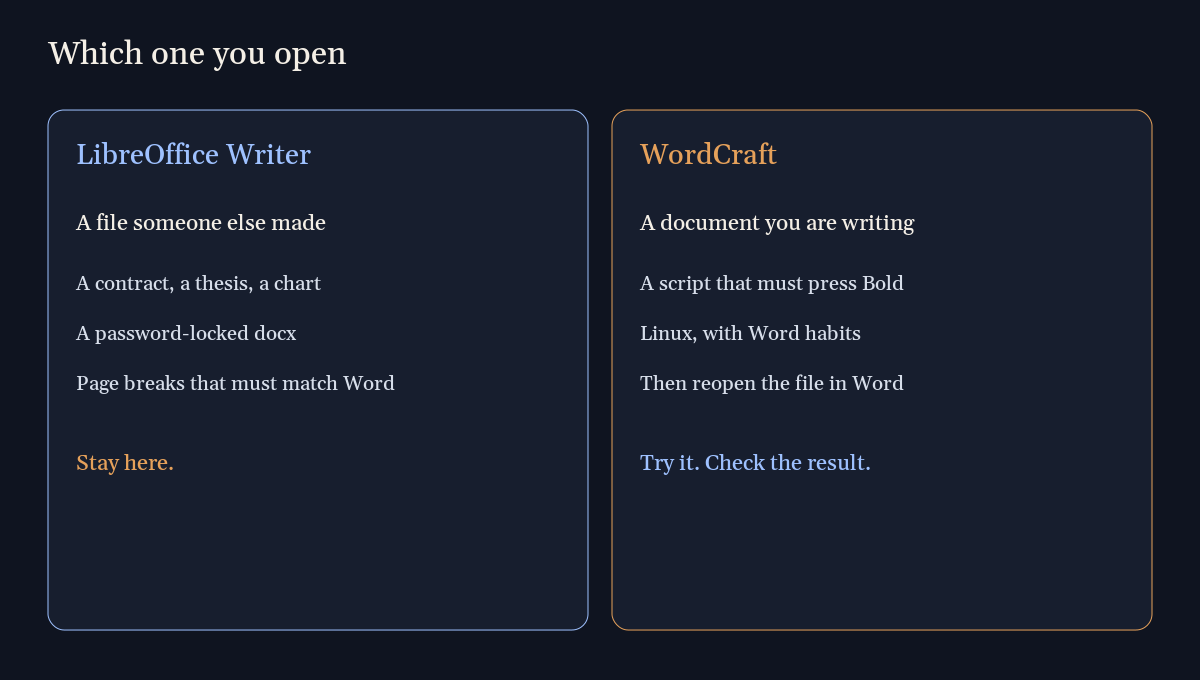
Left side, stay. Right side, try, then look. The right side is not a smaller Writer. It is a different risk. You are allowed to like the ribbon and still refuse to bet a contract on it.
Writer is the opposite bet. It is the boring program. It has had years of docx practice, and it still surprises you on a complex file, so you still look. The difference is that the surprises are old surprises. WordCraft’s surprises are the ones that have not been collected yet. If the file is a PDF with a table of contents rather than a docx, that is a different job again: pageindex vs a vector database.
is wordcraft worth it
WordCraft is worth it when the thing you want is a local draft that feels like Word, or a script that can bold, select, and save without you holding the mouse. It is not worth it as a swap for LibreOffice on the files other people already made. I would write a note in WordCraft. I would open the attachment from finance in Writer. Then, if a script had touched the note, I would open the saved docx once more before I sent it.
That second open is the whole habit. A word processor can report success and still have dropped a part you did not look at. The command I ran changed one word’s weight and left the letters alone. Yours might. Look anyway.
The project lives at github.com/storytold/wordcraft. Writer’s own page is libreoffice.org/discover/writer. Read those if you want the install buttons. The decision does not change when you do: other people’s files stay in Writer, your own draft and your script can try WordCraft, and you open the saved file before it leaves your machine.
Common questions about wordcraft vs libreoffice
is wordcraft the same as libreoffice
No. Writer is one program in a full office suite, and its home format is ODT. WordCraft is a Word-shaped word processor with a command id for each action. They both read docx. They are not the same code, and they do not fail on the same files. If someone asks you to “just use the free one,” ask which failure they can live with.
does wordcraft work on linux
Yes. I built and ran wordcraft-cli on Linux. The desktop app is the same codebase, with Linux packages alongside the macOS and Windows builds. You do not need Windows to try the command path. The browser build is a third way, if you do not want a desktop install at all. I did not click through that browser build in this test. The Linux command line is the part I ran.
can a script bold text in wordcraft
Yes. The command is format.bold, after a select. An agent can also talk to a small server the project ships, MCP (a small server an agent is allowed to call), started with wordcraft-cli mcp. The same command id is what the ribbon button uses. That is the part Writer does not hand you for free. If the script is the point, start there. If the script is a maybe, stay in Writer until you actually need the id.
should I switch from libreoffice to wordcraft
No, not as a replacement. Add it beside Writer if you want the command path or a Word-like window for your own drafts. Leave Writer in place for the files you did not create. Switching means you accept alpha gaps on every attachment you receive. Keeping both means you use each one where it is actually strong. That is the wordcraft vs libreoffice choice. It is a which-file choice, not a which-team choice.