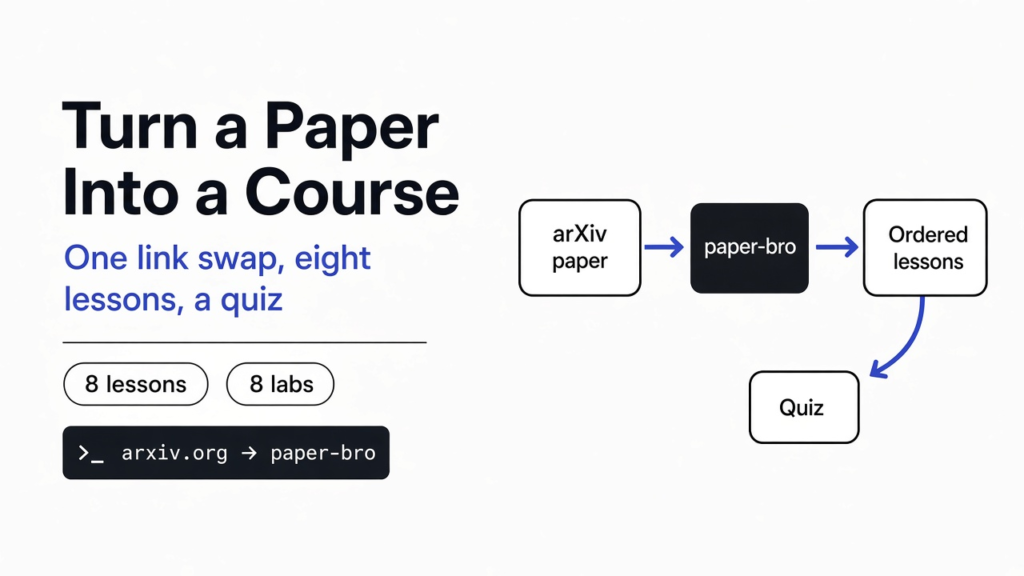
Short answer: to turn a paper into a course, swap the front of its arXiv link for paper-bro’s address, then work through the lessons in their numbered order and keep the paper open for every number.
I had a famous translation paper open and I still could not tell a friend how it works. The abstract (the short claim at the top of a paper) said attention is all you need. A chat summary repeated that sentence in softer words. paper-bro is a page that turns the paper’s address into a course: lessons in order, a tiny lab on each lesson, a word bank, and a quiz.
Checked on 31 October 2026 against the live paper-bro course for arXiv 1706.03762 (built 27 October 2026) and the paper itself, Attention Is All You Need, version 7.
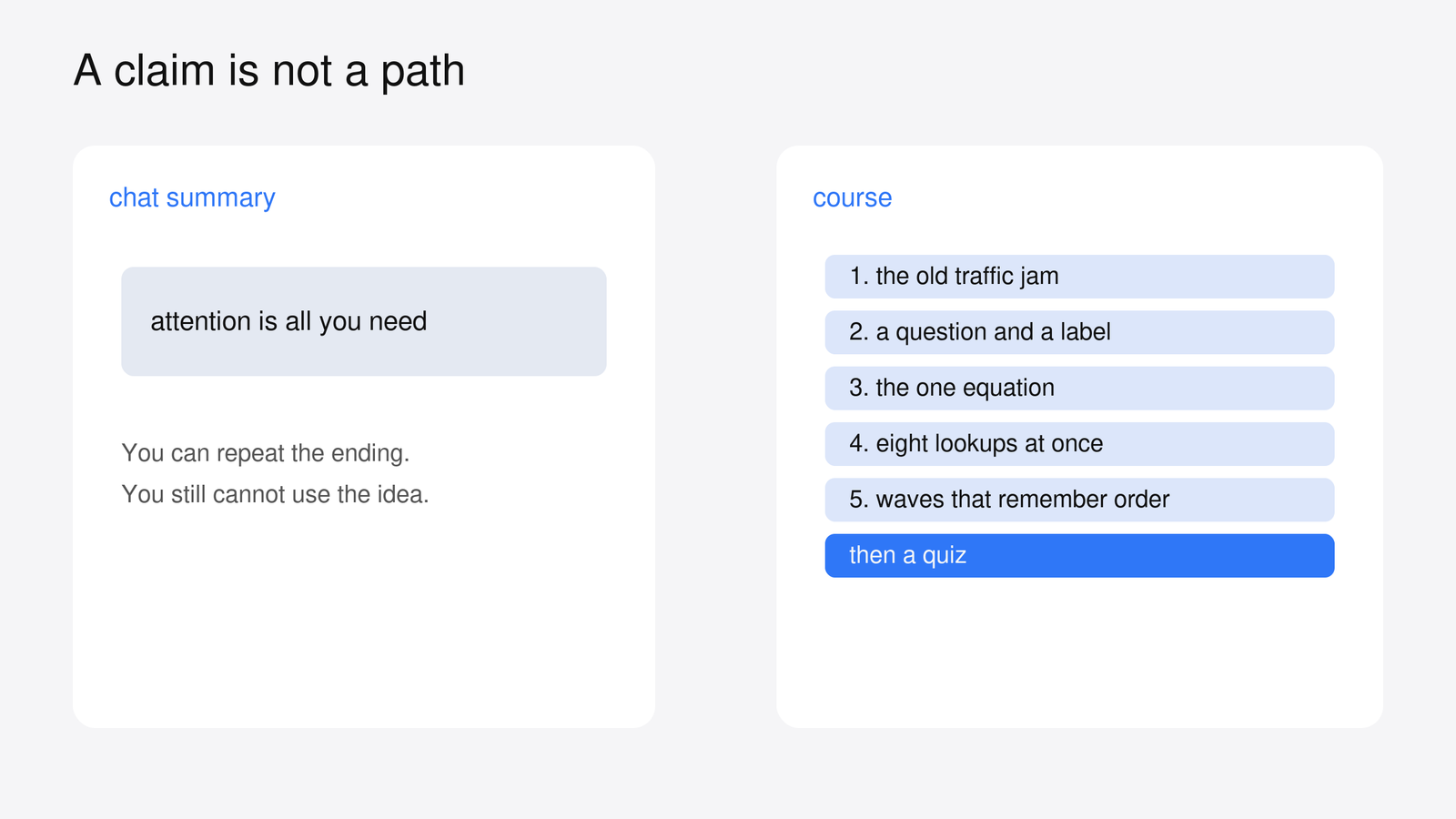
A summary is one sentence you can repeat. A course is a path you can walk, then a check that you walked it.
How to turn a paper into a course with one link change
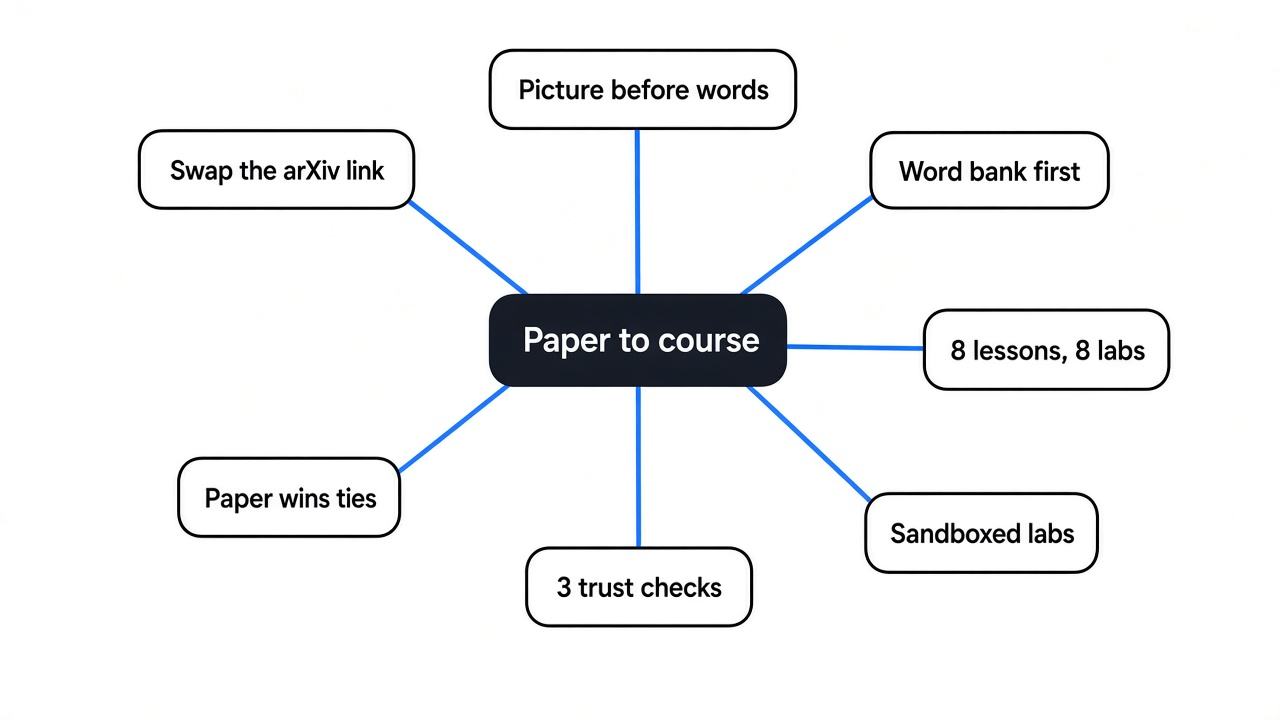
Replace https://arxiv.org with https://aero.oops.wtf/paper-bro in the paper’s address, then open the new link.
Before that trick means anything, the shelf has to be named. arXiv (a public shelf where researchers post papers, often before a journal prints them) gives every paper an address. The one I used looks like this: https://arxiv.org/abs/1706.03762. A paper, here, is a long argument with a claim, a method, and a result, written for people who already live in that field. I changed only the front of the address, to https://aero.oops.wtf/paper-bro/abs/1706.03762. The site redirected me to a finished course at https://aero.oops.wtf/p/arxiv-1706-03762. No account. The title on the page was plain: how transformers translate without waiting in line. The header promised 8 hands-on labs and about 46 minutes of reading.
That is the whole install. If the course for that paper already exists, you see it at once. The first person to ask pays the wait while the lessons are written. Everyone after them opens the same course. I landed on a course that was already there, so this test is a reading of the finished page, not a stopwatch on a fresh build.
Learn the picture before the first new word
You need the job the paper is doing, in a picture, before any name.
The job is translation. You have a line of English. You want a line of another language. Old machines did this like a person reading with one finger. Word 1 gets a note. Word 2 is allowed to start only after that note exists. Word 5 waits on word 4. That waiting has a name, sequential (one step must finish before the next step is allowed to start). A faster chip does not remove it. Step 5 still cannot begin during step 4.
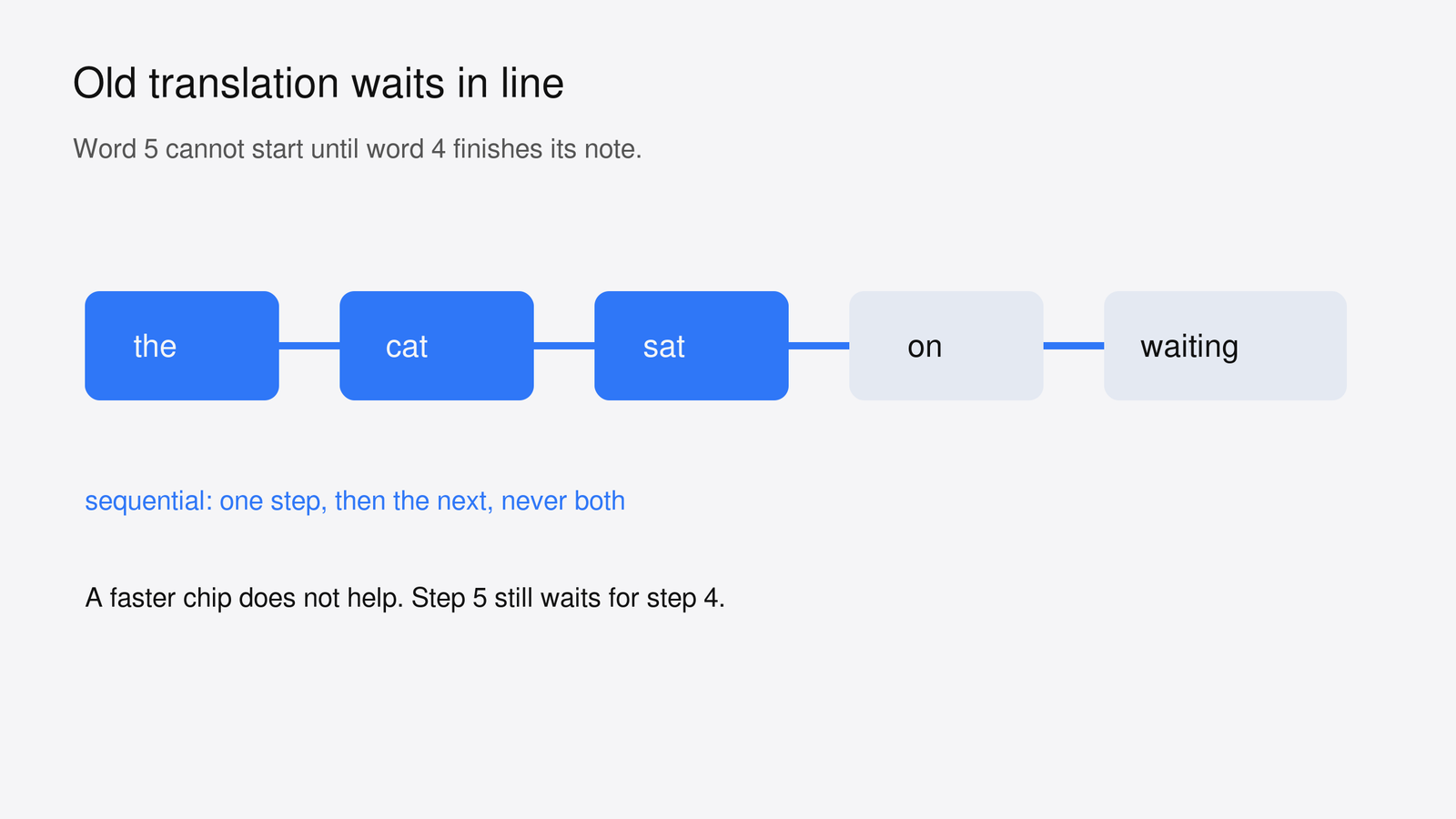
The course’s first lesson is called The Traffic Jam, and it is marked about four minutes. It opens on that assembly line. Only then does it name the old machine: an RNN (recurrent neural network: a reader with one notepad, who writes a new note from the last note plus the new word). The lesson writes the idea as a tiny formula, then says the plain version: you cannot write today’s note until yesterday’s note is finished. If the sentence has n words, you must take n steps in order. Computers call that inherently sequential. The lesson’s own key line is the one worth keeping: sequential means waiting in line.
This is the order a course has to keep, or it is just a summary wearing headings. Picture first. Pain second. Name third. If a new word shows up before the picture, stop and ask what the word is pointing at. That question is the prerequisite. paper-bro’s first lesson does this for the old translator. A chat reply that starts with “the Transformer uses self-attention” skips it.
paper-bro vs a ChatGPT-style summary
A chat summary gives you the ending. paper-bro gives you the path, then asks you to use it.
I have asked a chat box to explain this paper. What comes back is a competent paragraph: the model looks at every word at once, training got faster, translation scores went up. I could paste that paragraph into a slide. I could not, from that paragraph alone, tell you why the main formula divides by a square root, or why the writing half of the machine is forbidden to see future words. Those are the parts you need if you are going to use the idea, or spot a wrong retelling of it.
| Chat summary | paper-bro course I opened | |
|---|---|---|
| What you leave with | A few sentences of the claim | 8 lessons, 8 labs, a word bank, an 8-question quiz |
| New words | Used, often before they are taught | Taught from a picture, then listed |
| Can you try the idea | No | A small lab inside each lesson |
| If the retelling is wrong | You may not notice | The page says the paper wins |
| Use it when | You only need the claim | You need to use the idea or teach it |
The page is not shy about being a retelling. In the section About this course, it names the AI model that wrote the lessons (Muse Spark Open), says it explains the paper in its own words for beginners, so it simplifies, and it can make mistakes. When the course and the paper disagree, the paper is right. Figures are shown straight from arXiv and belong to the paper’s authors. That paragraph is the most useful thing on the page. I would not trust a course that hid it.
If your real job is shorter text, not a lesson, this is the wrong tool. A fold of a long document, or a walk down the headings of a long file, is a different job. For that split, PageIndex vs a vector database is the page that already answers it, and if all you want is a shorter version of a file you already have, TextFold vs a ChatGPT summary covers that job.
What the Attention Is All You Need course contains
Eight lessons, then an eight-question quiz, then a word bank. Each lesson had a lab.
The side list I read, in order:
- The Traffic Jam
- Attention as Lookup
- Scaled Dot-Product
- Multi-Head
- Position Waves
- Transformer Tower
- Why It Wins
- Results That Changed AI
- Final quiz
The labs were titled, which is how I know they are not empty decorations. Traffic jam versus open road. A spotlight mixer. Why divide by the square root. Eight heads. Put order back with waves. Stack six blocks, and do not peek ahead. Compute the trade-offs. Scoreboard versus clock.
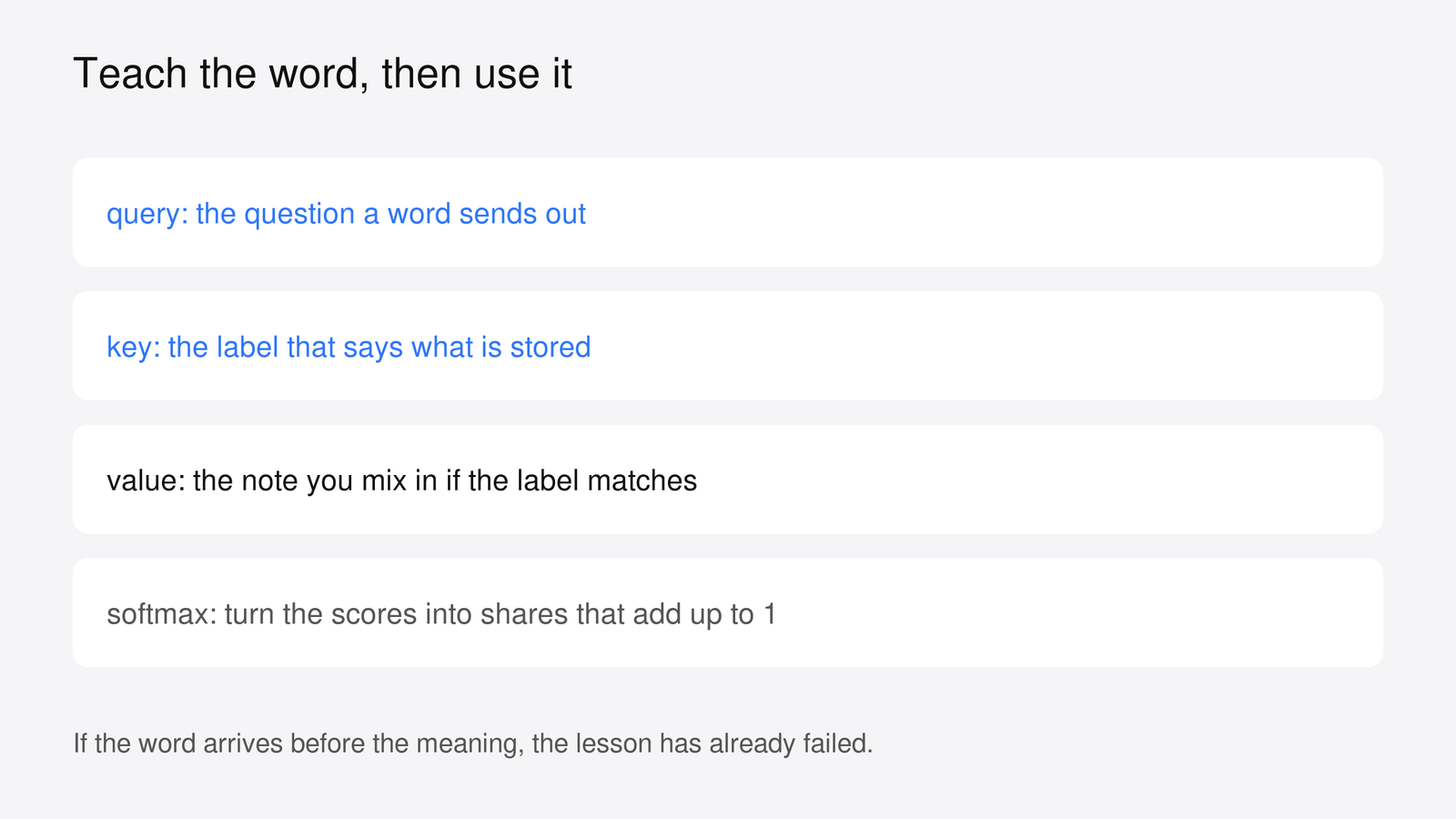
The word bank is a glossary (a list that says what each hard word means, in one or two lines). I am going to use its definitions, because they are the ones the course actually teaches, and because a reader should see the standard before I paraphrase it. Sequence transduction means turning one line, such as English words, into another line, such as German words. An RNN reads one word at a time, keeps a hidden note, and must finish step t minus 1 before step t. A query is the question a word sends out: what do I need? A key is the label on a stored note: what does this contain? A value is the note itself. Once the question has picked the close labels, you average those notes. Softmax turns a row of scores into shares that add up to 1, and it leans toward the biggest scores. A dot product is a way to measure whether two arrows point the same way. Self-attention means every position looks at every other position at once, instead of passing a note down a line. Multi-head attention means several of those lookups run together, each watching a different kind of link, then the results are joined. Masked attention means the writing half hides future words so it cannot cheat. Positional encoding means waves, sine and cosine, that stamp the order back on, because looking everywhere at once forgot the queue. A residual connection plus layer norm means you add a block’s input back onto its output, then tidy the size of the numbers, so a tall stack can still be trained. BLEU is a human-made grade for translation quality. Higher is better.
Read that list once before lesson 2 and the rest of the course is a story, not a fog. That is the prerequisite move. Do it even if you ignore the website and build the course yourself.
What attention is, as lesson 2 teaches it
Attention is a lookup: each word asks a question, every word wears a label, and the close labels donate more of their note.
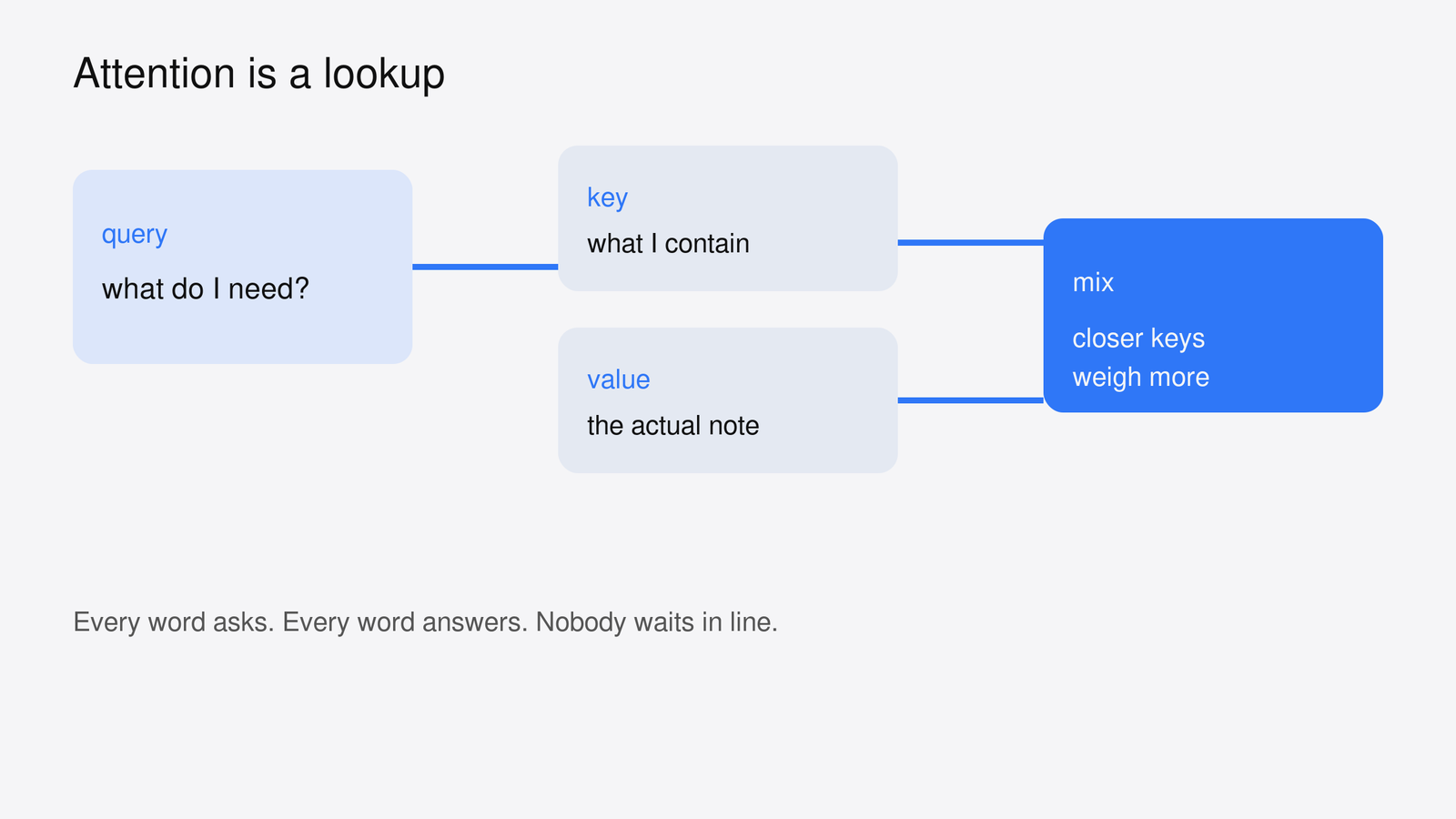
Lesson 2 calls this Attention as Lookup. The picture is a dictionary, not a brain scan. You do not need a new kind of math to hold the picture. You need three roles. The query asks. The key labels. The value pays out. “Close” here is not a feeling. It is the dot product: multiply matching slots and add them up. A big sum means the two arrows agree.
Lesson 3 is the part a summary always drops. The raw sums can get huge. Softmax then hands almost everything to one winner, and the mix stops being a mix. Dividing by the square root of the key size shrinks those sums so several labels can still share. The lab is titled “Why divide by sqrt(d_k)?” That letter d with a little k is just the width of the key, how many numbers sit in the label. The divide is a volume knob, not a new idea. If someone explains attention and cannot say why the square root is there, they have the slogan and not the machine.
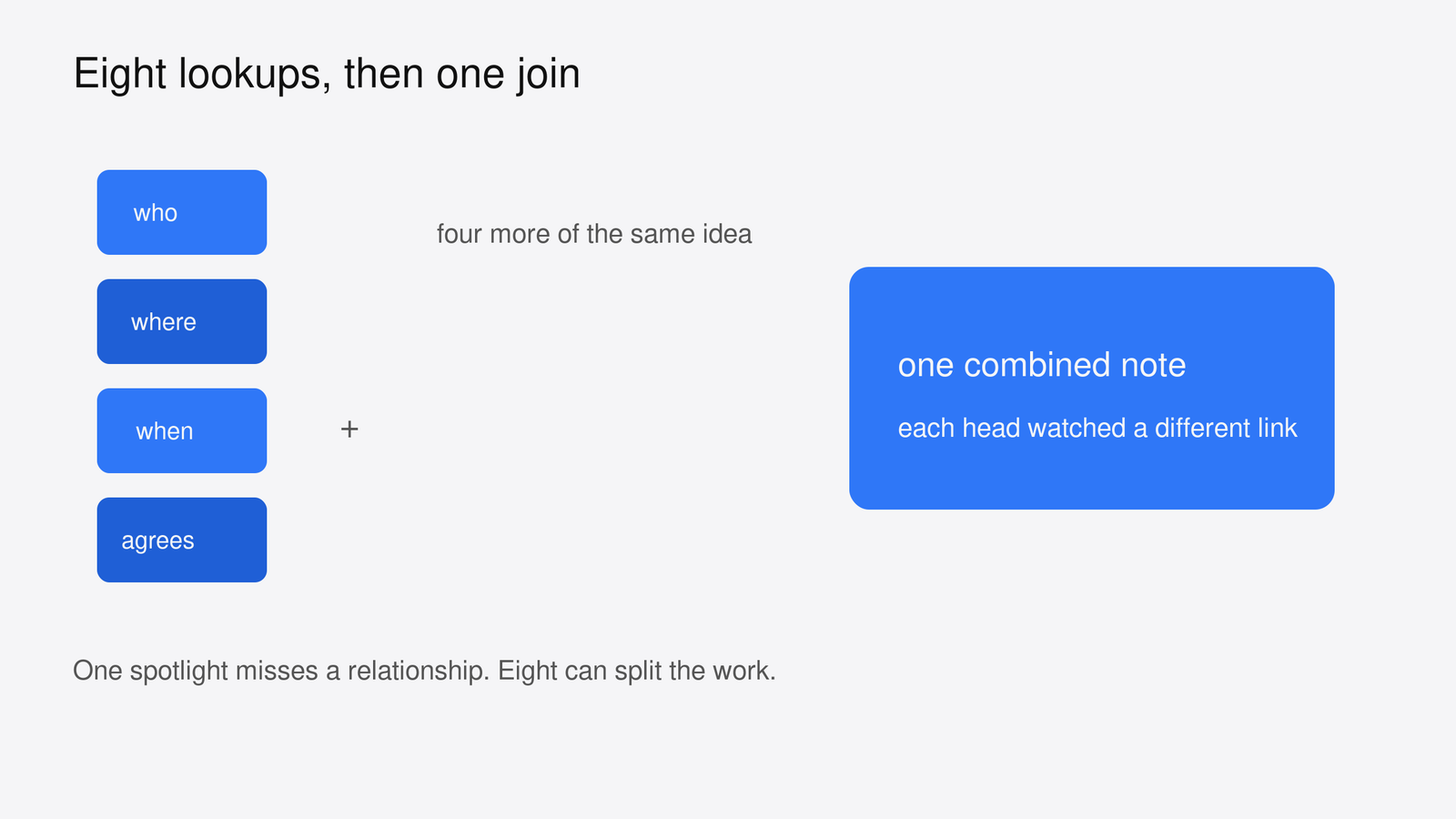
Lesson 4 splits the lookup into several heads (separate lookups running at the same time). One head might watch who did the thing. Another might watch where. Another might watch whether two words agree. The course’s lab says eight heads. The word bank says each head learns a different kind of relationship, then the results are combined. One spotlight is not enough, because a sentence holds more than one kind of link.
Lesson 5 puts order back. Once every word can see every other word in the same moment, the queue is gone, and “cat sat” can blur into “sat cat.” The paper adds waves so position is a pattern painted onto the word, not a place in a line. The word bank says those wavelengths run from 2π out to 10000 times 2π, which matches the sine and cosine formula in section 3.5 of the paper. If you will quote the range, quote it from the paper.
How the encoder and decoder stacks fit together
The machine is two stacks: one that reads the source line, and one that writes the translation without peeking ahead.
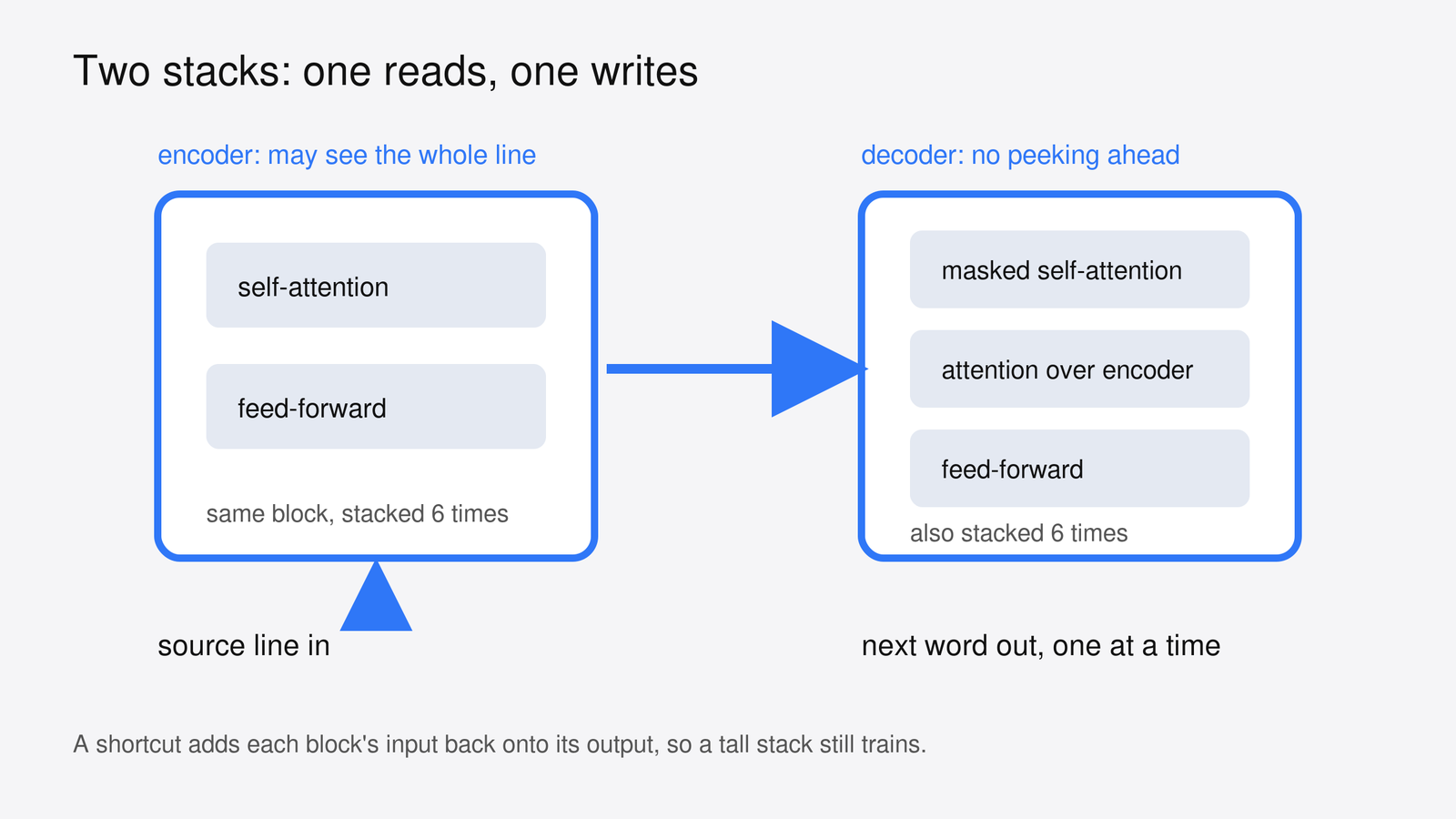
The reading half is the encoder (the stack that may look at the whole source line). The writing half is the decoder (the stack that produces the next word, and must not see words it has not written yet). Lesson 6’s lab says stack six blocks, and do not peek ahead. Six is the depth the paper uses (N = 6): the same block repeated, not six different inventions. Inside a block, attention runs, then a small private calculator runs on each position alone. That private calculator is the feed-forward step in the diagram above. A shortcut adds the block’s input back onto its output so the stack does not wash the original word away. Jay Alammar’s drawings of that block are the clearest still pictures I know: The Illustrated Transformer.
Lesson 7 is the payoff of the traffic jam. In the old line, a word at the start passes its note hand to hand. By the end of a long sentence the early note is worn out. Attention is one hop. Any word can read any other word directly. That is why the course heading on the page I opened says “one hop to anywhere.” The speed claim sits next to it: better translations in hours, not months, because the steps no longer have to wait on each other. A room full of chips can finally work at the same time.
Lesson 8 is the scoreboard. The word bank says the paper reports BLEU of 28.4 on English to German and 41.8 on English to French. Those match the paper’s results table for the big model on the WMT 2014 test sets. The course also flags that the paper’s text gives 41.0 for English to French in one place. Translation grades move when the test set moves. If you need the grade for anything except a rough memory, read it in the paper: Attention Is All You Need.
Do the paper-bro labs stay inside the page?
The labs can run scripts inside a fence. They are not given your files.
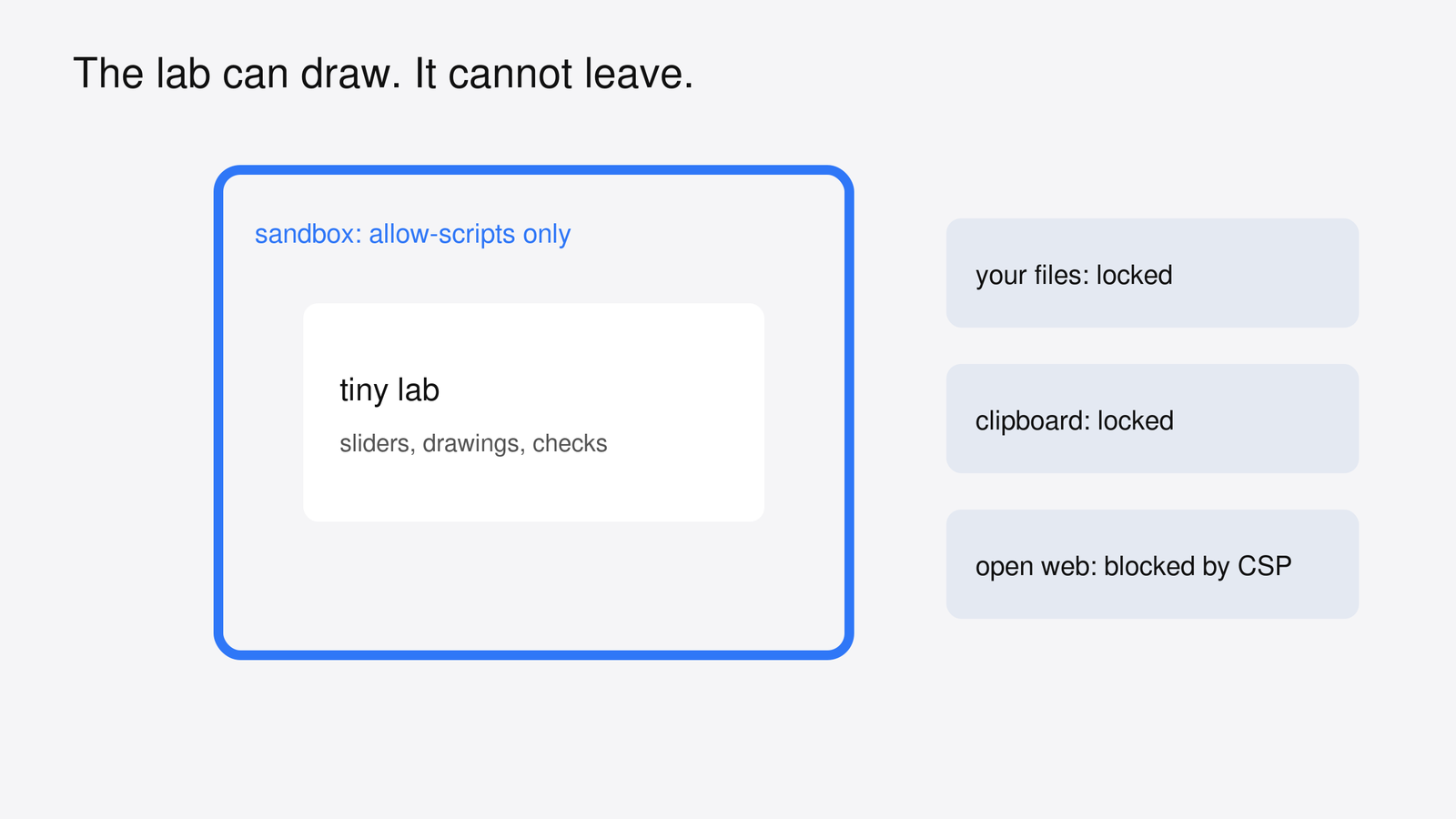
The course page has eight lab frames. Each one carries sandbox="allow-scripts" and no other permission: no reach into the parent page, no free pass at your disk. The page’s content security policy starts from default-src 'none' and only lets the page call its own lab-error endpoint and Google Analytics. A lab can draw, move a slider, and check an answer. It should not be able to read a folder on your computer or call out to some other site. The frame rules, not the look of the demo, decide whether a lab can escape, and on this page they are written into the HTML.
One honest limit: a fence on the lab is not a proof that the lesson is true. The lab can be a faithful toy of a wrong story. The course can simplify a step until the step is no longer the paper’s step. That is why the about section tells you the paper wins. Use the lab to get the picture into your hands. Use the paper before you repeat a number, a proof, or a claim you would bet work on.
When to skip the course and read the paper
Skip it when you only need the claim, when a smoothed proof would hide an error, or when the site is down and a local lesson file will do.
Use a summary when someone asks “what did they claim?” and you will not build on the method. Ten seconds is the right cost for that question. A course is wasteful there.
Skip the course when the paper is a pile of new math and a wrong sign would sink the result. A lesson that wants to be kind will sand the sharp edges off a proof. Sanding is how a sign error hides. If you are in that kind of paper, read the original and prefer a check a computer can accept. We already walked that limit on a large math drop: the catalogue and the papers that left over a sign error.
Skip it when what you need is a moving picture of a machine, not a lesson plan. A diagram you can turn is a different tool, and the choice is already written up: is the anatomy skill worth it.
If the website is down, keep the order and throw away the address. Write, or ask a coding agent to write, one html file with this spine: the mess, the old waiting line, the lookup, the one equation, why the equation has a boring-looking fix, several lookups at once, how order comes back, the two stacks, the result, then a quiz you write from a word bank you filled yourself. Open that file in a browser. No account, no second server. The order is the part that will still be right in a year. The address is only a convenience.
How to check the course did not invent the paper
Three checks. If any one fails, close the tab and read the paper, or read a drawing made by a person who showed their work.
First, the opening lesson should name the old pain before the new trick. The course I opened does. It spends lesson 1 on the traffic jam. If a course opens on the conclusion, it is a summary with extra headings.
Second, the word bank should use terms you can find in the paper, with meanings a beginner can repeat. Query, key, value, the mask that hides future words, and the two BLEU grades were all in the bank I read. A bank full of mood words and no terms is a brochure.
Third, the page should tell you it can be wrong, and that the paper wins the tie. This one does, in its own about section. A course that presents itself as the paper is the one I would not send to a coworker.
I would send this one, with that warning attached. After eight lessons I can say the idea without hiding behind the abstract. The old translator waited in line. The new one looks everywhere at once, asks a question, and mixes the answers. The square root is there so one answer does not swallow the mix. The writing half is not allowed to peek. That is enough to start. It is not enough to quote.
Common questions about turning a paper into a course
Can I do this with a PDF that is not on arXiv?
The address swap only works for a paper that already has an arXiv address. I only tested that swap.
A pdf on your disk is still a paper. The same spine works. Turn the pdf into text, then demand lessons in the order above, not a recap. Tell the writer to define each new word in the sentence before it is used, to put a tiny check at the end of each lesson, and to mark every number as “from the paper” or “my paraphrase.” Then you do the three checks. If you only wanted a shorter file, you did not want a course.
Is paper-bro the same as asking for a summary?
No. A summary ends at the claim. The course I opened had eight lessons and a lab on each one, plus a word bank and a final quiz.
The summary is the right tool when the claim is all you need. The course is the right tool when you will have to explain the method, or notice that someone else explained it wrong.
Can the lab see my files?
Not with the frame rules on the page today. Scripts are allowed inside the frame. A reach into your files is not on the sandbox flag, and the page’s policy blocks almost every outbound call.
That is a reading of the page’s rules, not a promise about some future version of the page. If you open a lab and it asks for a file from your disk, close it. The labs in the course I opened did not ask.
What if the course and the paper disagree?
Believe the paper. The course says so itself.
A lesson that is kind and slightly wrong is still wrong. The picture is there so you can enter the paper, not so you can retire it.