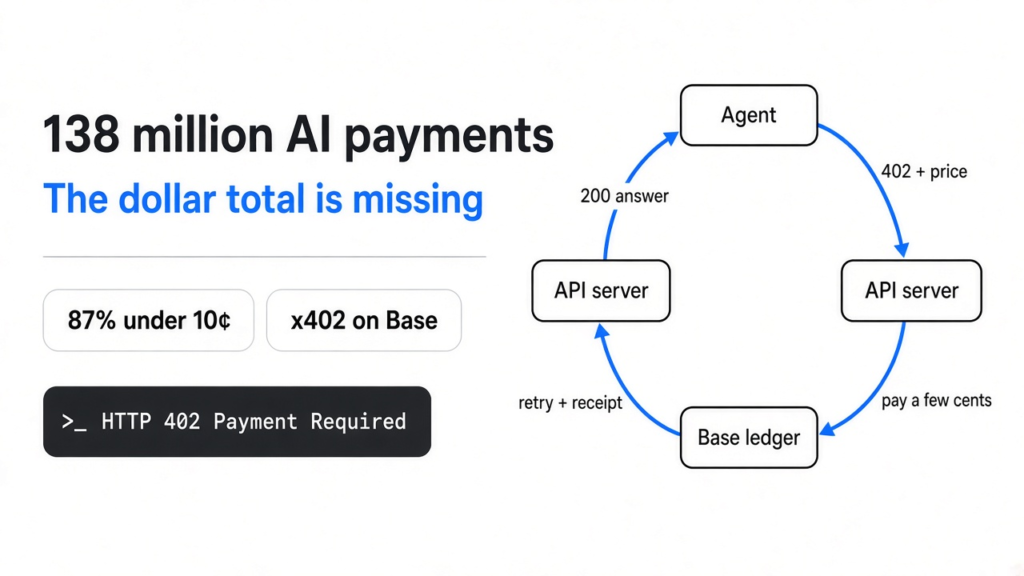
A count of tiny payments is not a shopping spree. The money total was never printed.
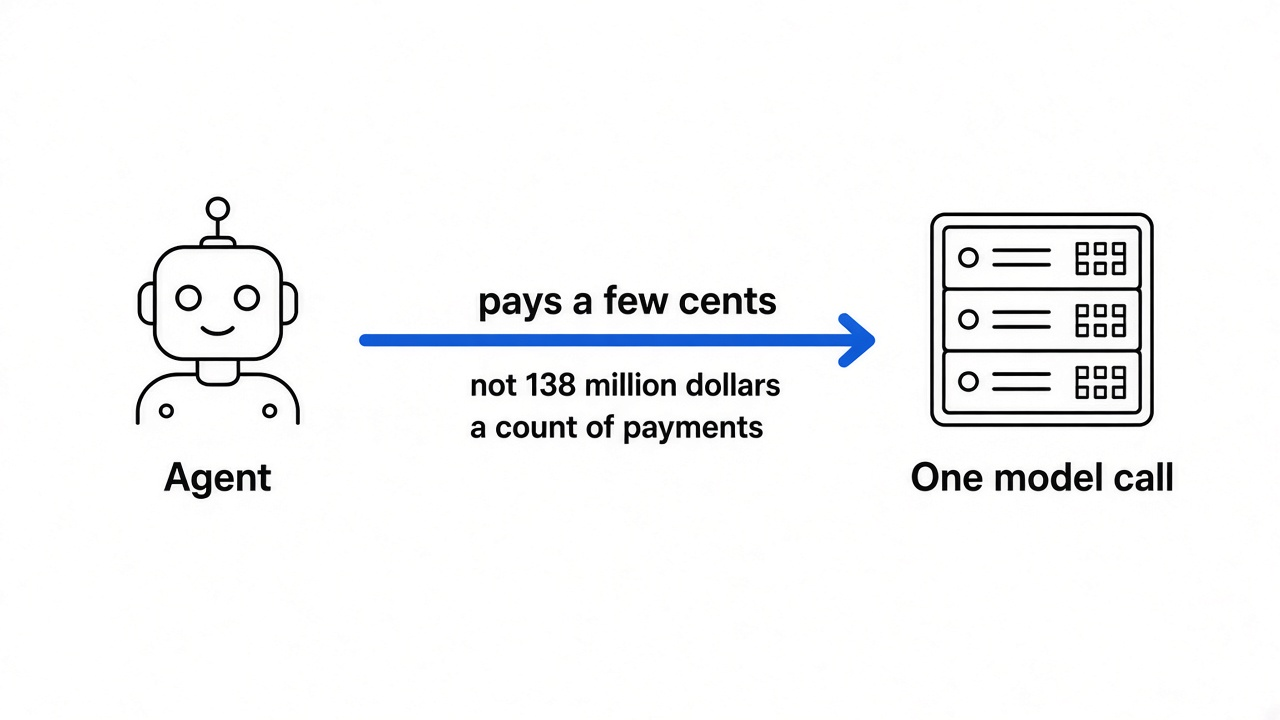
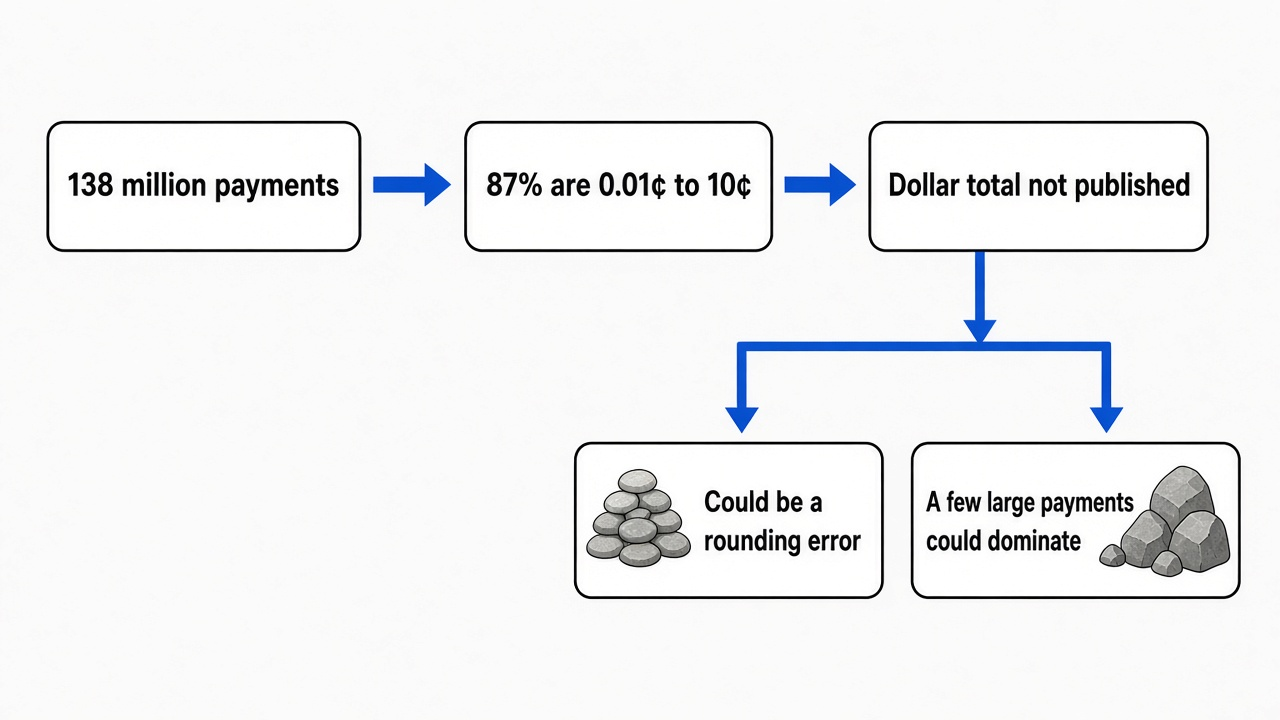
No. 138 million is not 138 million dollars, and it is not proof that robots went shopping. On 14 and 15 October 2026, write-ups of a Chainalysis report [Chainalysis reads public crypto ledgers and counts what moved] said software had made more than 138 million payments through a Coinbase protocol called x402, on a network called Base. These are AI agent micropayments: more than 87 percent of those payments sat between a hundredth of a cent and ten cents. Chainalysis did not publish the dollar total. Until that total exists, the headline can be a rounding error or a real budget, and a careful reader cannot yet tell which.
This post builds the machine from the ground, then puts the number back on it. You will leave knowing what an agent is, why a card cannot charge one cent, what the old web code 402 was waiting for, which facts the outlets actually share, and the one control that matters if you hand software a wallet.
What did they actually count?
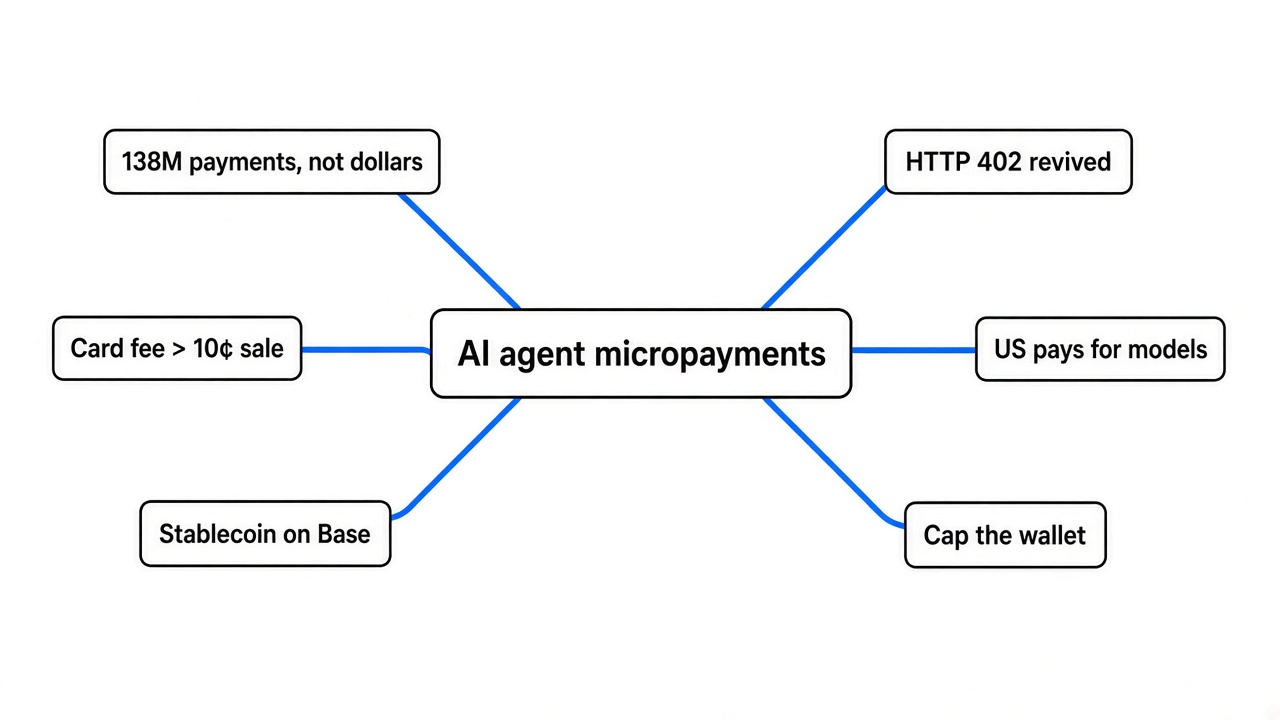
Messages that carried a payment, on one public rail, not every AI purchase on earth.
Start with a smaller word than “economy.” A transaction [one recorded transfer from one address to another] is a row in a book. Chainalysis counted rows that used x402 on Base. Decrypt and Yahoo Finance, both describing the same report, say the cumulative count rose from about 1,500 in mid-2025 to more than 138 million by the third quarter of 2026. Brave New Coin’s telling starts higher and later: about 58,800 in the third quarter of 2025, and about 138.5 million by the end of the third quarter of 2026. CryptoNews.com.au says the 138 million mark was already passed by 1 July 2026, and that a June count had been 100 million.
Chainalysis’s own write-up settles the calendar. Its 2026 reporting period is the 12 months ending 1 July 2026, and by the end of that period more than 138 million x402 transactions had happened on Base. The payment-size and wallet-age figures come from a longer window, the 16 months ending September 2026, which Chainalysis stretched because the technology is so new. That is why some write-ups say “by July” and others say “by the third quarter.”
Three limits sit on top of that count, and all three are in the reporting.
- It is x402 on Base, not every way an agent might pay. Card experiments from Visa, Mastercard, and Stripe are a different book. Google has its own agent-payments protocol, Decrypt notes. Those dollars are not in the 138 million.
- Chainalysis reads public ledgers. Permissioned systems [books only members can see] are invisible to it, Blockhead reports.
- A row is not a mind. Decrypt, citing earlier work from the tracing firm TRM, says a lot of what looks like an agent may be a script [a program that does one written sequence, with no judgment in the middle] or self-dealing [the same operator paying themselves to inflate a count]. Raw counts can overstate real commerce. That warning belongs in the first screen, not the footnote.
Why can’t the dollar total be skipped?
Because “most payments are tiny” is not “most of the money is tiny.”
Imagine a jar of pebbles and a few rocks. Counting pebbles tells you nothing about the weight until you weigh the jar. Chainalysis said more than 87 percent of x402 payments fell between $0.0001 and $0.10. Blockhead adds that one cent to ten cents was the most common size. That leaves up to about 13 percent of payments outside that band. A few large payments can outweigh a hundred million specks.
Here is the arithmetic for the common band only, and it is a sketch, not a Chainalysis number. If all 138 million payments were at the top of the common band, ten cents, the pile would be about $13.8 million. If they were all one cent, about $1.38 million. If they were all a hundredth of a cent, about $13,800. The real book is a mixture, and the mixture was not published. Anyone who turns 138 million into a revenue claim is inventing the missing column. An earlier Chainalysis look at x402 points the same way: payments of $1 or more carried 95 percent of the value moved, up from 49 percent in early 2025. The rocks, not the pebbles, held the money.
Memecoin trades [buying a joke coin because the name is moving, not because you needed a service] pumped some early volume and then faded, Blockhead says. That is another reason an old count and a new count are not the same kind of activity. Early rows may be people playing. Later rows may be software buying a tool. The report’s own shape says both happened.
What is a payment, before anyone says crypto?
A payment is a promise that a seller will actually get the money, after the fees.
You already know the shape from a shop. You tap a card. A bank guarantees the shop will be paid. The guarantee is not free. Online card processors commonly post a sticker like 2.9 percent plus 30 cents. That sticker is an illustration of the shape, not a figure from this report, and real interchange [the fee the banks in the middle keep] varies by card and country.
Run it on a ten-cent charge. Thirty cents of fixed fee, plus a fraction of a cent of percentage, is already larger than the thing being sold. The seller pays for the privilege of the sale. A one-cent charge is worse. Card rails were built for baskets, not for “answer one small question.”
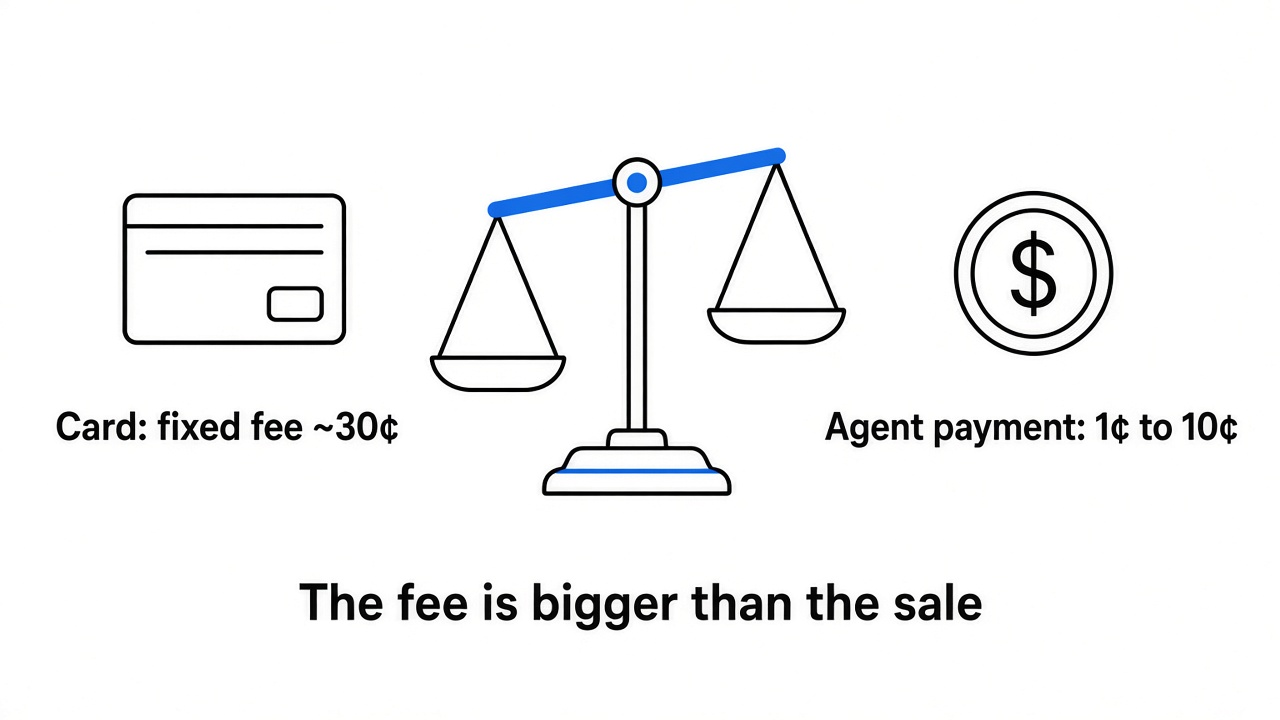
That is the entire opening for a new rail. Not ideology. Arithmetic. If the fee to move money is itself a fraction of a cent, a two-cent purchase can survive. If the fee is thirty cents, it cannot.
What is an agent, in one plain sentence?
An agent is software that is allowed to take a next action, not only to answer.
A chatbot [a program that replies in text and then waits] ends at the reply. An agent is that same kind of model with hands. The hands are tools [functions it is allowed to call: search, run code, send a request, pay]. You say “check this contract.” It may decide it needs a second model, a fresh web page, or a code-audit service, and it may pay for them in the middle of the job, without you seeing a checkout.
Nothing in that sentence requires the software to want anything. Wanting is a human word. The program follows a loop: look at the task, pick a tool, read the result, pick again, stop. If one of the tools is “send money,” the loop can spend. That is the whole danger and the whole use, and they are the same fact.
Two older posts on this site already cover the cage around those hands, and they still apply when the hand is a wallet: the brake that sits outside the model and which cage your coding agent is actually in. A payment rail does not replace either cage. It adds a new door.
What is the thing they are buying?
Usually a scrap of computation, or a scrap of someone else’s data.
A model [a file of numbers that guesses the next scrap of text] does not run for free. Using it is called inference [loading those numbers and asking for the next guess]. The scrap is a text-token [a chunk of text, sometimes a whole word, sometimes a piece of one]. Labs rent this out per million text-tokens. An agent in the middle of a task may need one small call, not a monthly subscription. That is a bad fit for a card and a fine fit for a fee measured in cents or less.
Do not confuse the two uses of the word token. A text-token is a piece of language. A crypto token [a digital unit you can send from one address to another] is a piece of money. This story is about the second one paying for the first one. Headlines mash them together. They are not the same object.
The other things agents paid for, according to Blockhead, were information services: code review, financial data, search-style APIs [a service you call from software, instead of a page you click], plus agent frameworks and tooling [the kits other agents are built from]. Inference was among the largest categories. “Shopping” is the wrong picture. “A program buying one unit of a tool” is the right one.
What is x402, from the web you already use?
A revival of a status code the web reserved in the 1990s and then ignored.
When your browser asks a server for a page, the server answers with a number before it answers with the page. 200 means here it is. 404 means nothing lives at that address. 402 means Payment Required. It was reserved early and almost never used, because the web had no standard way to attach a payment to the request. You paid on a separate checkout page, with a card form and an account.
Coinbase published x402 in May 2025, CryptoNews.com.au reports, later working with Cloudflare on it, according to Yahoo Finance. The idea is small. The server answers 402 and names a price. The caller pays in a stablecoin [a crypto token designed to stay near one US dollar; the one in Coinbase’s merchant tool is USDC, issued by Circle]. The caller retries the same request with proof that the payment happened. There is no account to create and no card form. Coinbase Business has let merchants accept these agent payments in USDC since July, the same write-up says.
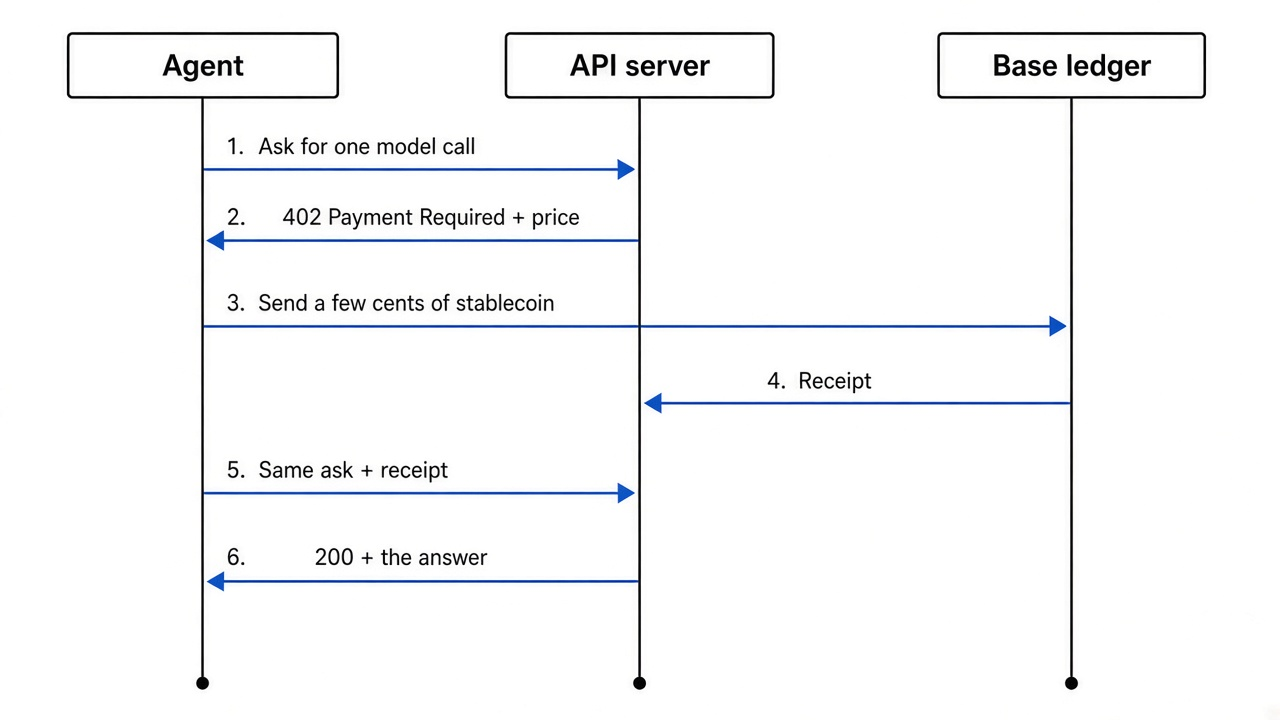
Base is the ledger those receipts land on. A ledger [a shared list of transfers that many computers agree on] is what people mean by a blockchain when they are being precise. Base is a layer 2 [a cheaper, faster list that later settles onto an older, more expensive list, in this case Ethereum], incubated by Coinbase. Its fees are small enough that a ten-cent payment is not eaten on the way. That is why this showed up here first. Not because a chat model suddenly understood money. Because the fee finally fit the price.
A wallet [an address, plus the secret key that is allowed to spend from it] is the last object. Whoever holds the key holds the budget. An agent with a key is an agent that can pay. An agent with your main key is an agent that can empty you.
Who is paying, and for what?
US-linked wallets pay for model calls. Chinese-linked wallets, in this dataset, pay for code audits. The split has a boring explanation.
Blockhead, citing the report: US-linked wallets were 88.1 percent of the payments for model inference that Chainalysis could place on a map. Chinese-linked wallets were 0.1 percent of those inference payments, and about 90 percent of the payments in security and code analysis. Nearly all of that second pile went to one smart-contract auditing service. CryptoNews.com.au names that service as AgentLISA, which checks Solidity [the language many Ethereum contracts are written in]. Chainalysis names the same service in its own write-up and says it audits Solidity smart contracts using a language model.
Chainalysis offers two reasons. One is what it calls AI nationalism: Chinese users may simply prefer Chinese-built models such as DeepSeek and Qwen. The other is plain economics. Chinese open-weight models [models whose number-file you can download and run yourself] are often free to run once you have the hardware. Leading US models are metered per call. People pay where there is a meter. They do not pay where the file is already on their own machine.
A second percentage is easy to mash into the first. CryptoNews.com.au says US-funded agents made 30 percent of the agent-to-service transactions Chainalysis could locate. That is not the same fact as 88.1 percent of inference payments. One is a share of a wide set. The other is a share of one category. Keep them apart.
What changed about the wallets themselves?
They got younger, and they spent almost immediately. That is the operational fact.
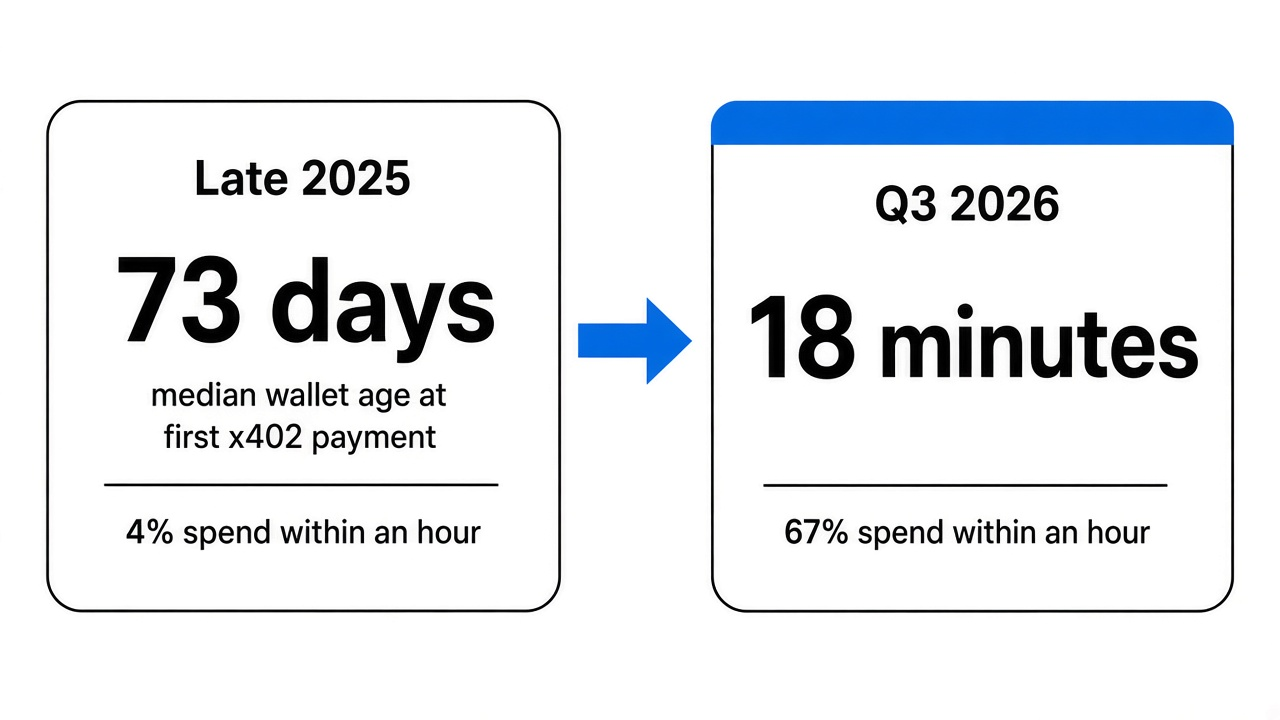
Blockhead again, from the same chapter: the median age of a wallet at its first x402 payment fell from 73 days in late 2025 to 18 minutes by the third quarter of 2026. The share of wallets that spent within an hour of being funded rose from 4 percent to 67 percent.
Read that as plumbing, not as a personality. A person who opens a bank account and waits 73 days before spending is living in the account. A wallet created and emptied of its first coins inside an hour is a tool a program spun up for a job. It matches the “hand software a budget” story. It also matches “a script is farming a count.” Both readings survive the number. Neither reading lets you skip a spending cap.
What is worth doing if you actually run an agent?
Cap the key. Do not debate the headline.
Nothing in this report is a reason to buy a coin, or to rip cards out of a business that sells kettles. It is a reason to notice that “give the agent a budget” has quietly become a real configuration, and that the wallets in the data do not sit around.
- Ask for dollars, not counts. If a vendor quotes x402 volume, ask for the dollar total and the median payment. A missing total is not a detail. It is the result.
- Fund a small wallet, never the one that holds savings. A key is a bearer instrument [whoever holds it can spend, with no further permission]. The data says the first spend now often happens inside an hour of funding.
- Put a ceiling on the tool. A daily cap, and an allowlist [a list of sellers the agent is allowed to pay, with everything else refused]. Inference and one code auditor are a different permission from “any server that answers 402.”
- Keep the other cages. A payment limit does not stop an agent from deleting files or sending mail. The brake and the execution cage are still the outer walls.
- If you are the one selling the API, do not treat a 402 as trust. A receipt proves a payment. It does not prove a careful buyer. Rate-limit and log as you would for any other client.
| Claim you will see | What the reporting actually supports |
|---|---|
| Agents spent 138 million | More than 138 million payments. Dollars were not published. |
| Most of the money was under a dime | Most of the payments were between $0.0001 and $0.10. The money share is unknown, because the other payments could be large. |
| Robots went shopping | The categories named are model calls, data, code review, and tooling. Memecoins inflated early volume, then faded. |
| This is all autonomous minds | TRM’s earlier warning, via Decrypt: many rows may be scripts or self-dealing. |
| US agents buy everything, Chinese agents buy nothing | US-linked wallets dominate metered model calls. Chinese-linked wallets dominate one code-audit category. Chainalysis points to AI nationalism and to free open weights versus metered US APIs. |
Common questions about AI agent micropayments
Did AI agents spend 138 million dollars?
Nobody published a dollar total. 138 million is a count of payments on one protocol, on one network. More than 87 percent of them were under ten cents. The rest could still hold most of the money.
Why not just use a credit card?
A card’s fixed fee is often about the size of the whole purchase, once the purchase is a few cents. The fee eats the sale. A ledger whose own fee is a fraction of a cent can carry a price that small.
Is my chatbot doing this?
Not unless you gave it a key and a tool that pays. A normal chat window has no wallet. The moment you add one, you have added a budget, and the wallets in this dataset tend to spend within an hour of being filled.
Does this mean crypto replaced Visa?
No. It means the first rail that fit a one-cent software purchase got used for one-cent software purchases. Card networks and Stripe are building their own agent rails beside it. Count those separately.