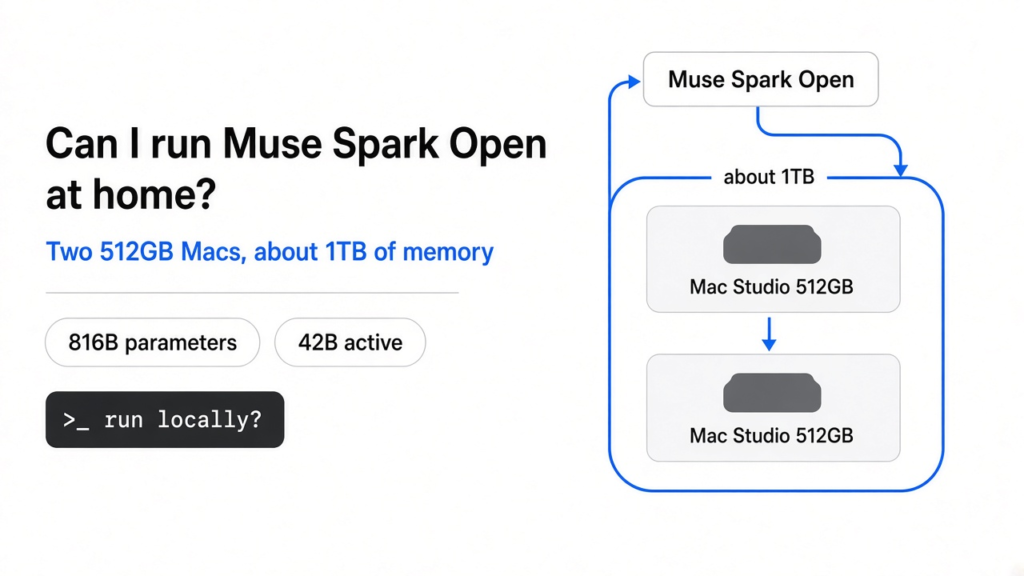
Meta says an 816-billion-parameter model now runs on a desktop. The desktop is two machines Apple scheduled for late October, and the “42 billion” in the headline is not the memory bill.
Short answer: You can run Muse Spark Open at home only if home includes about a terabyte of memory. Meta’s setup is two Apple Mac Studio computers with the M5 Ultra chip and 512GB of memory each. Apple’s own August note still had that 512GB option arriving in late October, and it did not print a price for it. On a server, Meta asks for at least 700GB of GPU memory for the compressed weights, or 2TB at full size. Everyone else should call a hosted API, then read the license before building a product.
You saw the post. 816 billion parameters. Runs on two Macs. Open. Stop there and you will either try to download it onto a laptop, or you will almost buy the wrong two computers.
The rest of this post is the bill, in order. The thread to hold on to: “active” is about speed. Memory is about everything the model has stored, awake or not.
What landed on 15 October?
Meta released the weights of Muse Spark Open. Not a new app, and not its best model.
A weight (one stored number the model learned in training) is the file you actually download. Open-weight means those files are public. It does not mean the training code is public, and it does not mean open source (software you can use, change, and share with no extra permission).
Meta’s research post, dated 15 October 2026, describes one model:
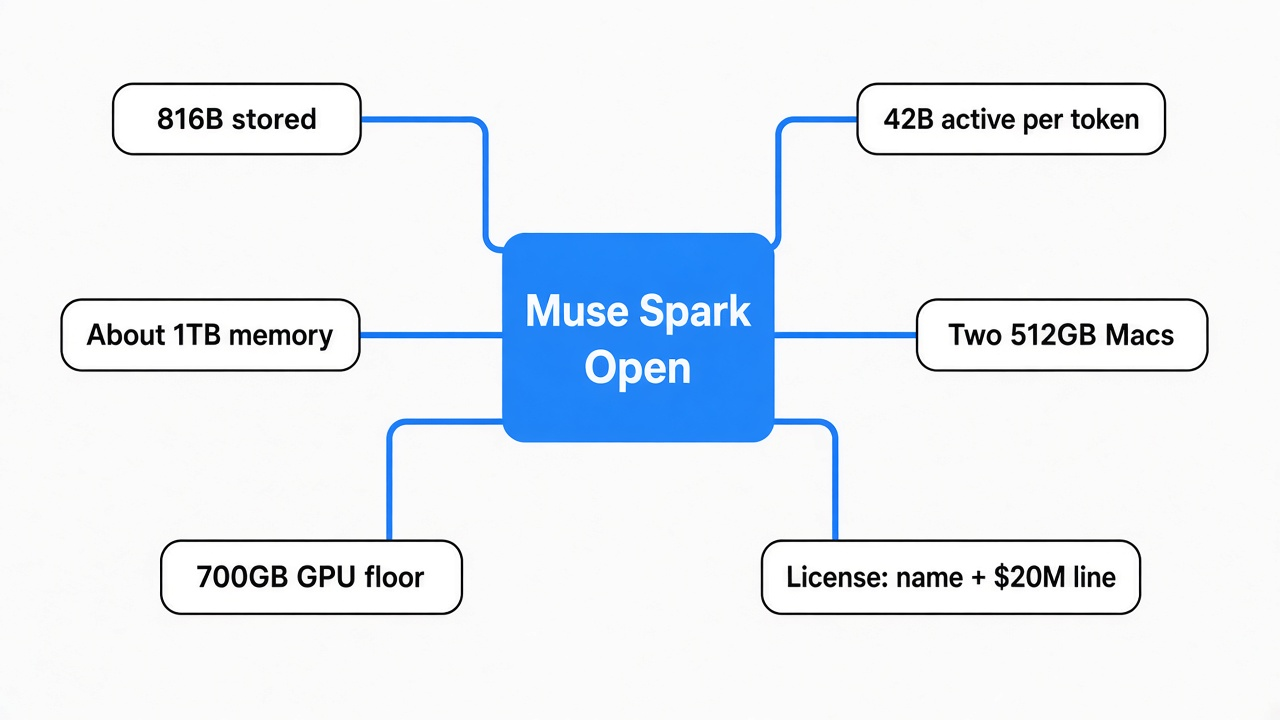
- 816 billion parameters in total, with 42 billion active on each token (a chunk of text, often part of a word)
- a context window (how much text it can look at in one go) of 1 million tokens
- it can take text, images, video, or audio in, and it answers in text
- it is built for coding and for agent work (jobs that take many steps and call tools, not one short reply)
The weights are on Hugging Face as meta-models/Muse-Spark-Open-816B-A42B, and also on Amazon SageMaker, Google Cloud Model Garden, and Microsoft Foundry. Meta’s hosted list is Baseten, Fireworks AI, Groq, Modal, Nebius, OpenRouter, and Together AI. Primary post: Introducing Muse Spark Open.
Artificial Analysis scored it on 16 October, after Meta shared access early. Their Intelligence Index number is 39. That was the top US open-weight score they published that day, ahead of NVIDIA’s Nemotron 3.5 Super VL at 26, which launched the same day. It sits about a point from Meta’s older Muse Spark 1.2, at 40. It is not Meta’s ceiling. The same note puts the closed Muse Wonder at 52 and Muse Wonder Full at 56.

What is a parameter, in one line?
A parameter is one learned number. The memory bill is that count times how many bytes you use to store each number.
Picture a mixing desk with one knob per number. Muse Spark Open has about 816 billion knobs. To answer you, the computer needs those knobs in fast memory. A disk is not a substitute, because every new token has to read the knobs again.
The usual full-size format is bf16 (a 16-bit number, so 2 bytes). The compressed format Meta ships is NVFP4 (a 4-bit number, about half a byte). Quantization (storing each knob with fewer bits, trading a little accuracy for a lot of space) is the step from the first line to the second. Meta’s card says quantized runs “may show minor quality differences in edge cases.”
| What you are counting | The math | Size |
|---|---|---|
| Weights alone, full size | 816 billion times 2 bytes | about 1.63 TB |
| Weights alone, 4-bit | 816 billion times 0.5 bytes | about 408 GB |
| Meta’s floor, full size (bf16) | weights plus room to run | at least 2 TB of GPU memory |
| Meta’s floor, compressed (NVFP4) | weights plus room to run | at least 700 GB of GPU memory |
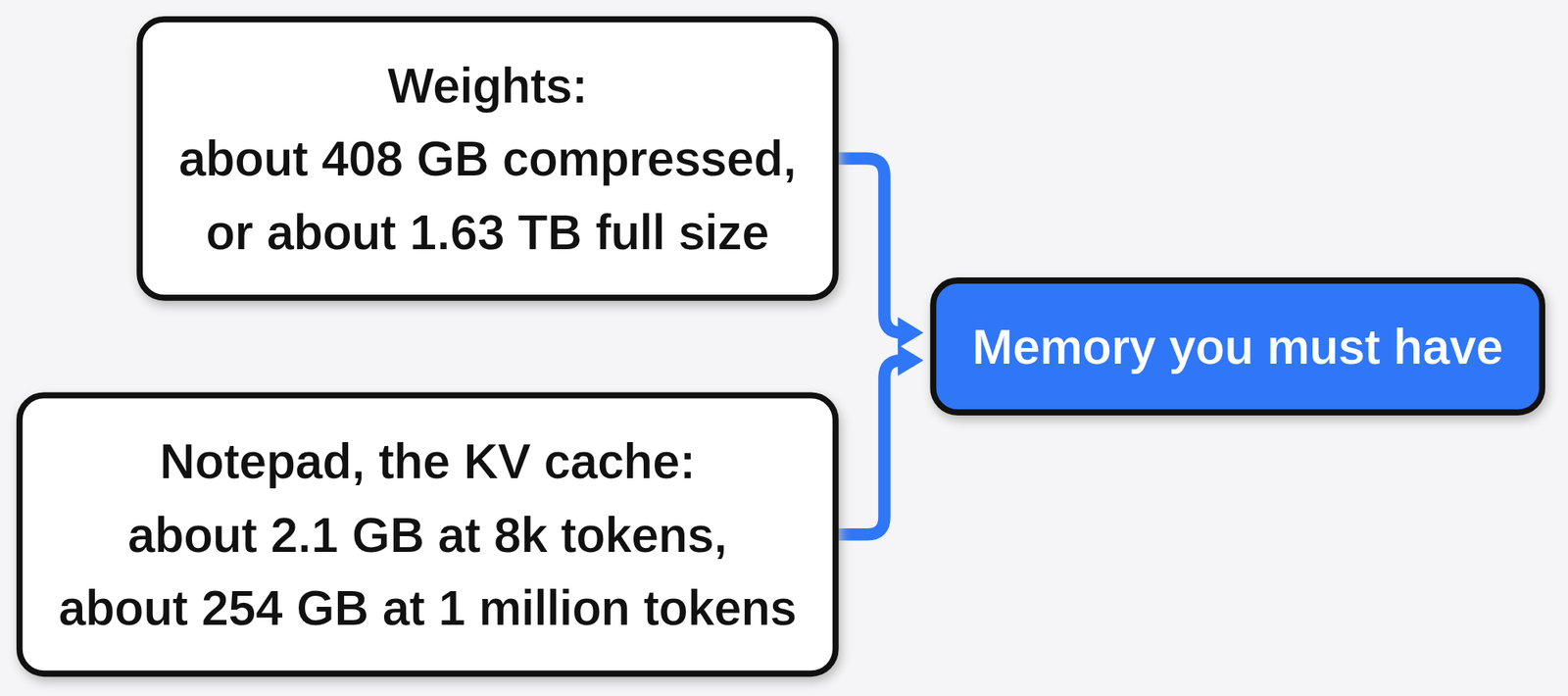
The floors are higher than the weights because a running model also keeps a notepad of the conversation and some working space. Do not shop for a 408GB machine and expect the 4-bit file to fit.

Why do people say only 42 billion?
Because this model is a mixture of experts. “Active” counts the experts that work on one token, not the experts you have to store.
A dense model (the ordinary kind) uses every knob on every token. A mixture of experts (a model split into many specialist blocks) adds a router (a small decider that picks a few specialists for this token). The specialists it does not pick sit idle for that token. They are still on the machine.
The model card says there are 256 experts, and 8 of them turn on per token. Eight out of 256 is about 3 percent of the specialists. The card’s “42 billion active out of 816 billion” is about 5 percent, because shared parts of the network stay on every time. Those shared parts include attention (the block that looks back at earlier tokens).
The speed story is real. The computer does the math for a slice. The memory story is the whole library. A library does not get smaller because you only open eight books.

What are the two Macs, exactly?
Two Mac Studios, M5 Ultra, 512GB of unified memory each. Not two of the computers that start at $5,499.
Unified memory (one pool shared by the main chip and the graphics cores, instead of a separate graphics card you copy the model into) is why a Mac can hold a model a normal PC cannot. The model lives in that one pool. There is no second, smaller pool to overflow into.
Apple’s newsroom post on 25 August 2026 says the M5 Ultra reaches 512GB of that pool, and 1.2TB/s of memory bandwidth (how fast the chip can read it). The same post says Mac Studio with 512GB “is coming in late October,” and that M5 Ultra starts at $5,499. It does not say $5,499 includes 512GB. Apple’s announcement is the source for the date and the starting price.
Macworld’s spec table lists the $5,499 configuration at 96GB. Two of those are 192GB combined. The 4-bit weights alone are about 408GB. Two base machines are not the demo.
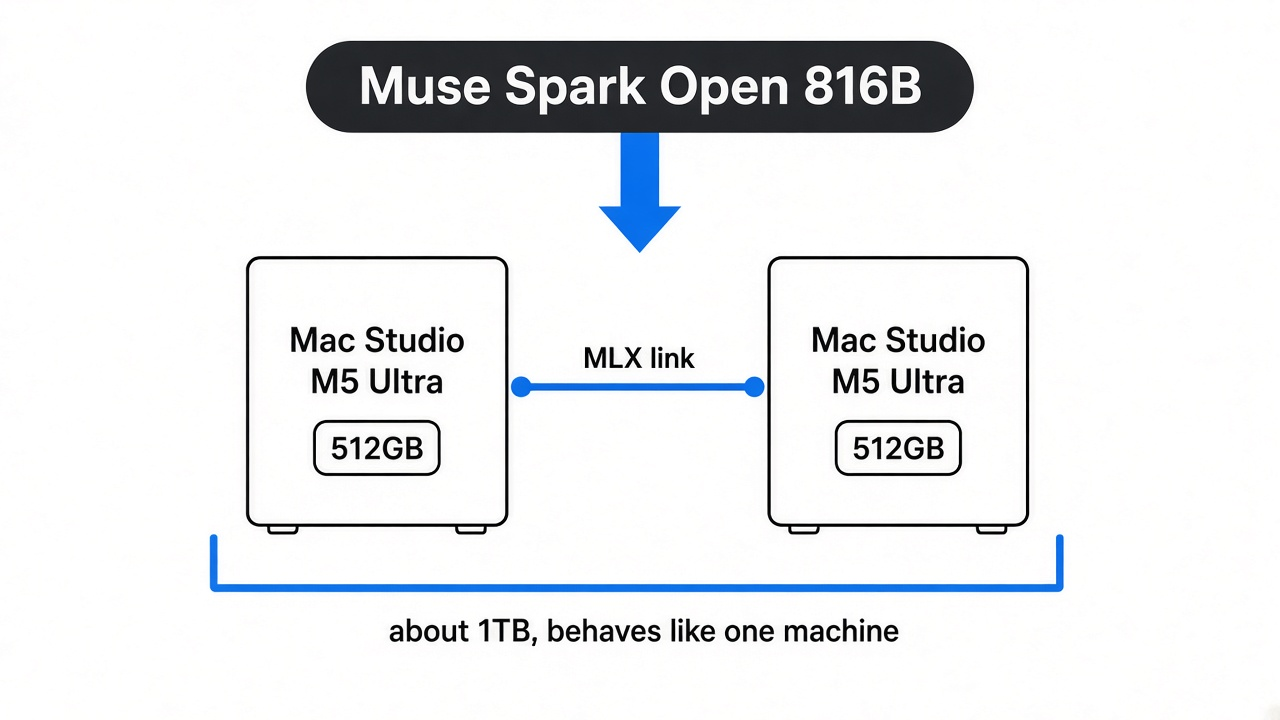
Meta says the two 512GB machines are linked with MLX (Apple’s open-source math library for its own chips), and that together they behave like one machine with about a terabyte of memory. As of 16 October 2026, “late October” is still a ship window. Check the store before you budget. No primary source has published the 512GB price. Ignore a tweet that invents one.
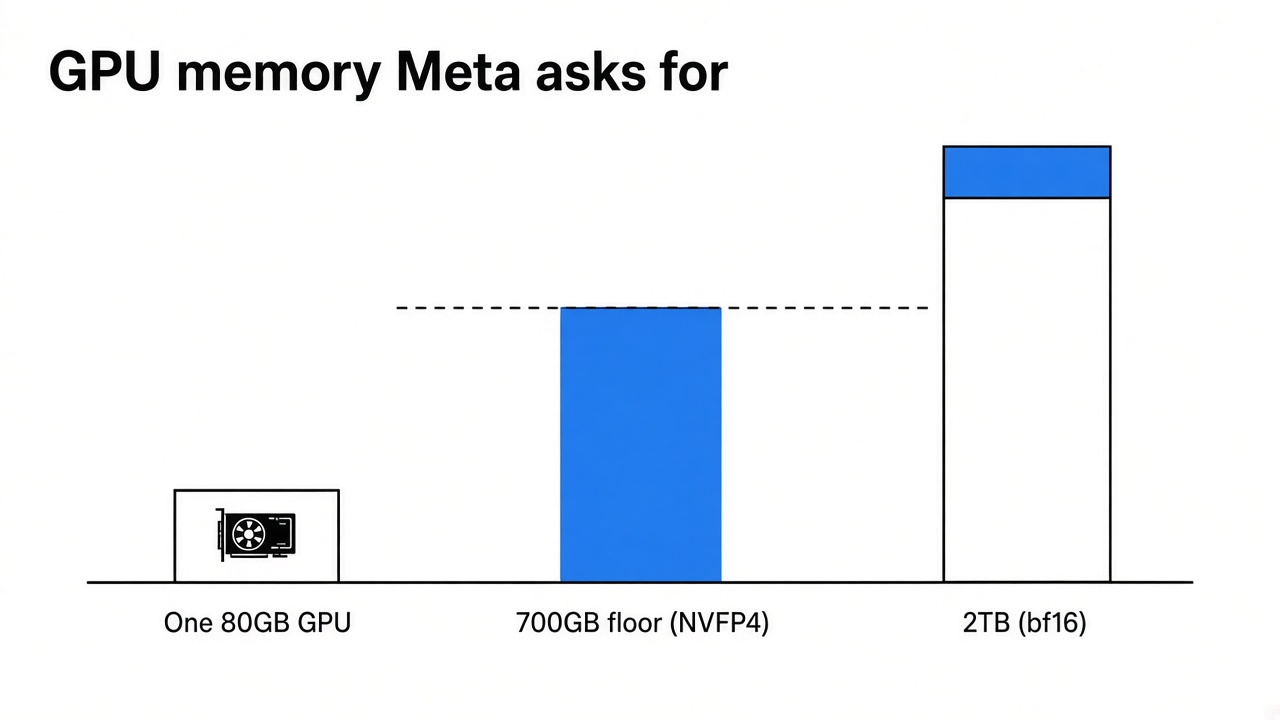
On servers the card is blunt. NVFP4 wants at least 700GB of VRAM (the GPU’s own memory). Full bf16 wants at least 2TB. The engines Meta names are SGLang, vLLM, TensorRT-LLM, Hugging Face, llama.cpp, Unsloth, and MLX on the Mac path. Naming an engine means the software can load the model. It does not mean a gaming PC can hold it.
What does the million-token window cost?
A context window is the notepad. The notepad has its own memory bill, and it grows with how much you paste in.
The model keeps a running memory of earlier tokens so it does not re-read them from scratch. That memory is the KV cache (a pair of notes per token, called the key and the value, kept for every layer). It is separate from the weights. “42 billion active” does not shrink it, because those notes are written in the shared attention blocks, not inside the eight specialists.
Using the card’s shape, 62 layers, 16 key-value heads, 64 numbers wide, stored at 2 bytes:
2 x 62 x 16 x 64 x 2 = 253,952 bytes per token
That is 248KB per token, worked out from the published shape. Meta did not print it. Real engines add overhead, and some store the cache in a smaller format.
- About 8,000 tokens, a long chat, is about 2.1GB of notepad.
- The full 1 million tokens is about 254GB of notepad, before overhead.
A million tokens is on the order of three quarters of a million words. You will not paste that into a box for fun. The window matters for long agent jobs: a big repository, a long video, a pile of documents. Those jobs are exactly when the notepad stops being a rounding error. Add it on top of the weights.
Where it leads, and where it loses
On the broad score it is the leading US open-weight model this week. It is not the leading open model.
Keep two kinds of numbers apart.
Independent, from Artificial Analysis on 16 October:
- Intelligence Index: 39, the top US open-weight score they published that day
- Nemotron 3.5 Super VL, also new that day: 26
- Older Muse Spark 1.2: 40
- Closed Muse Wonder: 52. Muse Wonder Full: 56
- About 40,000 output tokens per index task, against about 71,000 for GLM-5.3
- Launch price they quote at Together, Fireworks, and Baseten: $1.25 per million input tokens, $4.25 per million output tokens, $0.15 for cached input. About $0.84 per index task, against about $2.01 for GLM-5.3
Meta’s own comparison table, as reprinted the same day by OpenLM and MarkTechPost. Rival cells are Meta’s measurements until another lab reprints them one by one. A gap of a point is a tie, not a winner.
| Benchmark | Muse Spark Open | GLM 5.3 | Kimi K3 | Qwen3.8 |
|---|---|---|---|---|
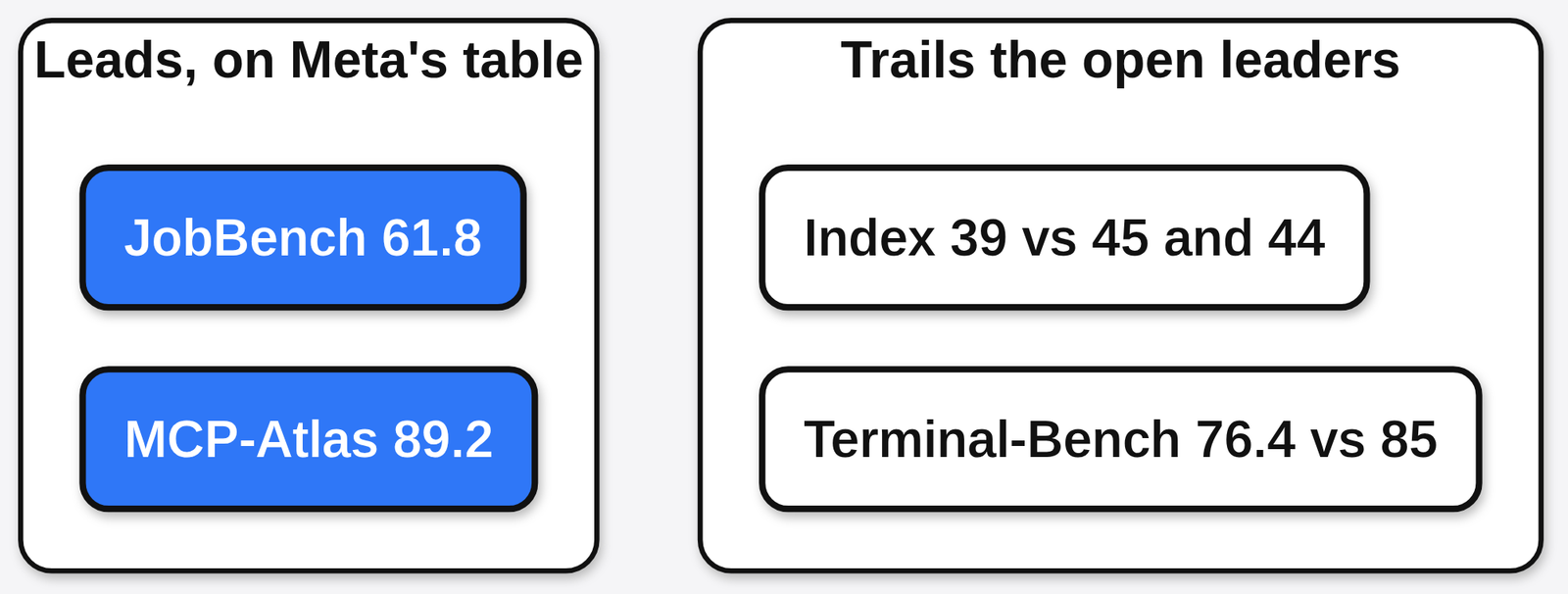
| Artificial Analysis Intelligence Index | 39 | 45 | 44 | 40 |
| MCP-Atlas, tool use | 89.2 | 84.2 | 82.3 | 84.5 |
| JobBench | 61.8 | 61.4 | 54.3 | 52.7 |
| Terminal-Bench 2.1, coding in a terminal | 76.4 | 83.9 | 85.0 | 82.0 |
| HLE-Diamond, hard questions, no tools | 26.1 | 16.4 | 22.2 | 17.3 |
MCP-Atlas gives the model a job in plain language and makes it choose which tools to call, and in what order. MCP (Model Context Protocol, a common plug shape for tools) is just the socket those tools use. JobBench is a set of professional tasks. Terminal-Bench is coding inside a terminal. HLE-Diamond is hard questions with the tools taken away.
Read the table as a shape. Muse leads the tool rows Meta wanted you to see. It trails on the broad index, and it trails on terminal coding. “Most capable US open-weight model” and “not the one I would pick for the index” are both allowed to be true.
One more limit, from the card. It can look at pictures, video, and audio. It answers in text. It will not hand you a new video.
What the license actually stops
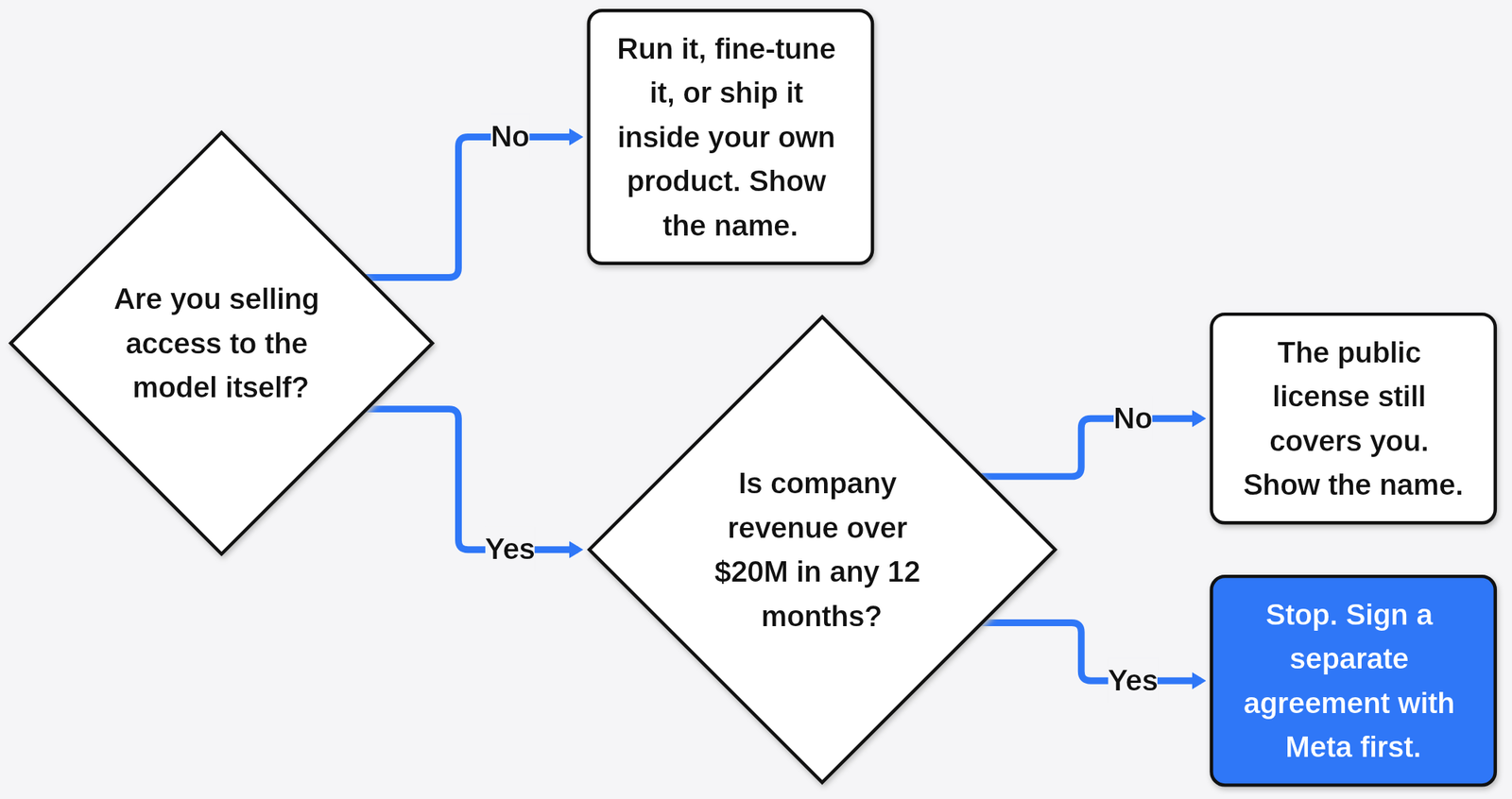
You can run it, change it, and put it inside your own product for free. You cannot quietly rent the model out once your company is past $20 million, and you cannot rub the name off.
The Muse Model License grants use, copying, modification, fine-tuning, distillation, and redistribution free of charge. Distillation (training a smaller model on this model’s answers) is on that list, and it does not wash the license off. A derivative has to carry the same terms.
Three lines matter more than the rest. They sit in the license text on the model card, so open the card again before you ship: Muse-Spark-Open-816B-A42B.
- The product has to show Built with Muse Spark Open prominently, in its interface or in the accompanying documentation, website, or settings menu.
- If you give a third party access to model outputs as a product, through an API or something like it, and the combined gross revenue of your company and its affiliates is over $20 million in any rolling 12 months, you must notify Meta and sign a separate agreement before you offer this model that way.
- That second line does not apply to internal use, research, or any business that is not model-rental. It also does not apply when the model is a feature inside your own product, as long as the product itself is not a model you rent out.
The $20 million is company revenue, not “money you made from Muse.” A $21 million company that sells access to models needs the extra agreement. A $21 million company that adds a coding helper inside an app it already sells does not, under that clause. Meta also says it claims no ownership of the outputs.
This is why “open source” is the wrong label. The files are downloadable. The permission slip has a logo line and a hosting line.
Which path should you take?
Match the path to the memory you have. Do not match it to the headline.
| Your situation | What to do |
|---|---|
| A laptop, a mini PC, or one Mac with 128GB or less | Do not download it. Use a hosted API, or a much smaller open model. |
| Two M5 Ultra Mac Studios at the $5,499 start | Still no, if those are the 96GB configs. 192GB combined does not hold the weights. |
| Two 512GB M5 Ultra Mac Studios, once they ship | This is Meta’s demo. Read the license, then try MLX. |
| A GPU cluster with 700GB or more | NVFP4 on an engine the card names. Full bf16 wants 2TB. |
| You sell a model API and the company is over $20M | Talk to Meta before you list it. The public license is not your contract. |
| You want it as a feature inside your own app | The revenue clause does not catch that. Show Built with Muse Spark Open in the interface or the docs. |
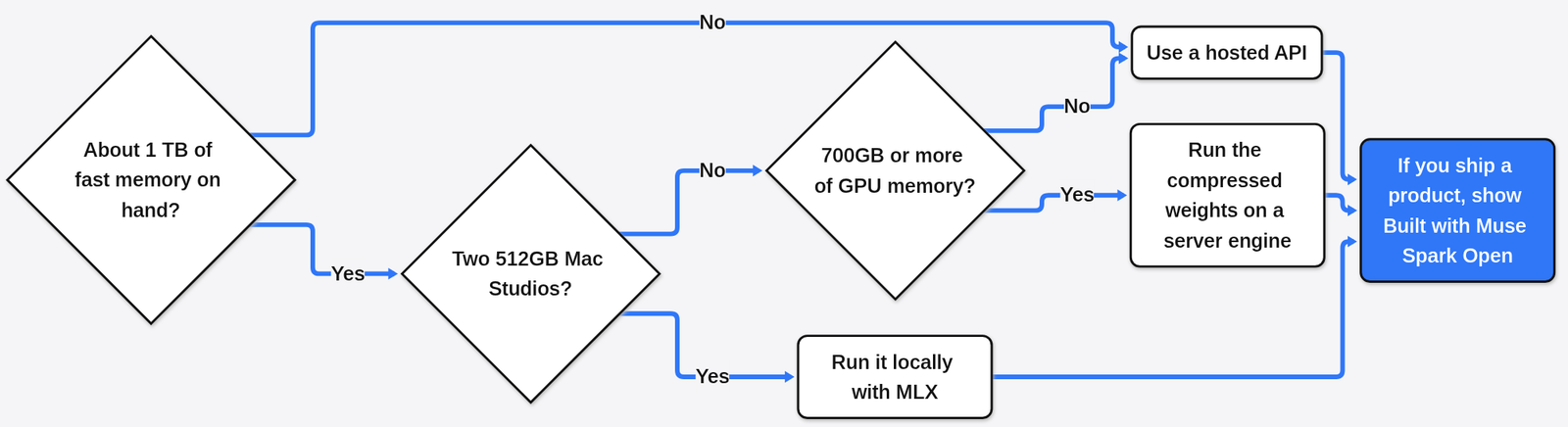
So, can you run Muse Spark Open at home? Only in the specific house Meta used for the demo: two maxed-out Mac Studios that Apple, in its own August note, was still planning to ship in late October. For everyone else, the honest version of “open” is an API, plus a license you can explain with one diagram.
If the question under this one is how a much smaller model can run on a weak GPU at all, the memory trade is the same idea at a different scale: Can I run a 70B model on a 4GB GPU?
Common questions about Muse Spark Open
Is Muse Spark Open open source?
No, not in the strict sense. The weights are public. The training code and the training set are not the release. The license adds a required name in the product or its docs, and a separate contract for companies over $20 million that sell model access. Call it open-weight.
Does “42 billion active” mean it fits in about 84GB?
No. Active is the math for one token. You still store all 816 billion parameters. At 2 bytes each, the weights alone are about 1.63TB.
Will two $5,499 Mac Studios run it?
Not if they are the starting M5 Ultra. Apple’s $5,499 is the start of that line. The 512GB option Meta’s demo needs was scheduled separately for late October, and Apple did not publish that price on 25 August 2026.
Can it generate images or edit video?
It can look at images, video, and audio. The card says the output is text. Plan on a written answer, not a rendered file.